Infinix Hot 60i
Lava Bold N1 Pro

Infinix Hot 60i Lava Bold N1 Pro

Overview

Welcome to our in-depth spec comparison between the Infinix Hot 60i and the Lava Bold N1 Pro — two budget-friendly Android smartphones vying for attention in a competitive market. Both share a number of similarities, from their LCD IPS displays with 120Hz refresh rates to their 50 MP main cameras and dual-SIM support, but they diverge in meaningful ways across performance, charging speed, connectivity, and build quality. Read on to discover which device aligns best with your priorities.

Common Features

  • Both phones are water resistant.
  • Neither phone has a rugged build.
  • Neither phone can be folded.
  • Both phones feature an LCD IPS display type.
  • Both phones share the same resolution of 720 x 1600 px.
  • Both phones have a 120Hz refresh rate.
  • Neither phone has branded damage-resistant glass.
  • Neither phone supports HDR10, HDR10+, or Dolby Vision.
  • Neither phone has a secondary screen.
  • Both phones share the same Geekbench 6 multi-core score of 1391.
  • Both phones have integrated LTE.
  • Both phones use a 12 nm semiconductor size.
  • Both phones support 64-bit processing.
  • Both phones support DirectX 12.
  • Both phones have integrated graphics.
  • Both phones use big.LITTLE technology.
  • Both phones have a 50 MP main camera.
  • Neither phone has a multi-lens main camera.
  • Both phones have an 8 MP front camera.
  • Neither phone has built-in optical image stabilization.
  • Neither phone has a dual-tone LED flash.
  • Neither phone has a BSI sensor.
  • Both phones have a CMOS sensor.
  • Both phones support continuous autofocus when recording movies.
  • Both phones include clipboard warnings.
  • Both phones have location privacy options.
  • Both phones have camera and microphone privacy options.
  • Neither phone has Mail Privacy Protection.
  • Both phones support theme customization.
  • Both phones can block app tracking.
  • Neither phone blocks cross-site tracking.
  • Both phones have on-device machine learning.
  • Neither phone supports wireless charging.
  • Both phones support fast charging.
  • Neither phone has a removable battery.
  • Both phones have a battery level indicator.
  • Both phones have a rechargeable battery.
  • Both phones include a 3.5 mm audio jack.
  • Neither phone supports aptX, LDAC, aptX HD, aptX Adaptive, aptX Lossless.
  • Both phones have a built-in FM radio.
  • Neither phone supports 5G.
  • Both phones support Wi-Fi 4 and Wi-Fi 5.
  • Both phones accommodate 2 SIM cards.
  • Both phones have an external memory slot.
  • Both phones have a USB Type-C port.
  • Both phones have a download speed of 300 MBits/s and upload speed of 100 MBits/s.
  • Both phones have a fingerprint scanner.
  • Both phones have a video light.
  • Neither phone has a sapphire glass display.
  • Neither phone has a curved or e-paper display.

Main Differences

  • Weight is 188 g on Infinix Hot 60i and 200 g on Lava Bold N1 Pro.
  • Thickness is 7.7 mm on Infinix Hot 60i and 8.4 mm on Lava Bold N1 Pro.
  • Width is 76.6 mm on Infinix Hot 60i and 77.2 mm on Lava Bold N1 Pro.
  • Height is 166 mm on Infinix Hot 60i and 165.8 mm on Lava Bold N1 Pro.
  • Volume is 97.91 cm³ on Infinix Hot 60i and 107.52 cm³ on Lava Bold N1 Pro.
  • IP rating is IP64 on Infinix Hot 60i and IP54 on Lava Bold N1 Pro.
  • Screen size is 6.7″ on Infinix Hot 60i and 6.67″ on Lava Bold N1 Pro.
  • Pixel density is 262 ppi on Infinix Hot 60i and 263 ppi on Lava Bold N1 Pro.
  • Always-On Display is available on Infinix Hot 60i but not on Lava Bold N1 Pro.
  • Internal storage is 256 GB on Infinix Hot 60i and 128 GB on Lava Bold N1 Pro.
  • RAM is 8 GB on Infinix Hot 60i and 4 GB on Lava Bold N1 Pro.
  • The chipset is MediaTek Helio G81 Ultra on Infinix Hot 60i and Unisoc T606 on Lava Bold N1 Pro.
  • The GPU is Mali G52 MP2 on Infinix Hot 60i and Mali G57 MP1 on Lava Bold N1 Pro.
  • CPU speed is 2 x 2 GHz and 6 x 1.8 GHz on Infinix Hot 60i, and 2 x 1.6 GHz and 6 x 1.6 GHz on Lava Bold N1 Pro.
  • Geekbench 6 single-core score is 420 on Infinix Hot 60i and 371 on Lava Bold N1 Pro.
  • Geekbench 5 multi-core score is 1300 on Infinix Hot 60i and 1175 on Lava Bold N1 Pro.
  • Geekbench 5 single-core score is 350 on Infinix Hot 60i and 313 on Lava Bold N1 Pro.
  • RAM speed is 1800 MHz on Infinix Hot 60i and 1600 MHz on Lava Bold N1 Pro.
  • Maximum memory bandwidth is 13.41 GB/s on Infinix Hot 60i and 12.8 GB/s on Lava Bold N1 Pro.
  • L2 cache is 0.3 MB on Infinix Hot 60i and 2 MB on Lava Bold N1 Pro.
  • Maximum memory amount is 8 GB on Infinix Hot 60i and 14 GB on Lava Bold N1 Pro.
  • Video recording resolution is 1440 x 30 fps on Infinix Hot 60i and 1080 x 30 fps on Lava Bold N1 Pro.
  • Number of flash LEDs is 2 on Infinix Hot 60i and 1 on Lava Bold N1 Pro.
  • Android version is Android 15 on Infinix Hot 60i and Android 14 on Lava Bold N1 Pro.
  • App offloading is supported on Infinix Hot 60i but not on Lava Bold N1 Pro.
  • Battery capacity is 5160 mAh on Infinix Hot 60i and 5000 mAh on Lava Bold N1 Pro.
  • Charging speed is 45W on Infinix Hot 60i and 10W on Lava Bold N1 Pro.
  • Stereo speakers are present on Infinix Hot 60i but not on Lava Bold N1 Pro.
  • Bluetooth version is 5.3 on Infinix Hot 60i and 5.0 on Lava Bold N1 Pro.
  • NFC is available on Infinix Hot 60i but not on Lava Bold N1 Pro.
  • A gyroscope is present on Infinix Hot 60i but not on Lava Bold N1 Pro.
  • A compass is present on Infinix Hot 60i but not on Lava Bold N1 Pro.
  • An infrared sensor is present on Infinix Hot 60i but not on Lava Bold N1 Pro.
Specs Comparison
Infinix Hot 60i

Infinix Hot 60i

Lava Bold N1 Pro

Lava Bold N1 Pro

Design:
water resistance Water resistant Water resistant
weight 188 g 200 g
thickness 7.7 mm 8.4 mm
width 76.6 mm 77.2 mm
height 166 mm 165.8 mm
volume 97.91012 cm³ 107.517984 cm³
Ingress Protection (IP) rating IP64 IP54
has a rugged build
can be folded

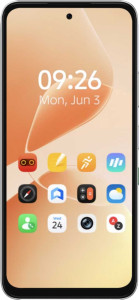
In terms of physical form, the Infinix Hot 60i is the more compact and pocketable of the two. It is 12 g lighter (188 g vs 200 g) and 0.7 mm thinner (7.7 mm vs 8.4 mm), which translates to a noticeably less bulky feel during extended one-handed use. The difference in volume — 97.91 cm³ vs 107.52 cm³ — confirms that the Hot 60i occupies meaningfully less physical space, even though both phones share nearly identical height and width footprints.

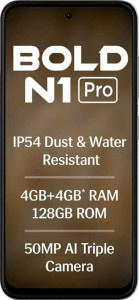
On water and dust resistance, both devices are rated water resistant, but the IP ratings diverge in an important way. The Hot 60i carries an IP64 rating, while the Lava Bold N1 Pro holds an IP54. The first digit is the dust protection score: a ″6″ means the Hot 60i is fully dust-tight, whereas the Bold N1 Pro's ″5″ only guarantees protection against limited dust ingress. The second digit (″4″ on both) is identical, meaning splash resistance from any direction is equivalent. For users in dusty environments or who simply want stronger long-term reliability, the Hot 60i's full dust sealing is a tangible advantage.

Neither phone has a rugged build or foldable form factor, so both target the same mainstream, slim-slab audience. Overall, the Hot 60i holds a clear design edge — it is lighter, slimmer, more compact, and offers superior dust protection — making it the better choice for users who prioritize a refined in-hand feel and stronger environmental resilience.

Display:
Display type LCD, IPS LCD, IPS
screen size 6.7" 6.67"
pixel density 262 ppi 263 ppi
resolution 720 x 1600 px 720 x 1600 px
refresh rate 120Hz 120Hz
has branded damage-resistant glass
supports HDR10
supports HDR10+
Always-On Display
supports Dolby Vision
Has a secondary screen
has a touch screen

These two displays are remarkably similar on paper. Both use an LCD IPS panel, share an identical 720 x 1600 px resolution, land at virtually the same pixel density (262 vs 263 ppi), and both run at a 120Hz refresh rate. At this screen size, the resolution is adequate for everyday tasks and casual media, though fine text and high-detail images won't be as crisp as on a 1080p panel. The 120Hz refresh rate, however, is a genuine win at this price tier — scrolling and animations feel noticeably smoother than on 60Hz competitors.

The one concrete differentiator here is the Always-On Display feature, which the Hot 60i supports and the Lava Bold N1 Pro does not. This allows the Hot 60i to passively show the time, notifications, or date without fully waking the screen — a small but genuinely useful convenience in daily use, particularly for users who frequently glance at their phone without unlocking it. Neither device offers branded damage-resistant glass, HDR support, or Dolby Vision, so both sit at the same baseline for durability and premium content rendering.

Overall, this category is essentially a tie in core display quality, but the Hot 60i earns a narrow practical edge solely due to its Always-On Display functionality — a feature the Bold N1 Pro simply lacks.

Performance:
internal storage 256GB 128GB
RAM 8GB 4GB
Chipset (SoC) name MediaTek Helio G81 Ultra Unisoc T606
GPU name Mali G52 MP2 Mali G57 MP1
CPU speed 2 x 2 & 6 x 1.8 GHz 2 x 1.6 & 6 x 1.6 GHz
Geekbench 6 result (multi) 1391 1391
Geekbench 6 result (single) 420 371
Geekbench 5 result (multi) 1300 1175
Geekbench 5 result (single) 350 313
Has integrated LTE
RAM speed 1800 MHz 1600 MHz
semiconductor size 12 nm 12 nm
Supports 64-bit
DirectX version DirectX 12 DirectX 12
Has integrated graphics
OpenGL ES version 3.2 3.2
Uses big.LITTLE technology
CPU threads 8 threads 8 threads
Has TrustZone
maximum memory bandwidth 13.41 GB/s 12.8 GB/s
OpenCL version 2 2
L2 cache 0.3 MB 2 MB
eMMC version 5.1 5.1
maximum memory amount 8GB 14GB
GPU execution units 2 1
GPU turbo 950 MHz 650 MHz
Thermal Design Power (TDP) 5W 10W
DDR memory version 4 4
shading units 32 64
L3 cache 1 MB 1 MB

The Infinix Hot 60i holds a substantial advantage in day-to-day usability, starting with memory. Its 8GB of RAM running at 1800 MHz is double what the Lava Bold N1 Pro offers (4GB at 1600 MHz), which directly affects how many apps stay open in the background, how quickly the system recovers after switching tasks, and overall fluidity under load. Similarly, 256GB of internal storage versus just 128GB means the Hot 60i can accommodate substantially more apps, photos, and media before the user needs to manage space.

Benchmark results reinforce the Hot 60i's lead. While the Geekbench 6 multi-core scores happen to be identical at 1391, the Hot 60i pulls ahead meaningfully in every other measure — notably a 420 vs 371 single-core score in Geekbench 6, which is the more representative figure for real-world responsiveness in tasks like launching apps, typing, and UI interactions. The MediaTek Helio G81 Ultra also operates at a 5W TDP compared to the Unisoc T606's 10W, suggesting the Hot 60i's chip does comparable or better work while consuming significantly less power — a meaningful factor for both battery life and sustained performance under thermal pressure.

The Bold N1 Pro's GPU technically sports more shading units on paper, but its single execution unit and far lower turbo clock (650 MHz vs 950 MHz) put it behind in practical graphics throughput. Taken together, the Hot 60i is the clear performance winner — it offers more RAM, more storage, stronger single-core speed, and a more power-efficient chip, making it the more capable device for multitasking and everyday performance alike.

Cameras:
megapixels (main camera) 50 MP 50 MP
Has a dual-lens (or multi-lens) main camera
megapixels (front camera) 8MP 8MP
has built-in optical image stabilization
video recording (main camera) 1440 x 30 fps 1080 x 30 fps
Has a dual-tone LED flash
number of flash LEDs 2 1
has a BSI sensor
has a CMOS sensor
has continuous autofocus when recording movies
Has phase-detection autofocus for photos
supports slow-motion video recording
has a built-in HDR mode
has manual exposure
has a flash
optical zoom 0x 0x
has manual ISO
has a serial shot mode
has manual focus
has a front camera
Has laser autofocus
Shoots 360° panorama
has manual white balance
shoots raw
has touch autofocus
has manual shutter speed
can create panoramas in-camera
Has timelapse function
Has a front-facing LED flash
has a dual-lens (or multi-lens) front camera
supports HDR10 recording
supports Dolby Vision recording
has a front-facing camera under the display
Has a RGB LED flash
has 3D photo/video recording capabilities

Strip away the differences and the camera hardware here is nearly a mirror image — both phones offer a 50 MP single-lens main camera, an 8 MP front shooter, phase-detection autofocus, continuous autofocus during video, and an identical suite of manual controls including ISO, exposure, focus, and white balance. Neither device has optical image stabilization, optical zoom, or the ability to shoot RAW files, so both sit at a comparable baseline for still photography flexibility.

Where the Hot 60i separates itself is in video capability. Its main camera records up to 1440p at 30 fps, a step above the Bold N1 Pro's ceiling of 1080p at 30 fps. For users who capture video to watch on modern high-resolution screens or who want more detail to work with when cropping footage, that extra resolution headroom is a meaningful practical advantage. Additionally, the Hot 60i features two flash LEDs compared to the Bold N1 Pro's single LED, which can produce more even and slightly more powerful illumination in low-light photography.

Given that still photo specs are functionally identical, the Hot 60i earns the edge in this category on the strength of its higher video resolution ceiling and dual-LED flash — two differences that matter in specific but real shooting scenarios.

Operating system:
Android version Android 15 Android 14
has clipboard warnings
has location privacy options
has camera/microphone privacy options
has Mail Privacy Protection
has theme customization
can block app tracking
blocks cross-site tracking
has on-device machine learning
has notification permissions
has media picker
Can play games while they download
has dark mode
has Wi-Fi password sharing
has battery health check
has an extra dim mode
has focus modes
has dynamic theming
can offload apps
Has customizable notifications
has Live Text
has full-page screenshots
supports split screen
gets direct OS updates
has PiP
Can be used as a PC
Has sharing intents
has a child lock
Supports widgets
Is free and open source
Has offline voice recognition
has voice commands
Tracks the current position of a mobile device
is a multi-user system
has Quick Start

The most consequential difference here is the Android version. The Infinix Hot 60i ships with Android 15, while the Lava Bold N1 Pro runs Android 14. Starting from a newer OS baseline matters because it means the Hot 60i arrives with the latest security patches, privacy improvements, and system-level features already baked in — without requiring the user to wait for an update that may or may not come, especially given that neither device receives direct OS updates from Google.

Beyond the version gap, the feature sets are strikingly alike. Both phones cover the full spectrum of modern Android privacy controls, productivity tools like split-screen and Picture-in-Picture, and quality-of-life additions such as dark mode, dynamic theming, and customizable notifications. The one additional functional difference is app offloading: the Hot 60i supports it, the Bold N1 Pro does not. This feature allows unused apps to be temporarily removed while preserving their data, which is a practical space-saving tool — particularly relevant given the Bold N1 Pro's already more limited 128GB storage.

Taken together, the Hot 60i holds a clear software edge. A newer Android version combined with app offloading support gives it both a stronger security and longevity foundation and a tangible day-to-day usability advantage over the Bold N1 Pro.

Battery:
battery power 5160 mAh 5000 mAh
has wireless charging
Supports fast charging
charging speed 45W 10W
has a removable battery
has a battery level indicator
has a rechargeable battery

Battery capacity is close but not equal — the Infinix Hot 60i packs 5160 mAh versus the Lava Bold N1 Pro's 5000 mAh. The 160 mAh difference is modest and unlikely to translate into a dramatic real-world gap in screen-on time, but the Hot 60i does edge ahead on raw endurance. Both are solidly large cells for this device class, comfortably targeting all-day and potentially two-day usage under moderate loads.

Where the gap becomes far more significant is charging speed. The Hot 60i supports 45W fast charging, while the Bold N1 Pro tops out at just 10W. In practical terms, 45W can take a depleted battery to a meaningful charge level in roughly 30–40 minutes, whereas 10W charging is a slow top-up that may require the better part of two hours for a full cycle. For users who rely on quick charges between activities — or who forget to charge overnight — this difference is genuinely impactful on a daily basis.

Neither phone supports wireless charging or has a removable battery, so those factors are a wash. Overall, the Hot 60i wins this category decisively: it offers a marginally larger battery and a dramatically faster charging experience, making it the stronger choice for users who prioritize both endurance and convenience.

Audio:
has a socket for a 3.5 mm audio jack
has stereo speakers
has aptX
has LDAC
has aptX HD
has aptX Adaptive
has aptX Lossless
Has a radio

Audio hardware is straightforward to compare here, with one standout difference. Both phones retain the increasingly rare 3.5 mm headphone jack and include a built-in FM radio — welcome inclusions for users who prefer wired listening or want broadcast access without a data connection. Neither device supports high-resolution Bluetooth codecs like aptX or LDAC, so wireless audio quality will be capped at standard levels on both.

The meaningful split is speaker configuration. The Infinix Hot 60i has stereo speakers, while the Lava Bold N1 Pro is limited to a single mono speaker. Stereo output creates a noticeably wider, more immersive soundstage when watching videos, playing games, or listening to music without headphones — the left-right channel separation makes content feel more spatial and engaging. A mono speaker, by contrast, projects sound in one direction only, which can feel flat by comparison, particularly on media-heavy content.

Given that the headphone jack and radio are shared features, the Hot 60i takes a clear win in audio on the strength of its stereo speaker setup alone — a difference that will be immediately perceptible to anyone who regularly consumes media through their phone's built-in speakers.

Connectivity & Features:
release date July 2025 June 2025
has 5G support
Wi-Fi version Wi-Fi 4 (802.11n), Wi-Fi 5 (802.11ac) Wi-Fi 4 (802.11n), Wi-Fi 5 (802.11ac)
SIM cards 2 SIM 2 SIM
Bluetooth version 5.3 5
has an external memory slot
Has USB Type-C
has NFC
download speed 300 MBits/s 300 MBits/s
upload speed 100 MBits/s 100 MBits/s
Has a fingerprint scanner
has emergency SOS via satellite
has crash detection
is DLNA-certified
has a gyroscope
supports ANT+
Has a heart rate monitor
has GPS
has a compass
supports Wi-Fi
Has an infrared sensor
has an accelerometer
has a cellular module
Has a barometer
has an HDMI output
Uses 3D facial recognition
Has an iris scanner
Stylus included
supports Galileo
Has motion tracking
Has optical tracking
Has a built-in projector

Shared foundations first: both phones run on dual-SIM LTE, offer identical Wi-Fi 4/5 support, USB Type-C, expandable storage, a fingerprint scanner, GPS with Galileo, and matching download and upload speed ceilings. Neither supports 5G, which is expected at this price tier. Where they diverge, however, the gap consistently favors the Infinix Hot 60i.

The most practically significant difference is NFC, which the Hot 60i has and the Bold N1 Pro lacks entirely. NFC enables contactless payments, quick device pairing, and data transfers — its absence on the Bold N1 Pro is a real limitation for users in markets where tap-to-pay is widespread. The Hot 60i also sports a newer Bluetooth 5.3 versus the Bold N1 Pro's Bluetooth 5.0, bringing incremental improvements in connection stability and energy efficiency. Adding to this, the Hot 60i includes an infrared sensor, allowing it to function as a universal remote for TVs and appliances — a niche but genuinely convenient feature the Bold N1 Pro does not offer.

On the sensor side, the Hot 60i further adds a gyroscope and compass, both absent on the Bold N1 Pro. The gyroscope is essential for accurate motion-based gaming and augmented reality apps, while the compass enables proper map orientation in navigation apps. Cumulatively, these differences are not trivial — the Hot 60i is the clear winner in connectivity and features, offering a meaningfully richer hardware toolkit across wireless, sensor, and convenience capabilities.
Miscellaneous:
has a video light
Has sapphire glass display
Has a curved display
Has an e-paper display

This specification group offers no differentiation between the two devices whatsoever. Both the Infinix Hot 60i and the Lava Bold N1 Pro share an identical profile across every listed attribute: each has a video light, and neither features sapphire glass, a curved display, or an e-paper display.

This is a complete tie — the data in this category provides no basis for preferring one device over the other, and prospective buyers should look to the other specification groups for meaningful points of comparison.

Comparison Summary & Verdict

After examining the full spec sheet, a clear picture emerges for each device. The Infinix Hot 60i stands out as the stronger all-rounder: it offers a more capable MediaTek Helio G81 Ultra chipset, double the RAM and storage, a significantly faster 45W charging speed, stereo speakers, NFC, a gyroscope, a compass, an infrared sensor, an Always-On Display, and a higher IP64 rating — all while being lighter and thinner. It also runs the newer Android 15 out of the box. The Lava Bold N1 Pro, on the other hand, counters with a larger L2 cache and a higher maximum memory ceiling of 14 GB, which may appeal to users who prioritize memory expandability. It is the better pick for buyers seeking a no-frills device at a lower price point. In summary, choose the Infinix Hot 60i for a richer, more feature-packed experience, and consider the Lava Bold N1 Pro if budget and memory flexibility are your primary concerns.

Infinix Hot 60i
Buy Infinix Hot 60i if...

Buy the Infinix Hot 60i if you want faster 45W charging, more RAM and storage, a richer feature set including NFC, stereo speakers, and an infrared sensor, and a higher IP64 water resistance rating.

Lava Bold N1 Pro
Buy Lava Bold N1 Pro if...

Buy the Lava Bold N1 Pro if you are on a tighter budget and prioritize a higher maximum memory ceiling of 14 GB alongside a larger L2 cache for memory-intensive tasks.