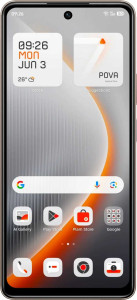
Infinix Note 50 4G
Tecno Pova 7

Infinix Note 50 4G Tecno Pova 7

Overview

Welcome to our in-depth comparison of the Infinix Note 50 4G and the Tecno Pova 7 — two feature-packed Android 15 smartphones competing for the same budget-conscious audience. Both share the same MediaTek Helio G100 chipset and OLED display, yet they take strikingly different approaches when it comes to battery capacity, camera hardware, and overall form factor. Read on to find out which device best suits your needs.

Common Features

  • Both phones are water resistant with an IP64 ingress protection rating.
  • Neither phone has a rugged build.
  • Neither phone can be folded.
  • Both phones feature an OLED/AMOLED display with a 6.78″ screen size.
  • Neither phone has branded damage-resistant glass.
  • HDR10 support is not available on either phone.
  • HDR10+ support is not available on either phone.
  • Dolby Vision support is not available on either phone.
  • Neither phone has a secondary screen.
  • Both phones have a touchscreen.
  • Both phones use the MediaTek Helio G100 chipset with a Mali G57 GPU running at 1000 MHz.
  • Both phones have 8GB of RAM at 4266 MHz and 256GB of internal storage.
  • Both phones have a CPU speed of 2 x 2.2 & 6 x 2 GHz.
  • Both phones have integrated LTE support.
  • Both phones have a dual-lens main camera.
  • Neither phone has a BSI sensor, but both have a CMOS sensor.
  • Both phones support continuous autofocus when recording movies.
  • Both phones support phase-detection autofocus for photos.
  • Both phones support slow-motion video recording.
  • Both phones run Android 15.
  • Both phones support fast charging at 45W.
  • Neither phone has a removable battery.
  • Both phones have a rechargeable battery with a battery level indicator.
  • Both phones have stereo speakers.
  • Neither phone supports aptX, LDAC, aptX HD, aptX Adaptive, aptX Lossless.
  • Both phones have an FM radio.
  • Neither phone supports 5G.
  • Both phones have dual SIM card slots.
  • Both phones have USB Type-C at USB version 2.
  • Both phones have NFC.
  • Both phones have the same download speed of 650 MBits/s and upload speed of 150 MBits/s.
  • Both phones have a fingerprint scanner.
  • Both phones have a video light.
  • Neither phone has a sapphire glass display, curved display, or e-paper display.

Main Differences

  • Weight is 199 g on Infinix Note 50 4G and 207 g on Tecno Pova 7.
  • Thickness is 7.6 mm on Infinix Note 50 4G and 9.3 mm on Tecno Pova 7.
  • Width is 74.4 mm on Infinix Note 50 4G and 76.6 mm on Tecno Pova 7.
  • Height is 163.3 mm on Infinix Note 50 4G and 168.6 mm on Tecno Pova 7.
  • Volume is 92.336352 cm³ on Infinix Note 50 4G and 120.107268 cm³ on Tecno Pova 7.
  • Pixel density is 393 ppi on Infinix Note 50 4G and 396 ppi on Tecno Pova 7.
  • Resolution is 1080 x 2436 px on Infinix Note 50 4G and 1080 x 2460 px on Tecno Pova 7.
  • Refresh rate is 144Hz on Infinix Note 50 4G and 120Hz on Tecno Pova 7.
  • AnTuTu benchmark score is 432052 on Infinix Note 50 4G and 411000 on Tecno Pova 7.
  • Main camera resolution is 50 & 8 MP on Infinix Note 50 4G and 108 & 2 MP on Tecno Pova 7.
  • Front camera resolution is 13MP on Infinix Note 50 4G and 8MP on Tecno Pova 7.
  • Optical image stabilization is present on Infinix Note 50 4G but not available on Tecno Pova 7.
  • Battery capacity is 5200 mAh on Infinix Note 50 4G and 7000 mAh on Tecno Pova 7.
  • Wireless charging is supported on Infinix Note 50 4G but not available on Tecno Pova 7.
  • A 3.5 mm audio jack is present on Tecno Pova 7 but not available on Infinix Note 50 4G.
Specs Comparison
Infinix Note 50 4G

Infinix Note 50 4G

Tecno Pova 7

Tecno Pova 7

Design:
water resistance Water resistant Water resistant
weight 199 g 207 g
thickness 7.6 mm 9.3 mm
width 74.4 mm 76.6 mm
height 163.3 mm 168.6 mm
volume 92.336352 cm³ 120.107268 cm³
Ingress Protection (IP) rating IP64 IP64
has a rugged build
can be folded

Both the Infinix Note 50 4G and the Tecno Pova 7 share the same IP64 rating, meaning neither is fully submersible but both offer meaningful protection against dust and water splashes — a practical perk for everyday use in light rain or humid conditions. Neither device has a rugged build or a foldable form factor, so they compete squarely as conventional candy-bar smartphones.

Where these two diverge significantly is in their physical footprint. The Note 50 4G is measurably more compact in every dimension: at 7.6 mm thick versus the Pova 7's 9.3 mm, it is nearly 1.7 mm slimmer — a difference that is immediately noticeable in-hand and in a pocket. Its total volume of 92.3 cm³ compared to the Pova 7's 120.1 cm³ represents roughly a 30% smaller physical bulk, which is a striking gap for devices in the same category. The Note 50 4G is also lighter at 199 g versus 207 g, though that 8-gram difference is minor on its own.

In terms of design, the Infinix Note 50 4G holds a clear advantage. Its dramatically slimmer profile and substantially lower volume make it the more pocketable and ergonomic choice for users who prioritize a sleek, lightweight feel. The Pova 7's larger body may hint at internal trade-offs — such as a bigger battery — but purely from a design and portability standpoint, the Note 50 4G is the more refined option.

Display:
Display type OLED/AMOLED OLED/AMOLED
screen size 6.78" 6.78"
pixel density 393 ppi 396 ppi
resolution 1080 x 2436 px 1080 x 2460 px
refresh rate 144Hz 120Hz
has branded damage-resistant glass
supports HDR10
supports HDR10+
supports Dolby Vision
Has a secondary screen
has a touch screen

On paper, these two displays are remarkably close. Both the Infinix Note 50 4G and the Tecno Pova 7 feature an AMOLED panel at an identical 6.78″ screen size, and their pixel densities — 393 ppi versus 396 ppi — are so near-identical that no human eye could distinguish a sharpness difference in everyday use. Neither device supports HDR10, HDR10+, or Dolby Vision, so content from streaming platforms will not receive any enhanced dynamic range treatment on either phone.

The one meaningful differentiator is the refresh rate. The Note 50 4G runs at 144Hz compared to the Pova 7's 120Hz. In practice, 120Hz already delivers very fluid scrolling and animations — it is widely considered the sweet spot for smoothness. However, 144Hz provides a noticeably snappier feel, particularly in fast-paced gaming and rapid UI navigation, where the extra frames per second reduce motion blur and input latency. For casual users the gap is subtle, but for mobile gamers it is a genuine functional advantage.

Overall, this category is close to a draw for most users, but the Note 50 4G edges ahead on the strength of its higher refresh rate. Given that both phones share the same panel technology, size, and effective sharpness, the 144Hz advantage is the only differentiator worth acting on — and it meaningfully favors those who prioritize display responsiveness.

Performance:
internal storage 256GB 256GB
RAM 8GB 8GB
AnTuTu benchmark score 432052 411000
Chipset (SoC) name MediaTek Helio G100 MediaTek Helio G100
GPU name Mali G57 Mali G57
CPU speed 2 x 2.2 & 6 x 2 GHz 2 x 2.2 & 6 x 2 GHz
GPU clock speed 1000 MHz 1000 MHz
Has integrated LTE
RAM speed 4266 MHz 4266 MHz
semiconductor size 6 nm 6 nm
Supports 64-bit
DirectX version DirectX 11 DirectX 11
Has integrated graphics
OpenGL ES version 3.2 3.2
Uses big.LITTLE technology
CPU threads 8 threads 8 threads
Uses HMP
Has TrustZone
maximum memory bandwidth 17.1 GB/s 17.1 GB/s
OpenCL version 2 2
maximum memory amount 12GB 12GB
Thermal Design Power (TDP) 5W 5W
DDR memory version 4 4

Strip away the branding and these two phones are, from a silicon perspective, identical twins. Both the Infinix Note 50 4G and the Tecno Pova 7 run on the MediaTek Helio G100 chipset, built on a 6 nm process, paired with the same Mali G57 GPU, the same 8GB of DDR4 RAM clocked at 4266 MHz, and 256GB of internal storage. Every architectural detail — CPU core configuration, memory bandwidth, TDP, OpenGL ES version — is a carbon copy across both devices.

The only data point that separates them is the AnTuTu benchmark score: the Note 50 4G registers 432,052 against the Pova 7's 411,000. That roughly 5% gap likely reflects differences in software optimization, thermal management, or testing conditions rather than any hardware distinction. In real-world usage — multitasking, gaming, app loading — neither phone will feel meaningfully faster than the other to any user.

This category is effectively a tie. Choosing between them on performance grounds alone is not possible, as the shared Helio G100 platform sets an identical performance ceiling for both. Buyers should look to other spec groups — display, design, battery — to make their decision.

Cameras:
megapixels (main camera) 50 & 8 MP 108 & 2 MP
Has a dual-lens (or multi-lens) main camera
megapixels (front camera) 13MP 8MP
has built-in optical image stabilization
Has a dual-tone LED flash
number of flash LEDs 2 2
has a BSI sensor
has a CMOS sensor
has continuous autofocus when recording movies
Has phase-detection autofocus for photos
supports slow-motion video recording
has a built-in HDR mode
has manual exposure
has a flash
optical zoom 0x 0x
has manual ISO
has a serial shot mode
has manual focus
has a front camera
Has laser autofocus
Shoots 360° panorama
has manual white balance
shoots raw
has touch autofocus
has manual shutter speed
can create panoramas in-camera
Has timelapse function
Has a front-facing LED flash
has a dual-lens (or multi-lens) front camera
supports HDR10 recording
supports Dolby Vision recording
has a front-facing camera under the display
Has a RGB LED flash
has 3D photo/video recording capabilities

The camera comparison between the Infinix Note 50 4G and the Tecno Pova 7 comes down to three pivotal differences amid an otherwise identical feature set. The Pova 7 leads with a striking 108 MP primary sensor, against the Note 50 4G's 50 MP main shooter. On the surface that sounds decisive, but megapixel count alone does not determine image quality — sensor size, pixel binning, and processing all play critical roles, none of which are captured in these specs. What the raw number does offer is greater flexibility for cropping and printing at large sizes.

However, the Note 50 4G counters with two meaningful advantages. First, it includes optical image stabilization (OIS), which the Pova 7 lacks entirely. OIS physically compensates for hand tremor during shots and video recording, producing noticeably sharper photos in low light and smoother footage — a hardware benefit that no software fix can fully replicate. Second, its secondary rear lens at 8 MP is considerably more capable than the Pova 7's 2 MP depth sensor, which is largely a cosmetic addition used only for portrait bokeh. The Note 50 4G also wins on selfies, offering a 13 MP front camera versus the Pova 7's 8 MP.

Weighing these trade-offs, the Note 50 4G holds the more practical camera advantage. The Pova 7's headline 108 MP sensor is an attention-grabbing spec, but the Note 50 4G's OIS, stronger secondary lens, and higher-resolution front camera represent real, everyday shooting benefits that the numbers support directly.

Operating system:
Android version Android 15 Android 15
has clipboard warnings
has location privacy options
has camera/microphone privacy options
has Mail Privacy Protection
has theme customization
can block app tracking
blocks cross-site tracking
has on-device machine learning
has notification permissions
has media picker
Can play games while they download
has dark mode
has Wi-Fi password sharing
has battery health check
has an extra dim mode
has focus modes
has dynamic theming
can offload apps
Has customizable notifications
has Live Text
has full-page screenshots
supports split screen
gets direct OS updates
has PiP
Can be used as a PC
Has sharing intents
has a child lock
Supports widgets
Is free and open source
Has offline voice recognition
has voice commands
Tracks the current position of a mobile device
is a multi-user system
has Quick Start

Rarely does a spec group produce such a clean result: the Infinix Note 50 4G and the Tecno Pova 7 are in absolute lockstep on every single operating system data point provided. Both ship with Android 15 and share an identical privacy feature set — including location controls, camera and microphone permissions, app tracking blockers, and clipboard warnings — along with the same productivity tools such as split-screen multitasking, picture-in-picture, dynamic theming, and on-device machine learning.

A few shared limitations are worth noting. Neither device receives direct OS updates from Google, meaning updates are filtered through each manufacturer's own release cycle — a common trade-off at this price tier that can result in slower or less consistent software support over time. Neither phone supports cross-site tracking protection or Wi-Fi password sharing either, though these are minor omissions in the broader Android ecosystem.

This category is an unambiguous tie. Every capability and every limitation is mirrored exactly between the two devices. Software experience will be shaped entirely by each brand's custom Android skin and their update cadence going forward — factors that fall outside the provided data and cannot be used to differentiate them here.

Battery:
battery power 5200 mAh 7000 mAh
has wireless charging
Supports fast charging
charging speed 45W 45W
has a removable battery
has a battery level indicator
has a rechargeable battery

Battery is where the Tecno Pova 7 makes its most compelling statement. Its 7000 mAh cell dwarfs the Infinix Note 50 4G's already-respectable 5200 mAh — a 35% larger capacity that, on the same shared chipset and a comparable display, should translate directly into significantly longer time between charges. For heavy users, travelers, or anyone far from an outlet, that gap is a meaningful real-world advantage.

The Note 50 4G, however, fights back with wireless charging — a convenience feature the Pova 7 lacks entirely. The ability to drop a phone on a pad without fumbling for a cable is a genuine daily quality-of-life benefit, and it is an increasingly expected feature at this tier. Both phones match each other on wired 45W fast charging, so topping up from low battery takes roughly the same time when plugged in — though the Pova 7's larger tank means full charges will take longer in absolute terms.

Ultimately, this category hinges on usage priorities. Users who want the longest possible battery life between charges should gravitate toward the Pova 7, whose 7000 mAh lead is too large to ignore. Those who value charging flexibility and convenience — particularly wireless charging — will find the Note 50 4G more accommodating. Neither outcome is a clear sweep, but for pure endurance, the Pova 7 holds the stronger hand.

Audio:
has a socket for a 3.5 mm audio jack
has stereo speakers
has aptX
has LDAC
has aptX HD
has aptX Adaptive
has aptX Lossless
Has a radio

Audio is a category where a single spec tells most of the story. Both the Infinix Note 50 4G and the Tecno Pova 7 offer stereo speakers and a built-in FM radio — a shared baseline that covers the needs of most casual listeners. Neither device supports high-resolution Bluetooth codecs such as aptX or LDAC, so wireless audio quality is capped at standard levels on both phones regardless of which earbuds or headphones are used.

The decisive difference is the 3.5 mm headphone jack. The Pova 7 includes one; the Note 50 4G does not. This is a straightforward but genuinely impactful distinction for users who own wired headphones, prefer the reliability of a physical connection, or want to listen while charging. The absence of a headphone jack on the Note 50 4G forces reliance on Bluetooth or a USB-C adapter — neither of which is as seamless as a direct wired connection.

The Tecno Pova 7 holds a clear edge in this category. With an identical speaker setup and codec support across both phones, the 3.5 mm jack is the only differentiator — and it is one that directly expands the Pova 7's compatibility and day-to-day convenience for anyone who regularly uses wired audio.

Connectivity & Features:
release date March 2025 June 2025
has 5G support
SIM cards 2 SIM 2 SIM
Has USB Type-C
USB version 2 2
has NFC
download speed 650 MBits/s 650 MBits/s
upload speed 150 MBits/s 150 MBits/s
Has a fingerprint scanner
has emergency SOS via satellite
has crash detection
is DLNA-certified
has a gyroscope
supports ANT+
Has a heart rate monitor
has GPS
has a compass
supports Wi-Fi
Has an infrared sensor
has an accelerometer
has a cellular module
Has a barometer
has an HDMI output
Uses 3D facial recognition
Has an iris scanner
Stylus included
supports Galileo
Has motion tracking
Has optical tracking
Has a built-in projector

Connectivity is another domain where the Infinix Note 50 4G and the Tecno Pova 7 offer no grounds for differentiation whatsoever. Both are 4G-only devices with dual SIM support, USB-C 2.0, NFC, matched download and upload speeds of 650 Mbps and 150 Mbps respectively, and identical sensor suites covering GPS, Galileo, gyroscope, accelerometer, and compass. Neither phone supports 5G, which is worth noting for buyers in markets where 5G coverage is expanding and longevity matters.

The inclusion of NFC on both devices is a shared highlight worth calling out — it enables contactless payments and quick device pairing, features that are far from universal at this price segment. Similarly, both phones include a fingerprint scanner and GPS with Galileo support, covering the essentials for biometric security and accurate navigation without any gap between them.

This category is a complete tie. Not a single connectivity or sensor spec differs between the two phones. Buyers prioritizing features like 5G, infrared, or advanced biometrics will find neither device satisfies those needs — but for standard everyday connectivity, both deliver an equivalent and well-rounded package.

Miscellaneous:
has a video light
Has sapphire glass display
Has a curved display
Has an e-paper display

The miscellaneous specs for the Infinix Note 50 4G and the Tecno Pova 7 are identical across every data point provided. Both feature a video light — useful for illuminating subjects during video calls or recording in dim conditions — and neither carries a curved display, sapphire glass, or an e-paper panel. None of these absences are surprising or penalizing at this market tier; they are simply confirmations that both phones stick to conventional mainstream design choices.

This category is a tie in the most complete sense. With only four data points available and all four matching exactly, there is nothing in this group that separates the two devices or should influence a purchase decision in either direction.

Comparison Summary & Verdict

After examining every specification, it is clear that these two phones serve distinct types of users. The Infinix Note 50 4G stands out with its slimmer, lighter design, a higher 144Hz refresh rate, optical image stabilization, a 13MP front camera, and the added convenience of wireless charging — making it the better pick for users who value portability and a more versatile camera system. The Tecno Pova 7, on the other hand, counters with a massive 7000 mAh battery, a 108MP main camera, and a 3.5mm audio jack, appealing to power users who prioritize endurance and wired audio. Both phones deliver the same core performance via the Helio G100, so your choice ultimately comes down to whether you prefer a sleek, feature-rich experience or maximum battery longevity.

Infinix Note 50 4G
Buy Infinix Note 50 4G if...

Buy the Infinix Note 50 4G if you want a slimmer and lighter phone with a smoother 144Hz display, optical image stabilization, and the convenience of wireless charging.

Tecno Pova 7
Buy Tecno Pova 7 if...

Buy the Tecno Pova 7 if long battery life is your top priority, or if you need a 108MP main camera and a 3.5mm headphone jack for wired audio.