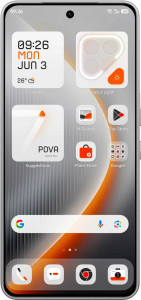
Infinix Note 50 Pro Plus 5G
Tecno Pova 7 Ultra 5G

Infinix Note 50 Pro Plus 5G Tecno Pova 7 Ultra 5G

Overview

Welcome to our in-depth comparison of the Infinix Note 50 Pro Plus 5G and the Tecno Pova 7 Ultra 5G — two compelling mid-range 5G smartphones that share more common ground than you might expect. Both devices run on the same chipset and offer AMOLED displays with 144Hz refresh rates, yet they diverge sharply when it comes to camera versatility, battery capacity, and charging capabilities. Read on to find out which one best suits your needs.

Common Features

  • Both phones are water resistant with an IP64 ingress protection rating.
  • Neither phone has a rugged build.
  • Neither phone can be folded.
  • Both phones feature an OLED/AMOLED display.
  • Both phones support a 144Hz refresh rate.
  • Neither phone has branded damage-resistant glass.
  • HDR10 support is not available on either phone.
  • HDR10+ support is not available on either phone.
  • Dolby Vision support is not available on either phone.
  • Neither phone has a secondary screen.
  • Both phones have a touchscreen.
  • Both phones come with 256GB internal storage and 12GB RAM.
  • Both phones are powered by the MediaTek Dimensity 8350 chipset with a Mali G615 MC6 GPU.
  • Both phones scored 4700 (multi) and 1536 (single) on Geekbench 6.
  • Both phones have a multi-lens main camera.
  • Both phones support continuous autofocus and phase-detection autofocus.
  • Both phones support slow-motion video recording.
  • Both phones run Android 15.
  • Both phones support wireless charging at 30W and fast wired charging.
  • Both phones come with a charger and have a non-removable battery.
  • Both phones have stereo speakers.
  • Neither phone supports aptX, LDAC, aptX HD, aptX Adaptive, aptX Lossless.
  • Both phones support 5G, dual SIM, USB Type-C (USB 2.0), and NFC.
  • Both phones have a fingerprint scanner.
  • Emergency SOS via satellite is not available on either phone.
  • Crash detection is not available on either phone.

Main Differences

  • Thickness is 8 mm on Infinix Note 50 Pro Plus 5G and 8.9 mm on Tecno Pova 7 Ultra 5G.
  • Width is 74.5 mm on Infinix Note 50 Pro Plus 5G and 75.2 mm on Tecno Pova 7 Ultra 5G.
  • Height is 163.4 mm on Infinix Note 50 Pro Plus 5G and 160 mm on Tecno Pova 7 Ultra 5G.
  • Volume is 97.39 cm³ on Infinix Note 50 Pro Plus 5G and 107.08 cm³ on Tecno Pova 7 Ultra 5G.
  • Screen size is 6.78″ on Infinix Note 50 Pro Plus 5G and 6.67″ on Tecno Pova 7 Ultra 5G.
  • Pixel density is 393 ppi on Infinix Note 50 Pro Plus 5G and 460 ppi on Tecno Pova 7 Ultra 5G.
  • Resolution is 1080 x 2436 px on Infinix Note 50 Pro Plus 5G and 1260 x 2800 px on Tecno Pova 7 Ultra 5G.
  • AnTuTu benchmark score is 1,420,000 on Infinix Note 50 Pro Plus 5G and 1,530,000 on Tecno Pova 7 Ultra 5G.
  • Main camera megapixels are 50 & 50 & 8 MP on Infinix Note 50 Pro Plus 5G and 108 & 8 MP on Tecno Pova 7 Ultra 5G.
  • Front camera megapixels are 32 MP on Infinix Note 50 Pro Plus 5G and 13 MP on Tecno Pova 7 Ultra 5G.
  • Optical image stabilization is available on Infinix Note 50 Pro Plus 5G but not on Tecno Pova 7 Ultra 5G.
  • Optical zoom is 3x on Infinix Note 50 Pro Plus 5G and not available on Tecno Pova 7 Ultra 5G.
  • Battery capacity is 5200 mAh on Infinix Note 50 Pro Plus 5G and 6000 mAh on Tecno Pova 7 Ultra 5G.
  • Wired charging speed is 90W on Infinix Note 50 Pro Plus 5G and 70W on Tecno Pova 7 Ultra 5G.
  • Reverse wireless charging is supported on Infinix Note 50 Pro Plus 5G but not on Tecno Pova 7 Ultra 5G.
  • A 3.5 mm audio jack is present on Tecno Pova 7 Ultra 5G but not available on Infinix Note 50 Pro Plus 5G.
  • A built-in radio is available on Infinix Note 50 Pro Plus 5G but not on Tecno Pova 7 Ultra 5G.
  • An infrared sensor is present on Infinix Note 50 Pro Plus 5G but not on Tecno Pova 7 Ultra 5G.
Specs Comparison
Infinix Note 50 Pro Plus 5G

Infinix Note 50 Pro Plus 5G

Tecno Pova 7 Ultra 5G

Tecno Pova 7 Ultra 5G

Design:
water resistance Water resistant Water resistant
thickness 8 mm 8.9 mm
width 74.5 mm 75.2 mm
height 163.4 mm 160 mm
volume 97.3864 cm³ 107.0848 cm³
Ingress Protection (IP) rating IP64 IP64
has a rugged build
can be folded

Both the Infinix Note 50 Pro Plus 5G and the Tecno Pova 7 Ultra 5G share the same IP64 ingress protection rating, meaning neither is fully waterproof but both can handle splashes and light water exposure without issue. Neither device offers a rugged build or a foldable form factor, so they compete squarely in the same conventional smartphone category.

Where they diverge is in their physical footprint. The Note 50 Pro Plus is measurably more compact: at just 8 mm thick versus the Pova 7 Ultra's 8.9 mm, it is nearly a millimeter slimmer, which translates to a noticeably sleeker feel in hand and pocket. Its total volume of 97.4 cm³ is significantly lower than the Pova 7 Ultra's 107.1 cm³ — roughly a 10% difference — indicating that the Note 50 Pro Plus packs its internals into a more efficiently shaped chassis. The Pova 7 Ultra is slightly shorter at 160 mm versus 163.4 mm, but its greater thickness and width more than offset that height advantage in terms of overall bulk.

In terms of design, the Infinix Note 50 Pro Plus 5G holds a clear edge: it is the slimmer, more compact device overall, which generally makes for a more premium in-hand feel and easier one-handed use. The Pova 7 Ultra's larger volume may hint at a bigger battery or additional internal hardware, but based purely on the design specs provided, the Note 50 Pro Plus is the more refined and pocketable of the two.

Display:
Display type OLED/AMOLED OLED/AMOLED
screen size 6.78" 6.67"
pixel density 393 ppi 460 ppi
resolution 1080 x 2436 px 1260 x 2800 px
refresh rate 144Hz 144Hz
has branded damage-resistant glass
supports HDR10
supports HDR10+
supports Dolby Vision
Has a secondary screen
has a touch screen

Both phones use an OLED/AMOLED panel and match each other at a smooth 144Hz refresh rate, so fast scrolling and gaming fluidity are equally strong on either device. Neither supports HDR10, HDR10+, or Dolby Vision, which puts them on the same level for high dynamic range content — meaning neither has an advantage for streaming HDR video.

The more meaningful story is in resolution and pixel density. The Tecno Pova 7 Ultra 5G packs a 1260 x 2800 px resolution into a 6.67″ screen, yielding an impressive 460 ppi — a figure that comfortably exceeds what the human eye can distinguish at normal viewing distances, resulting in exceptionally crisp text and fine detail. The Infinix Note 50 Pro Plus 5G, by contrast, offers a 1080 x 2436 px resolution on a slightly larger 6.78″ panel, producing 393 ppi. That is still a sharp, capable display, but the gap of 67 ppi is clearly perceptible — particularly when reading small text, viewing detailed images, or watching high-resolution video up close.

The Tecno Pova 7 Ultra 5G holds a clear advantage in display quality here. Its combination of a higher-resolution panel and significantly greater pixel density make it the sharper, more detail-rich screen of the two, and for users who prioritize visual fidelity, that difference is genuinely meaningful in daily use.

Performance:
internal storage 256GB 256GB
RAM 12GB 12GB
AnTuTu benchmark score 1420000 1530000
Chipset (SoC) name MediaTek Dimensity 8350 MediaTek Dimensity 8350
GPU name Mali G615 MC6 Mali G615 MC6
CPU speed 1 x 3.35 & 3 x 3.2 & 4 x 2.2 GHz 1 x 3.35 & 3 x 3.2 & 4 x 2.2 GHz
Geekbench 6 result (multi) 4700 4700
Geekbench 6 result (single) 1536 1536
GPU clock speed 1400 MHz 1400 MHz
Has integrated LTE
RAM speed 8533 MHz 8533 MHz
semiconductor size 4 nm 4 nm
Supports 64-bit
DirectX version DirectX 12 DirectX 12
Has integrated graphics
Uses big.LITTLE technology
CPU threads 8 threads 8 threads
Has NX bit
Uses HMP
Has TrustZone
maximum memory bandwidth 68.2 GB/s 68.2 GB/s
OpenCL version 2 2
memory channels 4 4
maximum memory amount 24GB 24GB
DDR memory version 5 5
L3 core 4 MB/core 4 MB/core
L3 cache 4 MB 4 MB

At the silicon level, these two phones are effectively twins. Both run on the MediaTek Dimensity 8350 chipset built on a 4 nm process, pair it with the same Mali G615 MC6 GPU, and ship with identical 12GB of RAM and 256GB of storage. CPU configuration, clock speeds, memory bandwidth, and every architectural detail in the provided data match exactly — so in day-to-day tasks like app switching, multitasking, and gaming, users should expect a virtually indistinguishable experience on either device.

The one numerical difference worth examining is the AnTuTu benchmark score: the Tecno Pova 7 Ultra 5G posts 1,530,000 versus the Infinix Note 50 Pro Plus 5G's 1,420,000 — a gap of roughly 7.7%. However, the Geekbench 6 scores are identical across both single-core (1536) and multi-core (4700) tests. This discrepancy suggests the AnTuTu difference likely reflects optimization in system-level software or thermal management rather than a fundamental hardware advantage, since the underlying silicon is provably the same.

For performance, this is essentially a tie. The shared Dimensity 8350 platform delivers strong mid-to-upper-range performance on both phones, and no meaningful real-world difference should be expected. A buyer choosing between these two devices can safely set performance aside as a deciding factor and focus on other differentiating areas.

Cameras:
megapixels (main camera) 50 & 50 & 8 MP 108 & 8 MP
Has a dual-lens (or multi-lens) main camera
megapixels (front camera) 32MP 13MP
has built-in optical image stabilization
Has a dual-tone LED flash
number of flash LEDs 2 2
has a BSI sensor
has a CMOS sensor
has continuous autofocus when recording movies
Has phase-detection autofocus for photos
supports slow-motion video recording
has a built-in HDR mode
has manual exposure
has a flash
optical zoom 3x 0x
has manual ISO
has a serial shot mode
has manual focus
has a front camera
Has laser autofocus
Shoots 360° panorama
has manual white balance
shoots raw
has touch autofocus
has manual shutter speed
can create panoramas in-camera
Has timelapse function
Has a front-facing LED flash
has a dual-lens (or multi-lens) front camera
supports HDR10 recording
supports Dolby Vision recording
has a front-facing camera under the display
Has a RGB LED flash
has 3D photo/video recording capabilities

The camera systems on these two phones take very different approaches. The Infinix Note 50 Pro Plus 5G features a triple rear camera setup at 50 + 50 + 8 MP, while the Tecno Pova 7 Ultra 5G goes for a dual-lens system led by a high-resolution 108 MP primary sensor paired with an 8 MP secondary. On paper, 108 MP sounds compelling, but raw megapixel count is only one dimension of camera capability — and in several other dimensions, the Note 50 Pro Plus pulls ahead decisively.

The two most impactful differentiators are optical image stabilization and zoom. The Note 50 Pro Plus includes built-in OIS, which physically compensates for hand movement during shots and video — especially valuable in low light and while recording. The Pova 7 Ultra lacks OIS entirely, which means it relies solely on software stabilization. Even more telling is optical zoom: the Note 50 Pro Plus offers 3x optical zoom, meaning it can magnify subjects without any loss in image quality, while the Pova 7 Ultra offers 0x optical zoom — any zoom it produces is purely digital cropping, which degrades image sharpness. For users who photograph subjects at a distance, this is a significant functional gap. The selfie camera gap is equally wide: the Note 50 Pro Plus shoots at 32 MP versus the Pova 7 Ultra's 13 MP, which makes a real difference for portrait clarity and detail in front-facing shots.

The Infinix Note 50 Pro Plus 5G holds a clear and multi-faceted advantage in this category. The combination of a triple-lens system, OIS, meaningful optical zoom, and a substantially higher-resolution front camera makes it the stronger all-around photography package of the two — regardless of the Pova 7 Ultra's headline 108 MP figure.

Operating system:
Android version Android 15 Android 15
has clipboard warnings
has location privacy options
has camera/microphone privacy options
has Mail Privacy Protection
has theme customization
can block app tracking
blocks cross-site tracking
has on-device machine learning
has notification permissions
has media picker
Can play games while they download
has dark mode
has Wi-Fi password sharing
has battery health check
has an extra dim mode
has focus modes
has dynamic theming
can offload apps
Has customizable notifications
has Live Text
has full-page screenshots
supports split screen
gets direct OS updates
has PiP
Can be used as a PC
Has sharing intents
has a child lock
Supports widgets
Is free and open source
Has offline voice recognition
has voice commands
Tracks the current position of a mobile device
is a multi-user system
has Quick Start

When it comes to software, these two phones are a perfect match — every single spec in this category is identical. Both run Android 15 out of the box and share the same feature set across privacy controls, productivity tools, and customization options. Neither receives direct OS updates, and both support the same set of capabilities including split-screen multitasking, Picture-in-Picture, dynamic theming, on-device machine learning, and offline voice recognition.

From a privacy standpoint, both offer the same suite of controls: location privacy options, camera and microphone permission management, app tracking blocks, and clipboard warnings. Neither blocks cross-site tracking, and neither includes Mail Privacy Protection — so users with heightened privacy expectations will find the same limitations on either device.

This is a complete tie. There is no software-based reason to choose one over the other — the operating system experience, feature depth, and privacy toolset are indistinguishable between the Infinix Note 50 Pro Plus 5G and the Tecno Pova 7 Ultra 5G based on the provided data.

Battery:
battery power 5200 mAh 6000 mAh
has wireless charging
Supports fast charging
charging speed 90W 70W
wireless charging speed 30W 30W
has reverse wireless charging
comes with a charger
has a removable battery
has a battery level indicator
has a rechargeable battery

Battery capacity and charging speed pull in opposite directions here, making this a genuine trade-off comparison. The Tecno Pova 7 Ultra 5G carries a larger 6000 mAh cell versus the Infinix Note 50 Pro Plus 5G's 5200 mAh — an 800 mAh difference that, in practice, translates to a meaningfully longer time between charges, particularly for heavy users who stream video, game, or stay connected throughout the day. The Pova 7 Ultra is the clear winner for raw endurance.

Flip the lens to charging, and the advantage shifts. The Note 50 Pro Plus supports 90W wired fast charging compared to the Pova 7 Ultra's 70W — a 20W gap that, despite the Note 50 Pro Plus having a smaller battery to fill, results in noticeably faster top-ups. Both devices match on 30W wireless charging, which is a strong and relatively uncommon feature at this segment. However, the Note 50 Pro Plus goes one step further with reverse wireless charging, allowing it to wirelessly top up other devices like earbuds or smartwatches — a convenience the Pova 7 Ultra does not offer.

Neither phone is a clear overall winner in this category — it comes down to what the user values more. The Tecno Pova 7 Ultra 5G is the better pick for all-day and multi-day battery life, while the Infinix Note 50 Pro Plus 5G wins on charging versatility, offering faster wired speeds and the added utility of reverse wireless charging.

Audio:
has a socket for a 3.5 mm audio jack
has stereo speakers
has aptX
has LDAC
has aptX HD
has aptX Adaptive
has aptX Lossless
Has a radio

Stereo speakers are a shared strength here — both devices deliver them, which means front-facing or dual-channel audio for media consumption is on the table for either phone. Neither supports high-resolution Bluetooth audio codecs such as aptX, LDAC, or any of their variants, so wireless audio quality is capped at the same standard level on both devices.

The two meaningful differentiators cut in opposite directions. The Tecno Pova 7 Ultra 5G includes a 3.5mm headphone jack — an increasingly rare feature that matters to users who own wired headphones or earphones, prefer zero-latency audio for gaming, or simply want to avoid the hassle of dongles and Bluetooth pairing. The Infinix Note 50 Pro Plus 5G drops the jack entirely, which is a genuine loss for wired audio users. On the other side, the Note 50 Pro Plus includes a built-in FM radio, useful for users in regions with strong broadcast coverage or those who want offline audio without consuming mobile data — a feature the Pova 7 Ultra omits.

For most users, the 3.5mm jack on the Tecno Pova 7 Ultra 5G represents the more broadly useful advantage — wired audio compatibility affects a wider range of everyday scenarios than FM radio access. That gives the Pova 7 Ultra a slight edge in audio hardware, though users who specifically value FM radio will find the Note 50 Pro Plus the better fit for their needs.

Connectivity & Features:
release date March 2025 June 2025
has 5G support
SIM cards 2 SIM 2 SIM
Has USB Type-C
USB version 2 2
has NFC
Has a fingerprint scanner
has emergency SOS via satellite
has crash detection
is DLNA-certified
has a gyroscope
supports ANT+
Has a heart rate monitor
has GPS
has a compass
supports Wi-Fi
Has an infrared sensor
has an accelerometer
has a cellular module
Has a barometer
has an HDMI output
Uses 3D facial recognition
Has an iris scanner
Stylus included
supports Galileo
Has motion tracking
Has optical tracking
Has a built-in projector

Across the core connectivity checklist — 5G, dual SIM, USB Type-C, NFC, Wi-Fi, GPS, Galileo support, fingerprint scanner, gyroscope, and accelerometer — both phones are completely identical. For everyday use cases like mobile payments via NFC, accurate navigation, dual-SIM flexibility, and reliable biometric unlocking, either device delivers the same capability without compromise.

The single differentiator in this entire category is the infrared sensor, which the Infinix Note 50 Pro Plus 5G includes and the Tecno Pova 7 Ultra 5G does not. An IR blaster lets the phone act as a universal remote control for televisions, air conditioners, set-top boxes, and other home appliances — a niche but genuinely convenient feature for users who want to consolidate their remotes into one device.

The Infinix Note 50 Pro Plus 5G takes a narrow edge here purely on the strength of that IR sensor. It is not a critical differentiator for most buyers, but it is a functional addition the Pova 7 Ultra simply cannot match. For users who value smart home or appliance control from their phone, the Note 50 Pro Plus is the more capable device in this category.

Miscellaneous:
has a video light
Has sapphire glass display
Has a curved display
Has an e-paper display

The miscellaneous specs for these two phones reveal no differences whatsoever. Both include a video light, and neither features a sapphire glass display, a curved screen, or an e-paper display — four data points that land identically across the board.

This is a complete tie. The provided data for this category offers no basis to distinguish the Infinix Note 50 Pro Plus 5G from the Tecno Pova 7 Ultra 5G, and buyers should look to other specification groups to inform their decision.

Comparison Summary & Verdict

After a thorough look at both devices, it is clear that each phone caters to a different kind of user. The Infinix Note 50 Pro Plus 5G stands out for photography enthusiasts and power users who value a versatile camera system with optical image stabilization and 3x optical zoom, a faster 90W wired charging speed, reverse wireless charging, and an infrared sensor — all in a slimmer, lighter body. On the other hand, the Tecno Pova 7 Ultra 5G appeals to users who prioritize a sharper 460 ppi display, a larger 6000 mAh battery for extended usage, a 3.5 mm headphone jack, and a higher AnTuTu benchmark score. Neither phone is a clear-cut winner — your ideal choice ultimately depends on whether you lean toward camera performance and fast charging, or toward display sharpness, battery endurance, and audio connectivity.

Infinix Note 50 Pro Plus 5G
Buy Infinix Note 50 Pro Plus 5G if...

Buy the Infinix Note 50 Pro Plus 5G if you want a versatile camera system with optical image stabilization and 3x optical zoom, faster 90W wired charging, reverse wireless charging, and a slimmer design with an infrared sensor.

Tecno Pova 7 Ultra 5G
Buy Tecno Pova 7 Ultra 5G if...

Buy the Tecno Pova 7 Ultra 5G if you prioritize a sharper high-resolution display, a larger 6000 mAh battery for longer usage, a 3.5 mm headphone jack, and a slightly higher AnTuTu performance score.