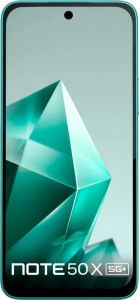
Infinix Note 50x 5G
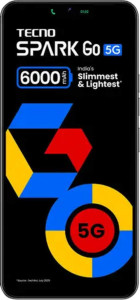
Tecno Spark Go 5G

Infinix Note 50x 5G Tecno Spark Go 5G

Overview

When choosing between the Infinix Note 50x 5G and the Tecno Spark Go 5G, shoppers face a genuinely competitive budget 5G showdown. Both devices share a familiar foundation — LCD IPS screens, 50 MP main cameras, Android 15, and dual SIM support — yet they diverge sharply when it comes to performance hardware, battery and charging, and audio and connectivity features. Read on to see exactly how these two stack up across every key specification.

Common Features

  • Both phones are water resistant with an IP64 ingress protection rating.
  • Both devices have a thickness of 8 mm.
  • Neither phone has a rugged build.
  • Neither phone can be folded.
  • Both phones feature an LCD IPS display type.
  • Both devices share a resolution of 720 x 1600 px.
  • Both displays have a 120Hz refresh rate.
  • Neither phone has branded damage-resistant glass.
  • HDR10 support is not available on either device.
  • HDR10+ support is not available on either device.
  • Always-On Display is not available on either phone.
  • Dolby Vision support is not available on either device.
  • Both phones come with 128GB of internal storage.
  • Both devices support 64-bit processing.
  • Both phones use big.LITTLE technology.
  • Both devices support DirectX 12.
  • The main camera on both phones is 50 MP.
  • Neither phone has built-in optical image stabilization.
  • Neither phone has a dual-tone LED flash.
  • Both phones feature a CMOS sensor and phase-detection autofocus.
  • Both devices run Android 15.
  • Both phones support fast charging.
  • Neither phone has wireless charging.
  • Neither phone has a removable battery.
  • Both devices have a radio.
  • Both phones support 5G connectivity.
  • Both devices have dual SIM card slots.
  • Both phones include a USB Type-C port.
  • Both phones have a fingerprint scanner.
  • Both devices have an external memory slot.
  • Emergency SOS via satellite is not available on either phone.
  • Crash detection is not available on either device.

Main Differences

  • Weight is 198.9 g on Infinix Note 50x 5G and 194 g on Tecno Spark Go 5G.
  • Width is 76.4 mm on Infinix Note 50x 5G and 77.7 mm on Tecno Spark Go 5G.
  • Height is 165.4 mm on Infinix Note 50x 5G and 167.7 mm on Tecno Spark Go 5G.
  • Volume is 101.09 cm³ on Infinix Note 50x 5G and 104.24 cm³ on Tecno Spark Go 5G.
  • Screen size is 6.67″ on Infinix Note 50x 5G and 6.74″ on Tecno Spark Go 5G.
  • Pixel density is 263 ppi on Infinix Note 50x 5G and 260 ppi on Tecno Spark Go 5G.
  • RAM is 8GB on Infinix Note 50x 5G and 4GB on Tecno Spark Go 5G.
  • The chipset is MediaTek Dimensity 7300 on Infinix Note 50x 5G and MediaTek Dimensity 6400 on Tecno Spark Go 5G.
  • The GPU is Mali G615 MC2 on Infinix Note 50x 5G and Arm Mali-G57 MC2 on Tecno Spark Go 5G.
  • CPU speed is 4 x 2.5 & 4 x 2 GHz on Infinix Note 50x 5G and 2 x 2.5 & 6 x 2 GHz on Tecno Spark Go 5G.
  • GPU clock speed is 1047 MHz on Infinix Note 50x 5G and 950 MHz on Tecno Spark Go 5G.
  • RAM speed is 6400 MHz on Infinix Note 50x 5G and 2133 MHz on Tecno Spark Go 5G.
  • Semiconductor size is 4 nm on Infinix Note 50x 5G and 6 nm on Tecno Spark Go 5G.
  • DDR memory version is 5 on Infinix Note 50x 5G and 4 on Tecno Spark Go 5G.
  • Front camera resolution is 8 MP on Infinix Note 50x 5G and 5 MP on Tecno Spark Go 5G.
  • Main camera video recording goes up to 2160 x 30 fps on Infinix Note 50x 5G and 1440 x 30 fps on Tecno Spark Go 5G.
  • Number of flash LEDs is 1 on Infinix Note 50x 5G and 2 on Tecno Spark Go 5G.
  • Battery capacity is 5500 mAh on Infinix Note 50x 5G and 6000 mAh on Tecno Spark Go 5G.
  • Charging speed is 45W on Infinix Note 50x 5G and 18W on Tecno Spark Go 5G.
  • A 3.5 mm audio jack is present on Tecno Spark Go 5G but not available on Infinix Note 50x 5G.
  • Stereo speakers are present on Infinix Note 50x 5G but not available on Tecno Spark Go 5G.
  • Wi-Fi 6 (802.11ax) support is present on Infinix Note 50x 5G but not available on Tecno Spark Go 5G.
  • Bluetooth version is 5.4 on Infinix Note 50x 5G and 5.3 on Tecno Spark Go 5G.
  • NFC is present on Infinix Note 50x 5G but not available on Tecno Spark Go 5G.
  • An infrared sensor is present on Infinix Note 50x 5G but not available on Tecno Spark Go 5G.
  • Download speed is 3270 Mbits/s on Infinix Note 50x 5G and 3300 Mbits/s on Tecno Spark Go 5G.
Specs Comparison
Infinix Note 50x 5G

Infinix Note 50x 5G

Tecno Spark Go 5G

Tecno Spark Go 5G

Design:
water resistance Water resistant Water resistant
weight 198.9 g 194 g
thickness 8 mm 8 mm
width 76.4 mm 77.7 mm
height 165.4 mm 167.7 mm
volume 101.09248 cm³ 104.24232 cm³
Ingress Protection (IP) rating IP64 IP64
has a rugged build
can be folded

Both the Infinix Note 50x 5G and the Tecno Spark Go 5G share a number of identical design fundamentals: an 8 mm thickness, IP64 water resistance, and neither offers a rugged build or a foldable form factor. That IP64 rating means both can handle dust and splashing water from any direction, which is a solid assurance for everyday use — though neither is suited for submersion.

Where the two diverge is in their overall footprint and weight. The Infinix Note 50x is the more compact and lighter of the two, measuring 165.4 × 76.4 mm and weighing 198.9 g, versus the Spark Go's 167.7 × 77.7 mm frame and 194 g. Interestingly, while the Spark Go is physically larger — with a volume of 104.24 cm³ compared to the Note 50x's 101.09 cm³ — it is actually about 4.9 g lighter. This suggests different internal layout choices or materials. In practice, neither difference in size nor weight is dramatic enough to be a dealbreaker, but users with smaller hands may find the Note 50x marginally easier to grip one-handed.

Overall, the two phones are essentially tied on design. They match on thickness, protection rating, and form factor type. The Note 50x has a slight edge in compactness, while the Spark Go is fractionally lighter — these trade-offs cancel each other out for most users, making design a non-differentiating factor in this comparison.

Display:
Display type LCD, IPS LCD, IPS
screen size 6.67" 6.74"
pixel density 263 ppi 260 ppi
resolution 720 x 1600 px 720 x 1600 px
refresh rate 120Hz 120Hz
has branded damage-resistant glass
supports HDR10
supports HDR10+
Always-On Display
supports Dolby Vision
Has a secondary screen
has a touch screen

On paper, the displays of these two phones are nearly indistinguishable. Both use an LCD IPS panel, share the same 720 x 1600 px resolution, and offer a 120Hz refresh rate — which at this price tier is a genuine perk, delivering noticeably smoother scrolling and animations compared to standard 60Hz screens.

The only measurable differences are in screen size and pixel density. The Spark Go edges ahead with a 6.74″ display versus the Note 50x's 6.67″, but that extra real estate comes at a cost: pixel density drops slightly to 260 ppi compared to 263 ppi on the Note 50x. Neither gap is perceptible in everyday use — at these density levels, text and images will appear essentially identical to the human eye on both devices. Neither phone supports HDR10, Dolby Vision, or damage-resistant glass, so those are non-factors here.

This is a virtual tie. The choice between a marginally larger canvas on the Spark Go and a fractionally sharper panel on the Note 50x amounts to no real-world difference for the vast majority of users. Display quality will feel identical day-to-day, and neither phone holds a meaningful advantage in this category.

Performance:
internal storage 128GB 128GB
RAM 8GB 4GB
Chipset (SoC) name MediaTek Dimensity 7300 MediaTek Dimensity 6400
GPU name Mali G615 MC2 Arm Mali-G57 MC2
CPU speed 4 x 2.5 & 4 x 2 GHz 2 x 2.5 & 6 x 2 GHz
GPU clock speed 1047 MHz 950 MHz
Has integrated LTE
RAM speed 6400 MHz 2133 MHz
semiconductor size 4 nm 6 nm
Supports 64-bit
DirectX version DirectX 12 DirectX 12
Has integrated graphics
Uses big.LITTLE technology
DDR memory version 5 4
supported displays 1 1

Performance is where these two phones part ways most significantly. The Infinix Note 50x 5G runs on the MediaTek Dimensity 7300, built on a 4 nm process, while the Tecno Spark Go 5G relies on the MediaTek Dimensity 6400, manufactured at 6 nm. The smaller node on the Note 50x translates directly to greater power efficiency and headroom for sustained performance — the chip can do more work while generating less heat and consuming less battery.

The RAM gap is equally telling. The Note 50x ships with 8 GB of LPDDR5 RAM running at a brisk 6400 MHz, whereas the Spark Go offers just 4 GB of LPDDR4 at 2133 MHz — less than a third of the memory bandwidth. In practice, this means the Note 50x can keep significantly more apps active in the background without reloading, and handles memory-intensive tasks like photo editing or gaming far more fluidly. The GPU advantage follows the same pattern: the Note 50x's Mali-G615 MC2 at 1047 MHz outclocks the Spark Go's Mali-G57 MC2 at 950 MHz, giving it an edge in graphics-heavy applications.

The Infinix Note 50x 5G holds a clear and meaningful advantage in performance across every measurable dimension in this category — a newer chip architecture, double the RAM with far greater bandwidth, and a faster GPU. For users who multitask, game, or simply want a phone that stays responsive over time, the Note 50x is the stronger choice here by a considerable margin.

Cameras:
megapixels (main camera) 50 MP 50 MP
Has a dual-lens (or multi-lens) main camera
megapixels (front camera) 8MP 5MP
has built-in optical image stabilization
video recording (main camera) 2160 x 30 fps 1440 x 30 fps
Has a dual-tone LED flash
number of flash LEDs 1 2
has a BSI sensor
has a CMOS sensor
has continuous autofocus when recording movies
Has phase-detection autofocus for photos
supports slow-motion video recording
has a built-in HDR mode
has manual exposure
has a flash
optical zoom 0x 0x
has manual ISO
has a serial shot mode
has manual focus
has a front camera
Has laser autofocus
Shoots 360° panorama
has manual white balance
shoots raw
has touch autofocus
has manual shutter speed
can create panoramas in-camera
Has timelapse function
Has a front-facing LED flash
has a dual-lens (or multi-lens) front camera
supports HDR10 recording
supports Dolby Vision recording
has a front-facing camera under the display
Has a RGB LED flash
has 3D photo/video recording capabilities

The rear cameras start on equal footing — both phones sport a 50 MP single-lens main camera with phase-detection autofocus, HDR mode, slow-motion support, and a solid set of manual controls. Neither offers optical image stabilization or optical zoom, so in that respect users are getting the same fundamental shooting experience from the back of either device.

Two differences stand out, however. The Note 50x's main camera can record at 2160p (4K) at 30 fps, while the Spark Go tops out at 1440p at 30 fps — a full resolution tier lower. For users who care about future-proofing their videos or want sharper footage for editing and cropping, that distinction is real. On the selfie side, the Note 50x's 8 MP front camera has a meaningful edge over the Spark Go's 5 MP shooter — the higher resolution produces more detailed self-portraits and supports better digital zoom in video calls. The Spark Go does have 2 flash LEDs to the Note 50x's 1, which could provide marginally more even flash illumination, but this is a minor offset against the other advantages.

The Infinix Note 50x 5G takes a clear edge in cameras. The combination of 4K video recording and a higher-resolution front camera makes it the more capable imaging device of the two, particularly for users who prioritize video quality or frequently shoot selfies.

Operating system:
Android version Android 15 Android 15
has clipboard warnings
has location privacy options
has camera/microphone privacy options
has Mail Privacy Protection
has theme customization
can block app tracking
blocks cross-site tracking
has on-device machine learning
has notification permissions
has media picker
Can play games while they download
has dark mode
has Wi-Fi password sharing
has battery health check
has an extra dim mode
has focus modes
has dynamic theming
can offload apps
Has customizable notifications
has Live Text
has full-page screenshots
supports split screen
gets direct OS updates
has PiP
Can be used as a PC
Has sharing intents
has a child lock
Supports widgets
Is free and open source
Has offline voice recognition
has voice commands
Tracks the current position of a mobile device
is a multi-user system
has Quick Start

When two phones share the same OS version and an identical feature checklist, the comparison becomes straightforward: the Infinix Note 50x 5G and the Tecno Spark Go 5G both run Android 15 and offer an exactly matching set of software capabilities across every single tracked attribute in this category.

That shared foundation is worth appreciating in context. Both phones bring meaningful privacy tooling — including camera and microphone access controls, app tracking blocks, and clipboard warnings — alongside practical daily-use features like split-screen multitasking, Picture-in-Picture, dynamic theming, and on-device machine learning. Neither receives direct OS updates from Google, which is a common trait at this price tier and means future software support will depend on each manufacturer's own update cadence.

This category is a complete tie. There is not a single software feature that separates these two devices based on the provided data. A buyer's decision here should rest entirely on the hardware differences covered in other categories.

Battery:
battery power 5500 mAh 6000 mAh
has wireless charging
Supports fast charging
charging speed 45W 18W
has a removable battery
has a battery level indicator
has a rechargeable battery

Battery is the one category where the Tecno Spark Go 5G punches back. It carries a 6000 mAh cell versus the Infinix Note 50x 5G's 5500 mAh — a 500 mAh difference that, all else being equal, translates to a meaningfully longer time between charges. For users who are heavy streamers, commuters, or simply far from an outlet for long stretches, that extra capacity is a tangible real-world benefit.

The trade-off comes at the charger. The Note 50x supports 45W fast charging, which can replenish a large battery in roughly an hour or so, while the Spark Go is limited to 18W — a noticeably slower rate that will take considerably longer to top up. Neither phone supports wireless charging. So the Spark Go lasts longer between sessions, but when it does need power, users will be waiting significantly longer compared to the Note 50x.

There is no clear overall winner here — it comes down to usage priorities. The Tecno Spark Go 5G has the edge for users who value maximum battery longevity and are rarely in a hurry to recharge. The Infinix Note 50x 5G is the better fit for those who prefer topping up quickly and can live with a slightly smaller battery.

Audio:
has a socket for a 3.5 mm audio jack
has stereo speakers
has aptX
has LDAC
has aptX HD
has aptX Adaptive
has aptX Lossless
Has a radio

Audio is another category where these two phones make opposite bets. The Infinix Note 50x 5G drops the headphone jack entirely but gains stereo speakers, while the Tecno Spark Go 5G goes the other direction — retaining the 3.5 mm audio jack but offering only a single mono speaker. Both include a built-in FM radio, and neither supports any high-resolution Bluetooth audio codecs like aptX or LDAC.

The practical implications depend entirely on how a user consumes audio. Stereo speakers on the Note 50x produce a wider, more immersive soundstage for media consumption — watching videos, playing games, or listening to music out loud will sound noticeably fuller than on a mono setup. The Spark Go's headphone jack, on the other hand, is a genuine convenience for anyone who owns wired earphones or headphones and prefers not to deal with dongles or Bluetooth pairing.

Neither advantage is objectively superior — this is a direct trade-off based on listening habits. Users who primarily use speakers will prefer the Infinix Note 50x 5G; those who rely on wired audio gear will find the Tecno Spark Go 5G more accommodating. The edge goes to the Note 50x for most casual media users, as stereo output is a more universally appreciated upgrade, but the Spark Go's jack remains a meaningful differentiator for a specific audience.

Connectivity & Features:
release date March 2025 August 2025
has 5G support
Wi-Fi version Wi-Fi 4 (802.11n), Wi-Fi 5 (802.11ac), Wi-Fi 6 (802.11ax) Wi-Fi 4 (802.11n), Wi-Fi 5 (802.11ac)
SIM cards 2 SIM 2 SIM
Bluetooth version 5.4 5.3
has an external memory slot
Has USB Type-C
has NFC
download speed 3270 MBits/s 3300 MBits/s
Has a fingerprint scanner
has emergency SOS via satellite
has crash detection
is DLNA-certified
supports ANT+
Has a heart rate monitor
has GPS
supports Wi-Fi
Has an infrared sensor
has an accelerometer
has a cellular module
Has a barometer
has an HDMI output
Uses 3D facial recognition
Has an iris scanner
Stylus included
supports Galileo
Has motion tracking
Has optical tracking
Has a built-in projector

The connectivity foundations are solid on both devices — 5G, dual SIM, USB Type-C, expandable storage, GPS with Galileo support, and fingerprint scanning are all present on each. Download speeds are virtually identical at 3270 Mbps on the Note 50x and 3300 Mbps on the Spark Go, a gap too small to matter in real-world use. Where things diverge is in the finer details.

The Infinix Note 50x 5G pulls ahead in three meaningful areas. It supports Wi-Fi 6 (802.11ax), while the Spark Go caps out at Wi-Fi 5 — Wi-Fi 6 offers better performance in congested environments like apartments or offices with many connected devices, plus improved battery efficiency during wireless transfers. The Note 50x also includes NFC, enabling contactless payments and quick device pairing, which the Spark Go entirely lacks. Additionally, it features an infrared sensor, letting it double as a universal remote for TVs and appliances — a handy bonus the Spark Go omits. The Note 50x's Bluetooth 5.4 is also a minor step ahead of the Spark Go's 5.3, offering marginally improved connection stability.

The Infinix Note 50x 5G holds a clear advantage in this category. NFC alone is a feature many users actively rely on for tap-to-pay, and the addition of Wi-Fi 6 and an IR blaster only widen the gap. The Spark Go covers the essentials competently, but the Note 50x simply offers more for users who want a better-connected device.

Miscellaneous:
has a video light
Has sapphire glass display
Has a curved display
Has an e-paper display

The miscellaneous category offers no differentiation whatsoever between these two devices. Both include a video light, and neither features sapphire glass, a curved display, or an e-paper panel — every tracked attribute is identical.

This is a complete tie, and by a wide margin the least consequential category in this comparison. Buyers should place no weight on these specs when choosing between the two phones, and instead focus on the more substantive differences covered in other categories such as performance, cameras, and connectivity.

Comparison Summary & Verdict

After a thorough comparison, each phone carves out a clear niche. The Infinix Note 50x 5G is the stronger performer overall: its MediaTek Dimensity 7300 chip, 8 GB of LPDDR5 RAM, 4 nm architecture, and 45W fast charging make it the better pick for users who value speed and responsiveness. It also adds Wi-Fi 6, NFC, an infrared sensor, and stereo speakers — a notably richer connectivity package. The Tecno Spark Go 5G counters with a larger 6000 mAh battery, a 3.5 mm headphone jack, and dual flash LEDs, making it ideal for users who prioritize endurance and audio versatility over raw power. If longevity on a single charge and traditional audio connectivity matter most, the Tecno is the pragmatic choice; if you want a snappier, more feature-packed experience, the Infinix is the clear frontrunner.

Infinix Note 50x 5G
Buy Infinix Note 50x 5G if...

Buy the Infinix Note 50x 5G if you want stronger performance, faster 45W charging, NFC, Wi-Fi 6, stereo speakers, and a more capable chipset for everyday multitasking.

Tecno Spark Go 5G
Buy Tecno Spark Go 5G if...

Buy the Tecno Spark Go 5G if you prioritize a larger 6000 mAh battery for extended endurance and need a 3.5 mm headphone jack for wired audio.