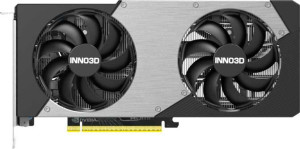
Inno3D GeForce RTX 5060 Ti Twin X2 16GB
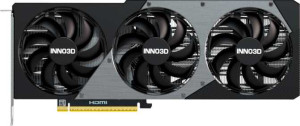
Inno3D GeForce RTX 5070 Ti X3

Inno3D GeForce RTX 5060 Ti Twin X2 16GB Inno3D GeForce RTX 5070 Ti X3

Overview

Choosing between the Inno3D GeForce RTX 5060 Ti Twin X2 16GB and the Inno3D GeForce RTX 5070 Ti X3 means weighing raw computational muscle against power efficiency and physical footprint. Both cards are built on the same Blackwell architecture, share 16GB of GDDR7 memory, and offer an identical feature set including DLSS and ray tracing — yet their performance ceilings and power demands diverge sharply. Read on to explore how every specification stacks up between these two Inno3D Blackwell-generation contenders.

Common Features

  • GPU memory speed is 1750 MHz on both Inno3D GeForce RTX 5060 Ti Twin X2 16GB and Inno3D GeForce RTX 5070 Ti X3.
  • Double Precision Floating Point (DPFP) is supported on both products.
  • Effective memory speed is 28000 MHz on both products.
  • Both products have 16GB of VRAM.
  • Both products use GDDR7 memory.
  • ECC memory is supported on both products.
  • Both products support DirectX 12 Ultimate.
  • OpenGL version 4.6 is available on both products.
  • OpenCL version 3 is supported on both products.
  • Multi-display technology is supported on both products.
  • Ray tracing is supported on both products.
  • 3D support is available on both products.
  • DLSS is supported on both products.
  • XeSS (XMX) is not available on either product.
  • Both products have an HDMI output.
  • Both products have 1 HDMI port.
  • Both products use HDMI version 2.1b.
  • Both products have 3 DisplayPort outputs.
  • Neither product has USB-C ports, DVI outputs, or mini DisplayPort outputs.
  • Both products are built on the Blackwell GPU architecture.
  • Both products use PCIe version 5.
  • Both products are manufactured on a 5 nm semiconductor process.
  • Air-water cooling is not available on either product.
  • Both products have a height of 116 mm.

Main Differences

  • GPU clock speed is 2407 MHz on Inno3D GeForce RTX 5060 Ti Twin X2 16GB and 2295 MHz on Inno3D GeForce RTX 5070 Ti X3.
  • GPU turbo clock is 2572 MHz on Inno3D GeForce RTX 5060 Ti Twin X2 16GB and 2452 MHz on Inno3D GeForce RTX 5070 Ti X3.
  • Pixel rate is 123.5 GPixel/s on Inno3D GeForce RTX 5060 Ti Twin X2 16GB and 235.4 GPixel/s on Inno3D GeForce RTX 5070 Ti X3.
  • Floating-point performance is 23.7 TFLOPS on Inno3D GeForce RTX 5060 Ti Twin X2 16GB and 43.94 TFLOPS on Inno3D GeForce RTX 5070 Ti X3.
  • Texture rate is 370.4 GTexels/s on Inno3D GeForce RTX 5060 Ti Twin X2 16GB and 686.6 GTexels/s on Inno3D GeForce RTX 5070 Ti X3.
  • Shading units number 4608 on Inno3D GeForce RTX 5060 Ti Twin X2 16GB and 8960 on Inno3D GeForce RTX 5070 Ti X3.
  • Texture mapping units (TMUs) total 144 on Inno3D GeForce RTX 5060 Ti Twin X2 16GB and 280 on Inno3D GeForce RTX 5070 Ti X3.
  • Render output units (ROPs) total 48 on Inno3D GeForce RTX 5060 Ti Twin X2 16GB and 96 on Inno3D GeForce RTX 5070 Ti X3.
  • Maximum memory bandwidth is 448 GB/s on Inno3D GeForce RTX 5060 Ti Twin X2 16GB and 896 GB/s on Inno3D GeForce RTX 5070 Ti X3.
  • Memory bus width is 128-bit on Inno3D GeForce RTX 5060 Ti Twin X2 16GB and 256-bit on Inno3D GeForce RTX 5070 Ti X3.
  • Thermal Design Power (TDP) is 180W on Inno3D GeForce RTX 5060 Ti Twin X2 16GB and 300W on Inno3D GeForce RTX 5070 Ti X3.
  • Number of transistors is 21900 million on Inno3D GeForce RTX 5060 Ti Twin X2 16GB and 45600 million on Inno3D GeForce RTX 5070 Ti X3.
  • Width is 250 mm on Inno3D GeForce RTX 5060 Ti Twin X2 16GB and 300 mm on Inno3D GeForce RTX 5070 Ti X3.
Specs Comparison
Inno3D GeForce RTX 5060 Ti Twin X2 16GB

Inno3D GeForce RTX 5060 Ti Twin X2 16GB

Inno3D GeForce RTX 5070 Ti X3

Inno3D GeForce RTX 5070 Ti X3

Performance:
GPU clock speed 2407 MHz 2295 MHz
GPU turbo 2572 MHz 2452 MHz
pixel rate 123.5 GPixel/s 235.4 GPixel/s
floating-point performance 23.7 TFLOPS 43.94 TFLOPS
texture rate 370.4 GTexels/s 686.6 GTexels/s
GPU memory speed 1750 MHz 1750 MHz
shading units 4608 8960
texture mapping units (TMUs) 144 280
render output units (ROPs) 48 96
Has Double Precision Floating Point (DPFP)

The most telling difference between these two cards lies in their raw computational muscle. The RTX 5070 Ti X3 nearly doubles the RTX 5060 Ti Twin X2 in almost every throughput metric: 43.94 TFLOPS of floating-point performance versus 23.7 TFLOPS, 8960 shading units versus 4608, and 280 TMUs versus 144. In practice, this means the 5070 Ti can process geometry, lighting, and shader workloads at roughly twice the theoretical rate — a gap that translates directly into higher sustained frame rates at demanding resolutions and quality settings.

Interestingly, the 5060 Ti holds a slight edge in raw clock speed, running a base of 2407 MHz and boosting to 2572 MHz, compared to the 5070 Ti's 2295 / 2452 MHz. However, clock speed alone is a poor proxy for real-world throughput when one card has so many more execution units. The 5070 Ti's massive advantage in ROPs (96 vs. 48) is equally significant — more render output units means faster pixel write-back, which directly benefits high-resolution rendering and anti-aliasing workloads. Both cards match on GPU memory speed at 1750 MHz and both support Double Precision Floating Point, making them equally capable for compute tasks that require DPFP.

The RTX 5070 Ti X3 holds a commanding and unambiguous performance advantage in this group. Its superior shading units, TMUs, ROPs, pixel rate (235.4 vs. 123.5 GPixel/s), and texture rate (686.6 vs. 370.4 GTexels/s) all point to a card designed for a fundamentally higher performance tier. The 5060 Ti's marginally higher clocks are a minor footnote against that scale of architectural difference.
Memory:
effective memory speed 28000 MHz 28000 MHz
maximum memory bandwidth 448 GB/s 896 GB/s
VRAM 16GB 16GB
GDDR version GDDR7 GDDR7
memory bus width 128-bit 256-bit
Supports ECC memory

On the surface, these two cards look remarkably similar in memory configuration: both carry 16GB of GDDR7 at the same 28000 MHz effective speed, and both support ECC memory for error-corrected compute workloads. For most users, identical VRAM capacity means neither card has an inherent advantage when it comes to fitting textures, frame buffers, or AI models into memory.

Where they diverge sharply is the memory bus width128-bit on the 5060 Ti versus 256-bit on the 5070 Ti — and this single architectural difference has outsized consequences. Because bandwidth scales directly with bus width at the same memory speed, the 5070 Ti achieves 896 GB/s of memory bandwidth compared to just 448 GB/s on the 5060 Ti. That 2× bandwidth advantage means the 5070 Ti can feed its larger shader array without memory becoming a bottleneck, which is especially impactful at high resolutions, with large textures, or in bandwidth-hungry workloads like raytracing and AI inference.

The RTX 5070 Ti X3 takes a clear edge in this group. While the equal VRAM capacity keeps both cards on par for memory-limited scenarios like large model loading, the 5070 Ti's doubled memory bandwidth ensures its GPU cores are far less likely to stall waiting for data — a meaningful real-world advantage that compounds on top of its already superior compute throughput.

Features:
DirectX version DirectX 12 Ultimate DirectX 12 Ultimate
OpenGL version 4.6 4.6
OpenCL version 3 3
Supports multi-display technology
supports ray tracing
Supports 3D
supports DLSS
has XeSS (XMX)
AMD SAM / Intel Resizable BAR Intel Resizable BAR Intel Resizable BAR
has LHR
has RGB lighting
supported displays 4 4

When it comes to features, these two cards are in complete lockstep. Both support DirectX 12 Ultimate, which is the current standard for modern gaming and unlocks hardware-accelerated ray tracing, variable rate shading, and mesh shaders. Alongside OpenGL 4.6 and OpenCL 3, neither card leaves anything on the table for compatibility with professional, creative, or legacy workloads.

Both GPUs also share DLSS support, ray tracing acceleration, and Intel Resizable BAR — the latter allowing the CPU to access the full GPU frame buffer at once, which can yield meaningful frame rate improvements in supported titles. Multi-monitor users are equally served, with both cards capped at 4 simultaneous displays. Neither card includes RGB lighting or an LHR (Lite Hash Rate) limiter, so there are no surprises on either front.

This group is a straightforward tie. Every feature present on one card is identically present on the other, with no exceptions. A buyer choosing between these two purely on feature set has no reason to favor either — the decision ultimately rests on the performance and memory differences covered in the other specification groups.

Ports:
has an HDMI output
HDMI ports 1 1
HDMI version HDMI 2.1b HDMI 2.1b
DisplayPort outputs 3 3
USB-C ports 0 0
DVI outputs 0 0
mini DisplayPort outputs 0 0

Port selection is identical across both cards. Each offers 1 HDMI 2.1b output and 3 DisplayPort outputs, totaling four display connections — consistent with the maximum of four supported displays noted in the Features group. HDMI 2.1b is the latest HDMI revision, supporting up to 4K at high refresh rates and 8K output, so neither card is behind the curve for modern monitor and TV connectivity.

The absence of USB-C on both cards is worth noting for users who own USB-C or Thunderbolt-based displays, as they would need an active adapter. However, since this applies equally to both products, it is not a differentiator — simply a shared limitation to be aware of before purchase.

This group is another clear tie. Connector layout, port counts, and HDMI versioning are completely mirrored between the two cards. Connectivity preferences will play no role in choosing between the 5060 Ti Twin X2 and the 5070 Ti X3.

General info:
GPU architecture Blackwell Blackwell
release date April 2025 February 2025
Thermal Design Power (TDP) 180W 300W
PCI Express (PCIe) version 5 5
semiconductor size 5 nm 5 nm
number of transistors 21900 million 45600 million
Has air-water cooling
width 250 mm 300 mm
height 116 mm 116 mm

Both cards are built on the same Blackwell architecture using a 5 nm process node and connect via PCIe 5.0, placing them on identical generational footing. The foundational similarity ends there, however. The 5070 Ti houses 45,600 million transistors compared to the 5060 Ti's 21,900 million — more than double — which directly explains the performance and memory bandwidth gaps seen in earlier groups. More transistors mean a physically larger, more complex die capable of packing in those extra shader units, ROPs, and the wider memory bus.

That larger die comes with a significantly higher power demand. The 5070 Ti carries a 300W TDP versus the 5060 Ti's 180W, a 120W difference that has real practical implications. Users considering the 5070 Ti will need a power supply with meaningful headroom above that figure, and case airflow becomes more important to manage thermals. The 5060 Ti's lower TDP makes it a notably more power-efficient option relative to its output, and a friendlier fit for smaller or less ventilated builds.

Physically, both cards share the same 116 mm height, but the 5070 Ti is 50 mm longer at 300 mm versus 250 mm — a consideration for compact cases with tight GPU clearance. Neither card offers liquid cooling. For buyers with constrained power budgets or smaller enclosures, the 5060 Ti Twin X2 holds a practical advantage in this group; for those with full-size builds and capable PSUs, the 5070 Ti's higher TDP is simply the cost of entry for its substantially larger silicon.

Comparison Summary & Verdict

Having examined every specification, both GPUs share a compelling common foundation: the Blackwell architecture, 16GB of GDDR7 memory, identical port layouts, and full support for ray tracing and DLSS. However, the gap between them is significant. The Inno3D GeForce RTX 5070 Ti X3 delivers 43.94 TFLOPS of floating-point performance, 8960 shading units, and 896 GB/s of memory bandwidth — nearly double the figures of its sibling — making it the obvious pick for high-resolution gaming and compute-heavy workloads. The Inno3D GeForce RTX 5060 Ti Twin X2 16GB, on the other hand, offers a notably lower 180W TDP, a more compact 250mm width, and higher base and turbo clock speeds, positioning it as a smart, efficient choice for builders who prioritize a smaller footprint and lower power draw without sacrificing the Blackwell feature set.

Inno3D GeForce RTX 5060 Ti Twin X2 16GB
Buy Inno3D GeForce RTX 5060 Ti Twin X2 16GB if...

Buy the Inno3D GeForce RTX 5060 Ti Twin X2 16GB if you want a power-efficient Blackwell GPU with a compact 250mm form factor, higher clock speeds, and a 180W power envelope that suits smaller or energy-conscious builds.

Inno3D GeForce RTX 5070 Ti X3
Buy Inno3D GeForce RTX 5070 Ti X3 if...

Buy the Inno3D GeForce RTX 5070 Ti X3 if you demand maximum graphics performance, with 8960 shading units, 896 GB/s of memory bandwidth, and 43.94 TFLOPS of floating-point power for the most demanding games and workloads.