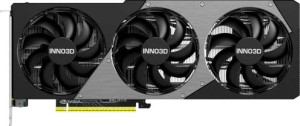
Inno3D GeForce RTX 5060 Ti X3 OC 16GB
Nvidia GeForce RTX 5060 Ti 16GB

Inno3D GeForce RTX 5060 Ti X3 OC 16GB Nvidia GeForce RTX 5060 Ti 16GB

Overview

Welcome to our detailed spec comparison between the Inno3D GeForce RTX 5060 Ti X3 OC 16GB and the Nvidia GeForce RTX 5060 Ti 16GB. Both cards are built on the Blackwell architecture and share an identical memory configuration, yet they differ in areas such as GPU turbo clock speeds, raw compute throughput, and physical dimensions. Read on to see how these two GPUs stack up across performance, features, and connectivity.

Common Features

  • Both cards share a GPU memory speed of 1750 MHz.
  • Both cards feature 4608 shading units.
  • Both cards have 144 texture mapping units (TMUs).
  • Both cards have 48 render output units (ROPs).
  • Double Precision Floating Point (DPFP) is supported on both cards.
  • Both cards have an effective memory speed of 28000 MHz.
  • Both cards offer a maximum memory bandwidth of 448 GB/s.
  • Both cards come with 16GB of VRAM.
  • Both cards use GDDR7 memory.
  • Both cards have a 128-bit memory bus width.
  • ECC memory is supported on both cards.
  • Both cards support DirectX 12 Ultimate.
  • Both cards support OpenGL version 4.6.
  • Both cards support OpenCL version 3.
  • Multi-display technology is supported on both cards.
  • Ray tracing is supported on both cards.
  • 3D is supported on both cards.
  • DLSS is supported on both cards.
  • XeSS (XMX) is not available on either card.
  • Both cards feature one HDMI 2.1b output and three DisplayPort outputs, with no USB-C or DVI outputs.
  • Both cards are based on the Blackwell GPU architecture.
  • Both cards have a Thermal Design Power (TDP) of 180W.
  • Both cards use PCIe version 5.
  • Both cards are manufactured on a 5 nm process with 21,900 million transistors.
  • Air-water cooling is not available on either card.

Main Differences

  • GPU clock speed is 2407 MHz on Inno3D GeForce RTX 5060 Ti X3 OC 16GB and 2410 MHz on Nvidia GeForce RTX 5060 Ti 16GB.
  • GPU turbo speed is 2602 MHz on Inno3D GeForce RTX 5060 Ti X3 OC 16GB and 2570 MHz on Nvidia GeForce RTX 5060 Ti 16GB.
  • Pixel rate is 124.9 GPixel/s on Inno3D GeForce RTX 5060 Ti X3 OC 16GB and 123.4 GPixel/s on Nvidia GeForce RTX 5060 Ti 16GB.
  • Floating-point performance is 23.98 TFLOPS on Inno3D GeForce RTX 5060 Ti X3 OC 16GB and 23.69 TFLOPS on Nvidia GeForce RTX 5060 Ti 16GB.
  • Texture rate is 374.7 GTexels/s on Inno3D GeForce RTX 5060 Ti X3 OC 16GB and 370.1 GTexels/s on Nvidia GeForce RTX 5060 Ti 16GB.
  • Width is 300 mm on Inno3D GeForce RTX 5060 Ti X3 OC 16GB and 241 mm on Nvidia GeForce RTX 5060 Ti 16GB.
  • Height is 116 mm on Inno3D GeForce RTX 5060 Ti X3 OC 16GB and 111 mm on Nvidia GeForce RTX 5060 Ti 16GB.
Specs Comparison
Inno3D GeForce RTX 5060 Ti X3 OC 16GB

Inno3D GeForce RTX 5060 Ti X3 OC 16GB

Nvidia GeForce RTX 5060 Ti 16GB

Nvidia GeForce RTX 5060 Ti 16GB

Performance:
GPU clock speed 2407 MHz 2410 MHz
GPU turbo 2602 MHz 2570 MHz
pixel rate 124.9 GPixel/s 123.4 GPixel/s
floating-point performance 23.98 TFLOPS 23.69 TFLOPS
texture rate 374.7 GTexels/s 370.1 GTexels/s
GPU memory speed 1750 MHz 1750 MHz
shading units 4608 4608
texture mapping units (TMUs) 144 144
render output units (ROPs) 48 48
Has Double Precision Floating Point (DPFP)

At the core of this Performance comparison, both cards share identical architectural building blocks: 4608 shading units, 144 TMUs, 48 ROPs, and the same 1750 MHz memory speed. This means any real-world performance delta between them is determined almost entirely by clock speeds rather than silicon differences — they are, in essence, the same GPU running at slightly different frequencies.

The decisive differentiator is the GPU turbo (boost) clock: the Inno3D X3 OC reaches 2602 MHz versus the reference Nvidia card's 2570 MHz — a 32 MHz advantage. While modest in isolation, this factory overclock is exactly what drives the Inno3D's marginally higher 23.98 TFLOPS of floating-point throughput versus 23.69 TFLOPS, and its slightly superior texture and pixel fill rates. In sustained workloads like raytracing, rasterization, or compute tasks, a consistently higher boost clock translates to a small but real uplift in frame rates and processing throughput.

The Inno3D GeForce RTX 5060 Ti X3 OC holds a clear, if narrow, performance edge in this group. It is the faster card by spec, thanks purely to its higher boost clock — the product of Inno3D's factory OC tuning. That said, the gap is small enough that users prioritizing cost or acoustics over peak throughput may find the reference Nvidia RTX 5060 Ti effectively equivalent in practice.

Memory:
effective memory speed 28000 MHz 28000 MHz
maximum memory bandwidth 448 GB/s 448 GB/s
VRAM 16GB 16GB
GDDR version GDDR7 GDDR7
memory bus width 128-bit 128-bit
Supports ECC memory

Memory is one area where these two cards are in complete lockstep. Both feature 16GB of GDDR7 VRAM running at an effective 28000 MHz across a 128-bit bus, delivering an identical 448 GB/s of memory bandwidth. There is simply no differentiator to find here — every meaningful memory specification is shared.

What is worth contextualizing, however, is what these shared specs mean for buyers. GDDR7 is a significant generational step, and 448 GB/s through a 128-bit bus is a notably strong result for that bus width — achieved precisely because GDDR7 extracts far more bandwidth per pin than GDDR6X. This means both cards punch above their bus-width class, keeping texture streaming and frame buffer throughput competitive with wider-bus alternatives. The 16GB VRAM allocation is also a meaningful real-world asset, providing headroom for high-resolution textures, large AI model inference, and future game assets that are already pushing beyond the 12GB ceiling common in this segment.

This group is an unambiguous tie. Neither the Inno3D X3 OC nor the reference Nvidia RTX 5060 Ti holds any memory advantage whatsoever — buyers can treat this dimension as identical and focus their decision elsewhere.

Features:
DirectX version DirectX 12 Ultimate DirectX 12 Ultimate
OpenGL version 4.6 4.6
OpenCL version 3 3
Supports multi-display technology
supports ray tracing
Supports 3D
supports DLSS
has XeSS (XMX)
AMD SAM / Intel Resizable BAR Intel Resizable BAR Intel Resizable BAR
has LHR
has RGB lighting
supported displays 4 4

Feature parity is total in this group — every single capability listed is shared identically between the Inno3D X3 OC and the reference Nvidia RTX 5060 Ti. Both support DirectX 12 Ultimate, which unlocks the full suite of modern rendering features including hardware ray tracing, variable rate shading, and mesh shaders. Both also carry DLSS support, Nvidia's AI-driven upscaling technology that remains one of the most impactful real-world performance multipliers available — allowing games to render at lower resolutions and reconstruct a higher-quality image with minimal visual compromise.

Ray tracing support on both cards means neither buyer is locked out of current-generation lighting and shadow rendering pipelines. The shared 4-display output ceiling is also worth noting for multi-monitor users, covering even demanding productivity or sim-racing setups. Intel Resizable BAR support on both cards allows the CPU to access the full VRAM pool simultaneously, which can yield measurable frame rate improvements in titles optimized for it.

This is another clear tie. From a features standpoint, choosing one card over the other confers no software or capability advantage — both deliver the same toolset to the end user.

Ports:
has an HDMI output
HDMI ports 1 1
HDMI version HDMI 2.1b HDMI 2.1b
DisplayPort outputs 3 3
USB-C ports 0 0
DVI outputs 0 0
mini DisplayPort outputs 0 0

Both cards present an identical port configuration: one HDMI 2.1b output and three DisplayPort outputs, totaling four display connections — matching the supported display count noted in the Features group. The absence of USB-C, DVI, and mini DisplayPort outputs is consistent across both, so neither card introduces any connectivity surprises.

The HDMI 2.1b standard is the headline here from a practical standpoint. It supports up to 10K resolution, high frame rate 4K output, and Variable Refresh Rate passthrough to compatible TVs — making it well-suited for living room gaming setups alongside a dedicated monitor chain. Three full-size DisplayPort outputs give multi-monitor users flexible, high-bandwidth connection options without the need for adapters.

Predictably, this group is a tie. The Inno3D X3 OC and the reference Nvidia RTX 5060 Ti offer precisely the same physical connectivity — buyers with specific port requirements will find no reason to prefer one over the other on this basis alone.

General info:
GPU architecture Blackwell Blackwell
release date April 2025 April 2025
Thermal Design Power (TDP) 180W 180W
PCI Express (PCIe) version 5 5
semiconductor size 5 nm 5 nm
number of transistors 21900 million 21900 million
Has air-water cooling
width 300 mm 241 mm
height 116 mm 111 mm

Underneath, these two cards are built from the same foundation: identical Blackwell architecture, the same 5nm process node, an identical transistor count of 21.9 billion, and a shared 180W TDP. PCIe 5.0 support on both ensures neither card will face any interface bottleneck on current or near-future platforms. From a silicon and power perspective, there is nothing to separate them.

Where they diverge is physical footprint. The Inno3D X3 OC measures 300mm in length compared to the reference Nvidia card's 241mm — a 59mm difference that is far from trivial. That extra length accommodates the X3 OC's triple-fan cooler, which is what enables its factory overclock by providing greater thermal headroom at the same 180W power envelope. The height difference is minor at 5mm, but the length gap means the Inno3D card requires a case that can comfortably accommodate a 300mm GPU — a real consideration for compact or mid-tower builds with drive cage obstructions.

The Nvidia RTX 5060 Ti reference card holds a meaningful advantage for space-constrained builds, fitting into systems where the Inno3D X3 OC simply will not. Buyers with full-size cases have no physical reason to favor one over the other here, but anyone building in a smaller chassis should verify clearance carefully before choosing the longer Inno3D board.

Comparison Summary & Verdict

After examining all available specifications, the Inno3D GeForce RTX 5060 Ti X3 OC 16GB and the Nvidia GeForce RTX 5060 Ti 16GB are remarkably close siblings. Both offer identical 16GB GDDR7 memory with 448 GB/s bandwidth, the same 180W TDP, and full feature parity including ray tracing and DLSS support. The key differentiator is the Inno3D card's higher GPU turbo clock of 2602 MHz versus 2570 MHz on the reference model, translating into a slightly higher floating-point performance of 23.98 TFLOPS against 23.69 TFLOPS. However, this performance edge comes with a larger physical footprint at 300 mm wide and 116 mm tall, compared to 241 mm and 111 mm on the reference card. Users who want every last frame should lean toward the Inno3D, while those working in compact builds will appreciate the more modest dimensions of the reference Nvidia card.

Inno3D GeForce RTX 5060 Ti X3 OC 16GB
Buy Inno3D GeForce RTX 5060 Ti X3 OC 16GB if...

Buy the Inno3D GeForce RTX 5060 Ti X3 OC 16GB if you want the highest possible boost clock and marginally better compute throughput, and your case has enough room to accommodate its larger dimensions.

Nvidia GeForce RTX 5060 Ti 16GB
Buy Nvidia GeForce RTX 5060 Ti 16GB if...

Buy the Nvidia GeForce RTX 5060 Ti 16GB if you are building in a compact case and need a shorter, slimmer card, while still getting the same memory configuration and feature set.