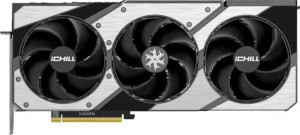
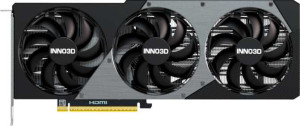
Inno3D GeForce RTX 5070 Ti iChill X3
Inno3D GeForce RTX 5070 Ti X3 OC

Inno3D GeForce RTX 5070 Ti iChill X3 Inno3D GeForce RTX 5070 Ti X3 OC

Overview

When two cards share the same GPU family, the differences in the details become decisive. This page compares the Inno3D GeForce RTX 5070 Ti iChill X3 and the Inno3D GeForce RTX 5070 Ti X3 OC, examining their respective boost clock speeds, physical dimensions, and feature sets to help you identify which variant best suits your build and preferences.

Common Features

  • Both products share a base GPU clock speed of 2295 MHz.
  • Both products have a GPU memory speed of 1750 MHz.
  • Both products feature 8960 shading units.
  • Both products include 280 texture mapping units (TMUs).
  • Both products have 96 render output units (ROPs).
  • Double Precision Floating Point (DPFP) is supported on both products.
  • Both products have an effective memory speed of 28000 MHz.
  • Both products offer a maximum memory bandwidth of 896 GB/s.
  • Both products come with 16GB of VRAM.
  • Both products use GDDR7 memory.
  • Both products feature a 256-bit memory bus width.
  • ECC memory is supported on both products.
  • Both products support DirectX 12 Ultimate.
  • Both products support OpenGL version 4.6.
  • Both products support OpenCL version 3.
  • Multi-display technology is supported on both products.
  • Ray tracing is supported on both products.
  • 3D support is available on both products.
  • DLSS is supported on both products.
  • XeSS (XMX) is not available on either product.
  • Both products include one HDMI output with HDMI 2.1b.
  • Both products feature three DisplayPort outputs.
  • Neither product includes USB-C, DVI, or mini DisplayPort outputs.
  • Both products are based on the Blackwell GPU architecture.
  • Both products have a Thermal Design Power (TDP) of 300W.
  • Both products use PCIe version 5.
  • Both products are manufactured on a 5 nm semiconductor process.
  • Both products contain 45600 million transistors.
  • Neither product features air-water cooling.

Main Differences

  • GPU turbo clock speed is 2512 MHz on the Inno3D GeForce RTX 5070 Ti iChill X3 and 2482 MHz on the Inno3D GeForce RTX 5070 Ti X3 OC.
  • Pixel rate is 241.2 GPixel/s on the Inno3D GeForce RTX 5070 Ti iChill X3 and 238.3 GPixel/s on the Inno3D GeForce RTX 5070 Ti X3 OC.
  • Floating-point performance is 45.02 TFLOPS on the Inno3D GeForce RTX 5070 Ti iChill X3 and 44.48 TFLOPS on the Inno3D GeForce RTX 5070 Ti X3 OC.
  • Texture rate is 703.4 GTexels/s on the Inno3D GeForce RTX 5070 Ti iChill X3 and 695 GTexels/s on the Inno3D GeForce RTX 5070 Ti X3 OC.
  • RGB lighting is present on the Inno3D GeForce RTX 5070 Ti iChill X3 but not available on the Inno3D GeForce RTX 5070 Ti X3 OC.
  • Card width is 334 mm on the Inno3D GeForce RTX 5070 Ti iChill X3 and 300 mm on the Inno3D GeForce RTX 5070 Ti X3 OC.
  • Card height is 148 mm on the Inno3D GeForce RTX 5070 Ti iChill X3 and 116 mm on the Inno3D GeForce RTX 5070 Ti X3 OC.
Specs Comparison
Inno3D GeForce RTX 5070 Ti iChill X3

Inno3D GeForce RTX 5070 Ti iChill X3

Inno3D GeForce RTX 5070 Ti X3 OC

Inno3D GeForce RTX 5070 Ti X3 OC

Performance:
GPU clock speed 2295 MHz 2295 MHz
GPU turbo 2512 MHz 2482 MHz
pixel rate 241.2 GPixel/s 238.3 GPixel/s
floating-point performance 45.02 TFLOPS 44.48 TFLOPS
texture rate 703.4 GTexels/s 695 GTexels/s
GPU memory speed 1750 MHz 1750 MHz
shading units 8960 8960
texture mapping units (TMUs) 280 280
render output units (ROPs) 96 96
Has Double Precision Floating Point (DPFP)

Both cards share an identical foundation: the same 2295 MHz base clock, 8960 shading units, 280 TMUs, 96 ROPs, and 1750 MHz memory speed. This means their out-of-the-box, non-boosted behavior is effectively equivalent, and both support Double Precision Floating Point — relevant for compute workloads beyond gaming.

The real differentiator lies in the boost clock. The iChill X3 reaches a 2512 MHz GPU turbo versus 2482 MHz on the X3 OC — a 30 MHz advantage. While 30 MHz sounds modest, it cascades into measurable gaps across derived metrics: the iChill X3 leads in floating-point throughput (45.02 TFLOPS vs 44.48 TFLOPS), texture rate (703.4 vs 695 GTexels/s), and pixel rate (241.2 vs 238.3 GPixel/s). In sustained rendering workloads, a higher sustained boost means more consistent frame pacing and a slight edge in compute-heavy scenes.

In practice, the performance gap between these two cards is narrow — roughly 1.2% across all throughput metrics — and unlikely to be perceptible in most gaming scenarios. However, on a spec-for-spec basis, the iChill X3 holds a clear, if slim, performance edge over the X3 OC, driven entirely by its higher boost clock ceiling. Users prioritizing peak theoretical throughput should lean toward the iChill X3.

Memory:
effective memory speed 28000 MHz 28000 MHz
maximum memory bandwidth 896 GB/s 896 GB/s
VRAM 16GB 16GB
GDDR version GDDR7 GDDR7
memory bus width 256-bit 256-bit
Supports ECC memory

Across every memory specification, the iChill X3 and X3 OC are completely identical. Both cards carry 16GB of GDDR7 VRAM across a 256-bit bus, running at an effective speed of 28000 MHz and delivering 896 GB/s of peak memory bandwidth. There is simply no distinction to draw here — the memory subsystem is shared hardware.

That said, these shared specs are worth contextualizing. GDDR7 at 896 GB/s represents a substantial generational leap over GDDR6X, making both cards well-equipped for high-resolution textures, large AI model inference, and bandwidth-hungry workloads like ray tracing at 4K. The 16GB VRAM pool is comfortably future-proof for current gaming and handles most professional creative tasks without paging. ECC memory support on both cards is a bonus for compute users where data integrity matters.

This group is a definitive tie. Memory configuration offers zero basis for choosing one card over the other — any purchase decision should rest entirely on the performance and cooling differences identified in other spec groups.

Features:
DirectX version DirectX 12 Ultimate DirectX 12 Ultimate
OpenGL version 4.6 4.6
OpenCL version 3 3
Supports multi-display technology
supports ray tracing
Supports 3D
supports DLSS
has XeSS (XMX)
AMD SAM / Intel Resizable BAR Intel Resizable BAR Intel Resizable BAR
has LHR
has RGB lighting
supported displays 4 4

From a software and API standpoint, these two cards are indistinguishable. Both support DirectX 12 Ultimate, ray tracing, and DLSS — the trifecta that defines a modern high-end GeForce experience. Up to four simultaneous displays are supported on each, and Intel Resizable BAR is present on both, enabling the CPU to access the full VRAM pool at once for measurable frame rate gains in compatible titles.

The sole differentiator in this group is aesthetic: the iChill X3 includes RGB lighting, while the X3 OC does not. For builders investing in a windowed case with a themed build, this is a genuine distinguishing factor — RGB on a card of this size can anchor an entire lighting scheme. For those who prefer a cleaner, understated look or are building in a closed case, its absence on the X3 OC is irrelevant.

On purely functional features, this group is a tie. The iChill X3 gains a cosmetic edge via RGB lighting, but whether that constitutes an advantage depends entirely on the buyer's aesthetic priorities rather than any performance or compatibility consideration.

Ports:
has an HDMI output
HDMI ports 1 1
HDMI version HDMI 2.1b HDMI 2.1b
DisplayPort outputs 3 3
USB-C ports 0 0
DVI outputs 0 0
mini DisplayPort outputs 0 0

Port selection is identical on both cards: one HDMI 2.1b output and three DisplayPorts, totaling four display outputs — consistent with the maximum supported displays noted in the Features group. HDMI 2.1b is the latest revision of the standard, capable of driving 4K at high refresh rates or 8K displays, making both cards ready for current and near-future monitor hardware without any adapters.

The three DisplayPort outputs comfortably serve multi-monitor workstation setups or high-refresh gaming arrays. Notably, neither card offers a USB-C output, which rules out direct connection to USB-C monitors or VR headsets that rely on that interface — but this is a shared limitation, not a differentiator between the two.

This group is a complete tie. Connectivity is carbon-copy identical, and neither card offers any advantage in display output versatility or port variety.

General info:
GPU architecture Blackwell Blackwell
release date February 2025 February 2025
Thermal Design Power (TDP) 300W 300W
PCI Express (PCIe) version 5 5
semiconductor size 5 nm 5 nm
number of transistors 45600 million 45600 million
Has air-water cooling
width 334 mm 300 mm
height 148 mm 116 mm

At the silicon level, these two cards are built from the same cloth — identical Blackwell architecture, a 5nm process node, 45.6 billion transistors, and a 300W TDP delivered over a PCIe 5.0 interface. The shared TDP confirms that neither card is factory-tuned to draw more power than the other despite the iChill X3's boost clock advantage, meaning the difference in performance comes from how each cooler manages the same thermal envelope rather than from any power limit increase.

Where this group diverges meaningfully is physical footprint. The iChill X3 measures 334 × 148 mm, while the X3 OC is notably more compact at 300 × 116 mm — a difference of 34mm in length and 32mm in height. That is a substantial gap. In a mid-tower or small form factor case with tight GPU clearance, the X3 OC's smaller body could be the deciding factor for fitment. Conversely, the iChill X3's larger cooler likely contributes to its ability to sustain a higher boost clock, as more heatsink surface area generally enables better thermal headroom under sustained load.

This group surfaces a genuine trade-off rather than a simple winner. The X3 OC holds a clear edge in case compatibility thanks to its significantly smaller dimensions, while the iChill X3's larger build may be the physical reason it sustains a higher boost clock. Buyers in spacious cases should weigh this against the performance data; those with constrained builds should strongly favor the X3 OC.

Comparison Summary & Verdict

The Inno3D GeForce RTX 5070 Ti iChill X3 and the Inno3D GeForce RTX 5070 Ti X3 OC are built on the same Blackwell architecture and share identical memory configurations, TDP, and feature support, making them closely matched at their core. The meaningful distinctions come down to boost clock performance and physical size. The iChill X3 pulls ahead with a higher turbo clock of 2512 MHz, translating into a slightly better pixel rate, texture rate, and floating-point performance, and it also adds RGB lighting for aesthetics-conscious builders. In exchange, it occupies a noticeably larger footprint at 334 x 148 mm compared to the X3 OC’s more compact 300 x 116 mm body. The X3 OC is the smarter pick for smaller cases or minimalist setups, while the iChill X3 is the better choice for enthusiasts seeking every last MHz and a visually striking card.

Inno3D GeForce RTX 5070 Ti iChill X3
Buy Inno3D GeForce RTX 5070 Ti iChill X3 if...

Buy the Inno3D GeForce RTX 5070 Ti iChill X3 if you want the highest boost clock and floating-point performance of the two, and want RGB lighting as part of your build aesthetics.

Inno3D GeForce RTX 5070 Ti X3 OC
Buy Inno3D GeForce RTX 5070 Ti X3 OC if...

Choose the Inno3D GeForce RTX 5070 Ti X3 OC if you need a more compact card that fits tighter cases and have no requirement for RGB lighting.