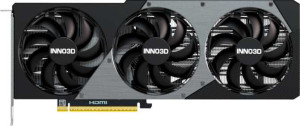
Both the Inno3D X3 OC and the Zotac Solid share an identical foundation: the same 2295 MHz base clock, 8960 shading units, 280 TMUs, 96 ROPs, and 1750 MHz memory speed. This means the two cards are built on exactly the same silicon configuration, and any real-world performance delta will come down to how aggressively each manufacturer has tuned the boost behavior.
The only meaningful differentiator in this group is the GPU turbo clock: the Inno3D X3 OC boosts to 2482 MHz versus the Zotac Solid's 2452 MHz — a gap of 30 MHz, or roughly 1.2%. That modest edge cascades into every throughput metric: the Inno3D pulls ahead with 44.48 TFLOPS of floating-point performance versus 43.94 TFLOPS, a 695 GTexels/s texture fill rate against 686.6 GTexels/s, and a pixel rate of 238.3 GPixel/s compared to 235.4 GPixel/s. These are not coincidences — they are direct, proportional consequences of the turbo clock difference.
In practice, a ~1.2% clock advantage will not produce a perceptible frame-rate difference in gaming or compute workloads; benchmarks would likely show results within the margin of run-to-run variance. That said, based strictly on the provided specs, the Inno3D GeForce RTX 5070 Ti X3 OC holds a clear — if numerically small — performance edge in every throughput category, making it the faster card on paper. The Zotac Solid is not slower by any meaningful real-world margin, but it does not match the Inno3D's out-of-box boost frequency.