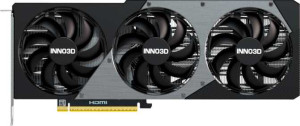
Inno3D GeForce RTX 5070 Ti X3
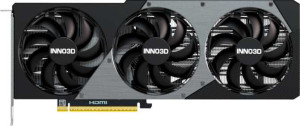
Inno3D GeForce RTX 5070 Ti X3 OC

Inno3D GeForce RTX 5070 Ti X3 Inno3D GeForce RTX 5070 Ti X3 OC

Overview

Welcome to our detailed spec comparison between the Inno3D GeForce RTX 5070 Ti X3 and the Inno3D GeForce RTX 5070 Ti X3 OC. These two Blackwell-architecture cards share the same memory configuration, feature set, and thermal profile, making this a focused battle where the key battlegrounds are GPU turbo clock speed, pixel rate, texture rate, and raw floating-point throughput. Read on to discover which variant best suits your needs.

Common Features

  • Both products share a base GPU clock speed of 2295 MHz.
  • Both products have a GPU memory speed of 1750 MHz.
  • Both products feature 8960 shading units.
  • Both products include 280 texture mapping units (TMUs).
  • Both products have 96 render output units (ROPs).
  • Double Precision Floating Point (DPFP) is supported on both products.
  • Both products have an effective memory speed of 28000 MHz.
  • Both products offer a maximum memory bandwidth of 896 GB/s.
  • Both products come with 16GB of VRAM.
  • Both products use GDDR7 memory.
  • Both products feature a 256-bit memory bus width.
  • ECC memory is supported on both products.
  • Both products support DirectX 12 Ultimate.
  • Both products support OpenGL version 4.6.
  • Both products support OpenCL version 3.
  • Multi-display technology is supported on both products.
  • Ray tracing is supported on both products.
  • 3D support is available on both products.
  • DLSS is supported on both products.
  • XeSS (XMX) is not available on either product.
  • Both products have one HDMI 2.1b output port.
  • Both products include 3 DisplayPort outputs.
  • Neither product has USB-C, DVI, or mini DisplayPort outputs.
  • Both products are built on the Blackwell GPU architecture.
  • Both products have a Thermal Design Power (TDP) of 300W.
  • Both products use PCIe version 5.
  • Both products are manufactured on a 5 nm semiconductor process.
  • Both products feature 45,600 million transistors.
  • Air-water cooling is not available on either product.
  • Both products share the same dimensions of 300 mm width and 116 mm height.

Main Differences

  • GPU turbo clock speed is 2452 MHz on Inno3D GeForce RTX 5070 Ti X3 and 2482 MHz on Inno3D GeForce RTX 5070 Ti X3 OC.
  • Pixel rate is 235.4 GPixel/s on Inno3D GeForce RTX 5070 Ti X3 and 238.3 GPixel/s on Inno3D GeForce RTX 5070 Ti X3 OC.
  • Floating-point performance is 43.94 TFLOPS on Inno3D GeForce RTX 5070 Ti X3 and 44.48 TFLOPS on Inno3D GeForce RTX 5070 Ti X3 OC.
  • Texture rate is 686.6 GTexels/s on Inno3D GeForce RTX 5070 Ti X3 and 695 GTexels/s on Inno3D GeForce RTX 5070 Ti X3 OC.
Specs Comparison
Inno3D GeForce RTX 5070 Ti X3

Inno3D GeForce RTX 5070 Ti X3

Inno3D GeForce RTX 5070 Ti X3 OC

Inno3D GeForce RTX 5070 Ti X3 OC

Performance:
GPU clock speed 2295 MHz 2295 MHz
GPU turbo 2452 MHz 2482 MHz
pixel rate 235.4 GPixel/s 238.3 GPixel/s
floating-point performance 43.94 TFLOPS 44.48 TFLOPS
texture rate 686.6 GTexels/s 695 GTexels/s
GPU memory speed 1750 MHz 1750 MHz
shading units 8960 8960
texture mapping units (TMUs) 280 280
render output units (ROPs) 96 96
Has Double Precision Floating Point (DPFP)

Both the Inno3D RTX 5070 Ti X3 and X3 OC share an identical foundation: the same 2295 MHz base clock, 8960 shading units, 280 TMUs, 96 ROPs, and 1750 MHz memory speed. This means the underlying GPU silicon and memory subsystem are equivalent, and any performance gap between the two cards will come entirely from how aggressively the factory boost clock has been tuned.

That tuning is where the X3 OC pulls ahead. Its GPU turbo of 2482 MHz versus 2452 MHz on the standard X3 — a 30 MHz uplift — translates directly into marginally higher throughput across every derived metric: floating-point performance rises from 43.94 TFLOPS to 44.48 TFLOPS, texture rate from 686.6 to 695 GTexels/s, and pixel fill rate from 235.4 to 238.3 GPixel/s. In practice, these are roughly 1.2–1.5% gains, which fall well below the threshold of perceptible frame-rate differences in real-world workloads.

The X3 OC holds a technical edge in this performance group, but the margin is slim enough that it will not be noticeable in gaming or typical GPU-compute tasks. The decision between the two should hinge primarily on price delta and cooling/noise characteristics rather than raw throughput — both cards support double-precision floating point and are otherwise performance-identical at the architectural level.

Memory:
effective memory speed 28000 MHz 28000 MHz
maximum memory bandwidth 896 GB/s 896 GB/s
VRAM 16GB 16GB
GDDR version GDDR7 GDDR7
memory bus width 256-bit 256-bit
Supports ECC memory

On the memory front, the X3 and X3 OC are completely indistinguishable. Both carry 16GB of GDDR7 across a 256-bit bus, running at an effective 28000 MHz and delivering up to 896 GB/s of bandwidth. That bandwidth figure is particularly significant — it places these cards well above GDDR6X-based predecessors and ensures the GPU's compute units are rarely starved of data, which matters most in high-resolution texturing, large AI model inference, and memory-intensive rendering workloads.

The 256-bit bus width paired with GDDR7 is a well-balanced combination at this tier: wide enough to sustain throughput for demanding workloads, while GDDR7's efficiency improvements over GDDR6X mean less heat and power draw from the memory subsystem itself. The 16GB VRAM capacity is sufficient for 4K gaming with modern texture packs and comfortably handles most professional GPU-compute tasks, including mid-scale AI inference. ECC memory support is an added bonus for users running precision-sensitive workloads, though it has no bearing on gaming performance.

This group is a complete tie. Every memory specification — capacity, speed, bandwidth, bus width, generation, and ECC support — is identical between the two cards. Memory performance will not be a differentiating factor in any use case, and buyers can disregard this spec group entirely when choosing between the X3 and X3 OC.

Features:
DirectX version DirectX 12 Ultimate DirectX 12 Ultimate
OpenGL version 4.6 4.6
OpenCL version 3 3
Supports multi-display technology
supports ray tracing
Supports 3D
supports DLSS
has XeSS (XMX)
AMD SAM / Intel Resizable BAR Intel Resizable BAR Intel Resizable BAR
has LHR
has RGB lighting
supported displays 4 4

Feature parity between the X3 and X3 OC is absolute — every capability listed is shared identically. The most consequential of these is DirectX 12 Ultimate support, which enables the full suite of modern rendering features including hardware-accelerated ray tracing and mesh shaders. Combined with DLSS support, both cards can leverage AI-driven upscaling to recover frame rates lost to ray tracing overhead, making these features practically useful rather than just checkbox items.

Intel Resizable BAR support is worth highlighting for system builders: when paired with a compatible CPU and motherboard, it allows the processor to access the full VRAM pool simultaneously rather than in small segments, which can yield measurable performance improvements in certain titles and workloads. Neither card carries an LHR limiter, which is relevant for compute users. The cap of 4 supported displays is ample for virtually all multi-monitor setups, and the absence of RGB lighting keeps the aesthetic straightforward — a non-issue for most buyers, but worth noting for those building themed systems.

This group is another complete tie. There is not a single feature that distinguishes the X3 OC from the standard X3 — the software and API capability set is carbon-copy identical. Feature set should play no role in the decision between these two cards.

Ports:
has an HDMI output
HDMI ports 1 1
HDMI version HDMI 2.1b HDMI 2.1b
DisplayPort outputs 3 3
USB-C ports 0 0
DVI outputs 0 0
mini DisplayPort outputs 0 0

The port configuration on both cards is identical: 3 DisplayPort outputs and 1 HDMI 2.1b port, totalling four display connections — which aligns neatly with the four-display limit noted in the features group. The combination is well-suited for a typical high-end setup, whether that means a single 4K or ultrawide monitor or a multi-display productivity arrangement.

HDMI 2.1b is the standout specification here. It supports up to 10K resolution and high refresh rates at 4K and beyond, making it fully capable of driving the latest gaming monitors and TVs without any bandwidth bottlenecks. For users connecting to a living-room display or a high-refresh 4K panel via HDMI, this version leaves ample headroom. The three DisplayPort outputs, meanwhile, give flexibility for daisy-chaining or connecting multiple monitors simultaneously. The absence of USB-C and DVI outputs is unlikely to matter for the target audience of these cards.

As with the previous groups, this is a complete tie — port layout, versions, and counts are perfectly mirrored across the X3 and X3 OC. Connectivity requirements will not factor into the choice between these two cards.

General info:
GPU architecture Blackwell Blackwell
release date February 2025 February 2025
Thermal Design Power (TDP) 300W 300W
PCI Express (PCIe) version 5 5
semiconductor size 5 nm 5 nm
number of transistors 45600 million 45600 million
Has air-water cooling
width 300 mm 300 mm
height 116 mm 116 mm

At their core, both cards are built on the same silicon: NVIDIA's Blackwell architecture, manufactured on a 5nm process node and packing 45,600 million transistors. These figures establish the generational context — Blackwell's 5nm fabrication enables higher transistor density and improved power efficiency compared to prior architectures, which is part of why both cards can deliver their performance levels within a 300W TDP envelope.

That 300W TDP is an important planning figure for system builders: it dictates PSU headroom requirements and case airflow needs. Both cards rely exclusively on air cooling, and their physical footprint is identical at 300mm long and 116mm tall, meaning chassis compatibility is the same for both. The shared PCIe 5.0 interface ensures neither card will be bottlenecked by the CPU-to-GPU data link on any modern platform, though both remain backward compatible with PCIe 4.0 slots at a modest bandwidth reduction.

Every general specification in this group is a mirror image across the X3 and X3 OC — architecture, process node, transistor count, power draw, cooling type, and dimensions are all identical. This group is a complete tie, and none of these factors should influence the buying decision between the two models.

Comparison Summary & Verdict

After examining every specification, it is clear that both cards are nearly identical siblings built on the same Blackwell architecture with 16GB GDDR7 memory, a 256-bit bus, 896 GB/s bandwidth, and a 300W TDP. The sole area of separation lies in the overclocked profile of the X3 OC, which edges ahead with a GPU turbo of 2482 MHz, a texture rate of 695 GTexels/s, and 44.48 TFLOPS of floating-point performance versus the standard model's 2452 MHz turbo and 43.94 TFLOPS. The gains are real but modest. Buyers who demand every last frame and the highest out-of-the-box clock speeds will prefer the Inno3D GeForce RTX 5070 Ti X3 OC, while those satisfied with near-identical performance at what is likely a lower price will find the Inno3D GeForce RTX 5070 Ti X3 to be an outstanding value.

Inno3D GeForce RTX 5070 Ti X3
Buy Inno3D GeForce RTX 5070 Ti X3 if...

Buy the Inno3D GeForce RTX 5070 Ti X3 if you want a capable RTX 5070 Ti card and are happy to trade a marginally lower GPU turbo clock and texture rate for what is typically a more accessible price point.

Inno3D GeForce RTX 5070 Ti X3 OC
Buy Inno3D GeForce RTX 5070 Ti X3 OC if...

Buy the Inno3D GeForce RTX 5070 Ti X3 OC if you want the highest out-of-the-box clock speeds, with a 2482 MHz GPU turbo, 44.48 TFLOPS of floating-point performance, and a 695 GTexels/s texture rate that edges ahead of the standard model.