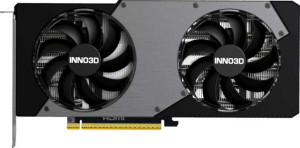
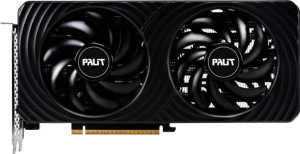
The core performance gap between the Inno3D RTX 5070 Twin X2 and the Palit RTX 5060 Dual is substantial, driven primarily by a significant difference in shader and compute resources. The RTX 5070 card features 6,144 shading units against the RTX 5060′s 3,840 — a 60% advantage — and this scales directly into raw compute throughput: 30.87 TFLOPS versus 19.18 TFLOPS. In practice, that gap translates to noticeably higher frame rates in GPU-bound scenarios, faster shader-heavy workloads, and more headroom for features like ray tracing and AI-accelerated rendering.
The texture and pixel throughput numbers reinforce the same story. The RTX 5070 delivers 482.3 GTexels/s and 201 GPixel/s, compared to 299.6 GTexels/s and 119.9 GPixel/s on the RTX 5060 — roughly a 60–68% lead in both metrics. Higher texture throughput means the GPU can apply more texture detail per second, which matters at higher resolutions and with complex materials, while higher pixel fill rate supports smoother rendering at 1440p and 4K. The RTX 5060′s 48 ROPs versus the RTX 5070′s 80 ROPs further underlines the fill-rate disparity. Clock speeds, by contrast, are closely matched — both cards run within 50 MHz of each other at base and boost — so the performance gap is almost entirely architectural (more silicon), not a tuning difference.
One notable commonality is that both cards share the same GPU memory speed of 1,750 MHz and both support Double Precision Floating Point (DPFP), meaning neither has an edge in memory bandwidth efficiency or professional compute precision. Overall, the RTX 5070 Twin X2 holds a clear and consistent performance advantage across every compute and throughput metric in this group, making it the stronger choice for users prioritizing rendering performance, while the RTX 5060 Dual trades raw power for a presumably lower price point.