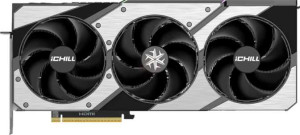
Inno3D GeForce RTX 5080 iChill X3
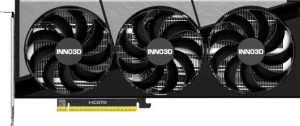
Inno3D GeForce RTX 5080 X3 OC

Inno3D GeForce RTX 5080 iChill X3 Inno3D GeForce RTX 5080 X3 OC

Overview

Welcome to our detailed specification comparison between the Inno3D GeForce RTX 5080 iChill X3 and the Inno3D GeForce RTX 5080 X3 OC. Both cards are built on the same Blackwell architecture and share a substantial amount of hardware DNA, yet they diverge in meaningful ways. In this head-to-head, we examine key battlegrounds including boost clock performance and physical dimensions to help you decide which card best suits your needs.

Common Features

  • Both cards share a base GPU clock speed of 2295 MHz.
  • Both cards have a GPU memory speed of 1875 MHz.
  • Both cards feature 10752 shading units.
  • Both cards include 336 texture mapping units (TMUs).
  • Both cards have 112 render output units (ROPs).
  • Double Precision Floating Point (DPFP) is supported on both cards.
  • Both cards have an effective memory speed of 30000 MHz.
  • Both cards offer a maximum memory bandwidth of 960 GB/s.
  • Both cards come with 16GB of VRAM.
  • Both cards use GDDR7 memory.
  • Both cards have a 256-bit memory bus width.
  • ECC memory is supported on both cards.
  • Both cards support DirectX 12 Ultimate.
  • Both cards support OpenGL version 4.6.
  • Both cards support OpenCL version 3.
  • Multi-display technology is supported on both cards.
  • Ray tracing is supported on both cards.
  • DLSS is supported on both cards.
  • XeSS (XMX) is not available on either card.
  • Both cards have one HDMI 2.1b output and three DisplayPort outputs, with no USB-C, DVI, or mini DisplayPort outputs.
  • Both cards are based on the Blackwell GPU architecture built on a 5 nm process with 45600 million transistors.
  • Both cards have a Thermal Design Power (TDP) of 360W.
  • Both cards use PCIe version 5.
  • Air-water cooling is not available on either card.

Main Differences

  • GPU turbo clock speed is 2715 MHz on Inno3D GeForce RTX 5080 iChill X3 and 2640 MHz on Inno3D GeForce RTX 5080 X3 OC.
  • Pixel rate is 304.1 GPixel/s on Inno3D GeForce RTX 5080 iChill X3 and 295.7 GPixel/s on Inno3D GeForce RTX 5080 X3 OC.
  • Floating-point performance is 58.38 TFLOPS on Inno3D GeForce RTX 5080 iChill X3 and 56.77 TFLOPS on Inno3D GeForce RTX 5080 X3 OC.
  • Texture rate is 912.2 GTexels/s on Inno3D GeForce RTX 5080 iChill X3 and 887 GTexels/s on Inno3D GeForce RTX 5080 X3 OC.
  • Width is 334 mm on Inno3D GeForce RTX 5080 iChill X3 and 300 mm on Inno3D GeForce RTX 5080 X3 OC.
  • Height is 148 mm on Inno3D GeForce RTX 5080 iChill X3 and 120 mm on Inno3D GeForce RTX 5080 X3 OC.
Specs Comparison
Inno3D GeForce RTX 5080 iChill X3

Inno3D GeForce RTX 5080 iChill X3

Inno3D GeForce RTX 5080 X3 OC

Inno3D GeForce RTX 5080 X3 OC

Performance:
GPU clock speed 2295 MHz 2295 MHz
GPU turbo 2715 MHz 2640 MHz
pixel rate 304.1 GPixel/s 295.7 GPixel/s
floating-point performance 58.38 TFLOPS 56.77 TFLOPS
texture rate 912.2 GTexels/s 887 GTexels/s
GPU memory speed 1875 MHz 1875 MHz
shading units 10752 10752
texture mapping units (TMUs) 336 336
render output units (ROPs) 112 112
Has Double Precision Floating Point (DPFP)

Both cards share the same foundation: identical base clocks of 2295 MHz, the same 10,752 shading units, 336 TMUs, 112 ROPs, and equal memory speeds of 1875 MHz. This means the two GPUs are built on the exact same silicon configuration, and any performance gap between them comes down entirely to how aggressively each card boosts under load.

That gap is meaningful but focused. The iChill X3 reaches a higher turbo clock of 2715 MHz versus 2640 MHz on the X3 OC — a difference of 75 MHz, or roughly 2.8%. This directly cascades into every derived throughput metric: the iChill X3 leads in floating-point performance (58.38 TFLOPS vs 56.77 TFLOPS), pixel fill rate (304.1 GPixel/s vs 295.7 GPixel/s), and texture throughput (912.2 GTexels/s vs 887 GTexels/s). In practice, this translates to a modest but consistent edge in GPU-bound workloads — particularly at high resolutions where fill rate and texture throughput become the bottleneck.

The iChill X3 holds a clear, if incremental, performance advantage in this group. The ~3% boost headroom it carries over the X3 OC won't be transformative in most gaming scenarios, but it does represent a tangible edge in sustained compute tasks, ray tracing, or any workload that consistently saturates the shader array. Users prioritizing peak theoretical throughput should favor the iChill X3.

Memory:
effective memory speed 30000 MHz 30000 MHz
maximum memory bandwidth 960 GB/s 960 GB/s
VRAM 16GB 16GB
GDDR version GDDR7 GDDR7
memory bus width 256-bit 256-bit
Supports ECC memory

Memory is a complete dead heat between these two cards. Every single spec — 16GB of GDDR7, a 256-bit bus, 30000 MHz effective speed, and 960 GB/s of bandwidth — is shared identically. There is no distinguishing factor here whatsoever.

That said, the shared memory configuration is worth contextualizing. 960 GB/s of bandwidth, delivered by GDDR7 over a 256-bit interface, represents a substantial generational leap over prior architectures. For users working at 4K or higher, or running memory-intensive workloads like large texture assets, AI inference, or video production, this bandwidth ceiling ensures neither card will be starved for data throughput. The 16GB VRAM pool is also sufficient for the vast majority of current gaming and creative workloads, though enthusiasts running very large AI models may find it a constraint over time.

ECC memory support is present on both cards, a feature relevant primarily to professional and compute users who require error-corrected data integrity rather than raw gaming performance. For this group, the verdict is an absolute tie — memory configuration plays zero role in differentiating the iChill X3 from the X3 OC.

Features:
DirectX version DirectX 12 Ultimate DirectX 12 Ultimate
OpenGL version 4.6 4.6
OpenCL version 3 3
Supports multi-display technology
supports ray tracing
Supports 3D
supports DLSS
has XeSS (XMX)
AMD SAM / Intel Resizable BAR Intel Resizable BAR Intel Resizable BAR
has LHR
has RGB lighting
supported displays 4 4

Feature parity is total across both cards. The iChill X3 and X3 OC share an identical software and API capability set: DirectX 12 Ultimate, ray tracing, and DLSS support are all present on both, meaning neither card has any advantage in terms of access to modern rendering techniques or compatibility with current and upcoming titles.

The more practically useful details here are the ones both cards share equally. DLSS support means users benefit from AI-driven upscaling, which can deliver significant frame rate gains with minimal visual quality loss — particularly valuable at 4K. Ray tracing hardware acceleration enables physically accurate lighting in supported titles. Intel Resizable BAR support allows the CPU to access the full VRAM pool simultaneously, which can yield measurable performance improvements in certain games and workloads. Support for up to 4 displays simultaneously makes either card a capable choice for multi-monitor productivity setups.

There is simply no differentiator to call out in this group. Both cards offer an identical and comprehensive modern feature set, making this another clean tie. A buyer's decision cannot be influenced by features alone — look to the performance and design groups for any meaningful distinction between the two.

Ports:
has an HDMI output
HDMI ports 1 1
HDMI version HDMI 2.1b HDMI 2.1b
DisplayPort outputs 3 3
USB-C ports 0 0
DVI outputs 0 0
mini DisplayPort outputs 0 0

Connectivity is once again identical across both cards. Each offers 3 DisplayPort outputs and 1 HDMI 2.1b port, totaling four display outputs — consistent with the four-display limit noted in the Features group. Legacy connectors like DVI and mini DisplayPort are absent on both, which is expected for modern high-end GPUs where those standards have been effectively retired.

The presence of HDMI 2.1b is worth noting for users targeting high-refresh-rate or high-resolution TV setups, as it supports the bandwidth needed for 4K at very high frame rates. The three DisplayPort outputs are well-suited for multi-monitor desktop configurations or high-refresh-rate gaming panels. The absence of any USB-C port on either card may be a consideration for users who rely on that interface for VR headsets or display connectivity, though it is not a differentiator between the two.

This group produces another unambiguous tie. Port selection is an area where neither the iChill X3 nor the X3 OC gains any ground over the other — both offer the same connectivity options in the same configuration.

General info:
GPU architecture Blackwell Blackwell
release date January 2025 January 2025
Thermal Design Power (TDP) 360W 360W
PCI Express (PCIe) version 5 5
semiconductor size 5 nm 5 nm
number of transistors 45600 million 45600 million
Has air-water cooling
width 334 mm 300 mm
height 148 mm 120 mm

At the architectural level, these two cards are indistinguishable. Both are built on the Blackwell architecture using a 5nm process node, pack the same 45.6 billion transistors, draw 360W TDP, and connect via PCIe 5.0. The shared TDP is particularly relevant: users should plan for robust power delivery and case airflow regardless of which card they choose, as 360W is a substantial thermal load that will stress both PSU headroom and chassis cooling equally.

Where this group finally reveals a meaningful difference is in physical dimensions. The iChill X3 measures 334 × 148 mm, while the X3 OC is noticeably more compact at 300 × 120 mm — a difference of 34mm in length and 28mm in height. This is not a marginal gap. In smaller form-factor cases or builds with tight GPU clearance, the X3 OC's smaller footprint could be the deciding factor, whereas the iChill X3's larger cooler shroud is likely what enables its higher turbo clock advantage seen in the Performance group.

For case compatibility and build flexibility, the X3 OC has a clear edge. Builders working within space constraints will find it considerably easier to accommodate. However, users in full-tower or large mid-tower cases who prioritize thermal headroom and sustained boost clocks may find the iChill X3's larger design advantageous — the extra cooler real estate likely contributes directly to its higher turbo ceiling.

Comparison Summary & Verdict

After a thorough look at the specs, both the Inno3D GeForce RTX 5080 iChill X3 and the Inno3D GeForce RTX 5080 X3 OC deliver identical memory configurations, feature sets, and port layouts, making them equally capable in those respects. The real distinction lies in raw throughput and size. The iChill X3 edges ahead with a higher GPU turbo clock of 2715 MHz, a superior floating-point performance of 58.38 TFLOPS, and a faster texture rate, making it the stronger pick for users who demand every last frame. However, it comes in a noticeably larger chassis at 334 x 148 mm. The X3 OC, at a more compact 300 x 120 mm, is the smarter choice for smaller builds where physical space is at a premium, while still delivering strong performance at 56.77 TFLOPS. Neither card compromises on features, so your decision ultimately comes down to peak performance versus build compatibility.

Inno3D GeForce RTX 5080 iChill X3
Buy Inno3D GeForce RTX 5080 iChill X3 if...

Buy the Inno3D GeForce RTX 5080 iChill X3 if you want maximum out-of-the-box performance, with a higher GPU turbo clock of 2715 MHz and 58.38 TFLOPS of floating-point power, and your case has room for a larger card.

Inno3D GeForce RTX 5080 X3 OC
Buy Inno3D GeForce RTX 5080 X3 OC if...

Buy the Inno3D GeForce RTX 5080 X3 OC if you have a compact build where physical space is limited, as its smaller 300 x 120 mm footprint fits tighter cases while still delivering strong RTX 5080-class performance.