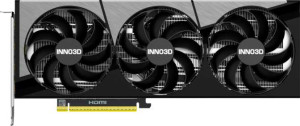
Both the Inno3D GeForce RTX 5080 X3 Gaming OC and the MSI GeForce RTX 5070 Ti Ventus 3X share an identical base GPU clock of 2295 MHz, meaning neither card has a head start at stock frequencies. The real divergence begins under load: the RTX 5080 X3 boosts to 2700 MHz versus the RTX 5070 Ti Ventus 3X's 2452 MHz — a gap of nearly 250 MHz that compounds across every other throughput metric. In practice, a higher sustained boost clock translates directly to smoother sustained performance in GPU-bound workloads, particularly in long gaming sessions or rendering tasks where the GPU stays at peak frequency for extended periods.
The hardware unit counts tell the deeper story. The RTX 5080 X3 packs 10,752 shading units, 336 TMUs, and 112 ROPs, compared to 8,960 shaders, 280 TMUs, and 96 ROPs on the RTX 5070 Ti. This translates into a floating-point throughput of 58.06 TFLOPS versus 43.94 TFLOPS — roughly a 32% lead — and a texture throughput advantage of 907.2 GTexels/s versus 686.6 GTexels/s. The ROP count difference is also meaningful: more ROPs means higher pixel fill rates (302.4 GPixel/s vs 235.4 GPixel/s), which benefits high-resolution rendering and anti-aliasing workloads where the GPU must write many pixels per frame. The RTX 5080 X3 also edges ahead in memory speed at 1875 MHz versus 1750 MHz, reducing a potential bandwidth bottleneck at higher resolutions.
The verdict for this group is unambiguous: the Inno3D RTX 5080 X3 Gaming OC holds a clear and consistent performance advantage across every measured dimension — compute throughput, texture throughput, pixel fill rate, and memory speed. Both cards support Double Precision Floating Point, so neither gains an edge in DPFP-dependent professional workloads. For users prioritizing raw GPU horsepower, the RTX 5080 X3 is the stronger performer by a significant margin.