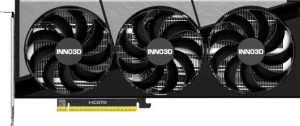
Inno3D GeForce RTX 5080 X3
Inno3D GeForce RTX 5080 X3 OC

Inno3D GeForce RTX 5080 X3 Inno3D GeForce RTX 5080 X3 OC

Overview

Welcome to our in-depth specification comparison between the Inno3D GeForce RTX 5080 X3 and the Inno3D GeForce RTX 5080 X3 OC. Both cards share the same Blackwell architecture, 16GB of GDDR7 memory, and a 360W TDP, making this a closely contested match. The key battlegrounds come down to GPU turbo clock speeds, raw compute throughput, and physical dimensions — subtle but potentially meaningful distinctions for enthusiast builders.

Common Features

  • Both cards have a base GPU clock speed of 2295 MHz.
  • Both cards have a GPU memory speed of 1875 MHz.
  • Both cards feature 10752 shading units.
  • Both cards have 336 texture mapping units (TMUs).
  • Both cards have 112 render output units (ROPs).
  • Double Precision Floating Point (DPFP) is supported on both cards.
  • Both cards have an effective memory speed of 30000 MHz.
  • Both cards offer a maximum memory bandwidth of 960 GB/s.
  • Both cards come with 16GB of VRAM.
  • Both cards use GDDR7 memory.
  • Both cards have a 256-bit memory bus width.
  • ECC memory support is available on both cards.
  • Both cards support DirectX 12 Ultimate.
  • Both cards support OpenGL version 4.6.
  • Both cards support OpenCL version 3.
  • Multi-display technology is supported on both cards.
  • Ray tracing is supported on both cards.
  • 3D support is available on both cards.
  • DLSS support is available on both cards.
  • XeSS (XMX) support is not available on either card.
  • Both cards have one HDMI 2.1b output.
  • Both cards have three DisplayPort outputs.
  • Neither card has USB-C ports, DVI outputs, or mini DisplayPort outputs.
  • Both cards are based on the Blackwell GPU architecture.
  • Both cards have a Thermal Design Power (TDP) of 360W.
  • Both cards use PCIe version 5.
  • Both cards are manufactured on a 5 nm process.
  • Both cards have 45600 million transistors.
  • Air-water cooling is not available on either card.
  • Both cards have a width of 300 mm.

Main Differences

  • GPU turbo clock speed is 2617 MHz on the Inno3D GeForce RTX 5080 X3 and 2640 MHz on the Inno3D GeForce RTX 5080 X3 OC.
  • Pixel rate is 293.1 GPixel/s on the Inno3D GeForce RTX 5080 X3 and 295.7 GPixel/s on the Inno3D GeForce RTX 5080 X3 OC.
  • Floating-point performance is 56.28 TFLOPS on the Inno3D GeForce RTX 5080 X3 and 56.77 TFLOPS on the Inno3D GeForce RTX 5080 X3 OC.
  • Texture rate is 879.3 GTexels/s on the Inno3D GeForce RTX 5080 X3 and 887 GTexels/s on the Inno3D GeForce RTX 5080 X3 OC.
  • Card height is 116 mm on the Inno3D GeForce RTX 5080 X3 and 120 mm on the Inno3D GeForce RTX 5080 X3 OC.
Specs Comparison
Inno3D GeForce RTX 5080 X3

Inno3D GeForce RTX 5080 X3

Inno3D GeForce RTX 5080 X3 OC

Inno3D GeForce RTX 5080 X3 OC

Performance:
GPU clock speed 2295 MHz 2295 MHz
GPU turbo 2617 MHz 2640 MHz
pixel rate 293.1 GPixel/s 295.7 GPixel/s
floating-point performance 56.28 TFLOPS 56.77 TFLOPS
texture rate 879.3 GTexels/s 887 GTexels/s
GPU memory speed 1875 MHz 1875 MHz
shading units 10752 10752
texture mapping units (TMUs) 336 336
render output units (ROPs) 112 112
Has Double Precision Floating Point (DPFP)

At their core, both the X3 and X3 OC share the same fundamental silicon: identical 2295 MHz base clocks, 10752 shading units, 336 TMUs, 112 ROPs, and 1875 MHz memory speed. This means the two cards are architecturally equivalent — the OC variant is not a different chip, but the same GPU factory-tuned to run slightly faster out of the box.

The real divergence lies in the boost clock: the X3 OC reaches 2640 MHz versus 2617 MHz on the standard X3 — a 23 MHz uplift. This flows directly into every throughput metric: floating-point performance edges up from 56.28 to 56.77 TFLOPS, texture rate from 879.3 to 887 GTexels/s, and pixel rate from 293.1 to 295.7 GPixel/s. In isolation these are sub-1% differences, which in practice translate to frame-time improvements that are effectively imperceptible in real workloads — well within run-to-run benchmark variance.

The X3 OC holds a narrow but measurable performance edge on paper, driven entirely by its higher turbo ceiling. However, given that the gains across every metric are under 1%, the practical real-world advantage is negligible for gaming or content creation. The decision between the two should hinge less on raw performance and more on factors such as price delta, cooling, and power targets — not these spec-sheet differences alone.

Memory:
effective memory speed 30000 MHz 30000 MHz
maximum memory bandwidth 960 GB/s 960 GB/s
VRAM 16GB 16GB
GDDR version GDDR7 GDDR7
memory bus width 256-bit 256-bit
Supports ECC memory

Memory is a complete dead heat between these two cards. Both carry 16GB of GDDR7 across a 256-bit bus, hitting an effective speed of 30000 MHz and delivering 960 GB/s of peak bandwidth — figures that are identical down to the last specification.

Those numbers deserve some context. GDDR7 represents a generational leap in memory technology, and 960 GB/s of bandwidth is exceptionally high for a consumer GPU, enabling fast texture streaming, smoother performance at high resolutions, and reduced bottlenecking in memory-intensive workloads like 4K gaming or AI inference tasks. The 16GB frame buffer is also a practical sweet spot for modern titles and creative applications, comfortably handling large texture sets and high-resolution assets. ECC memory support — shared by both — adds a layer of data integrity useful in professional or compute workloads, though it is rarely a deciding factor for gamers.

There is no differentiator to call out here: the X3 and X3 OC are in a complete tie on memory. Any performance differences between the two cards will originate entirely from the GPU clock side of the equation, not from memory configuration.

Features:
DirectX version DirectX 12 Ultimate DirectX 12 Ultimate
OpenGL version 4.6 4.6
OpenCL version 3 3
Supports multi-display technology
supports ray tracing
Supports 3D
supports DLSS
has XeSS (XMX)
AMD SAM / Intel Resizable BAR Intel Resizable BAR Intel Resizable BAR
has LHR
has RGB lighting
supported displays 4 4

Feature parity is total between these two cards — every capability listed is shared without exception. Both support DirectX 12 Ultimate and ray tracing, which together unlock the full suite of modern rendering techniques including hardware-accelerated reflections, shadows, and global illumination in compatible titles. DLSS support is equally present on both, allowing AI-driven upscaling to recover frame rates at higher resolutions — a particularly valuable tool when ray tracing is enabled and raw performance headroom shrinks.

On the practical side, support for up to 4 simultaneous displays makes either card a capable foundation for multi-monitor setups, whether for productivity or immersive gaming environments. Intel Resizable BAR is also present on both, enabling the CPU to access the full GPU frame buffer at once rather than in smaller chunks — a feature that can yield modest frame rate improvements in supported games without any user configuration beyond a BIOS toggle.

With no feature differentiating one card from the other, this group is an absolute tie. A buyer choosing between the X3 and X3 OC gains or loses nothing in terms of software capabilities, API support, or connectivity — the decision remains squarely a matter of clock speeds and pricing.

Ports:
has an HDMI output
HDMI ports 1 1
HDMI version HDMI 2.1b HDMI 2.1b
DisplayPort outputs 3 3
USB-C ports 0 0
DVI outputs 0 0
mini DisplayPort outputs 0 0

Connectivity is identical across both cards, with each offering a layout of 3 DisplayPort outputs and 1 HDMI 2.1b port — four outputs in total, matching the maximum supported display count noted in their feature specs. The absence of USB-C, DVI, or mini DisplayPort outputs is consistent with modern high-end GPU design, where legacy connectors have been dropped in favor of maximizing bandwidth-capable digital outputs.

HDMI 2.1b is worth highlighting as the headline connectivity feature shared by both. It supports high refresh rates at 4K and beyond, making it well-suited for connecting to modern gaming monitors or high-end televisions without an adapter. The three DisplayPort outputs complement this for users running multi-monitor workstation setups, offering flexible configuration options across all four ports simultaneously.

No differentiator exists between the X3 and X3 OC in this category — port selection and display connectivity are a complete tie. Buyers with specific cabling or display requirements can expect identical compatibility from either card.

General info:
GPU architecture Blackwell Blackwell
release date January 2025 January 2025
Thermal Design Power (TDP) 360W 360W
PCI Express (PCIe) version 5 5
semiconductor size 5 nm 5 nm
number of transistors 45600 million 45600 million
Has air-water cooling
width 300 mm 300 mm
height 116 mm 120 mm

Underneath the surface, these two cards are built from the same foundation: identical Blackwell architecture, a 5nm manufacturing process, 45.6 billion transistors, and a 360W TDP. That shared power envelope is particularly significant — it means both cards will place the same demands on a system's power supply and cooling infrastructure, with no hidden thermal advantage for either variant despite the OC model's slightly higher boost clock.

PCIe 5.0 support on both ensures neither card will face any interface-level bottleneck on current-generation platforms, and the air-cooling-only design is consistent across the pair. The only physical difference the specs reveal is a 4mm difference in height — 116mm on the X3 versus 120mm on the X3 OC. This is a minor dimensional gap that is unlikely to affect case compatibility in practice, but worth confirming against tight slot clearances in compact builds.

For general platform considerations, these cards are effectively identical. Same chip, same process node, same power draw, same interface. The marginal size difference gives neither card a meaningful advantage — this group, like memory and ports before it, does not shift the decision between the two.

Comparison Summary & Verdict

After a thorough look at the specs, it is clear that the Inno3D GeForce RTX 5080 X3 and the Inno3D GeForce RTX 5080 X3 OC are nearly identical cards. Both deliver the same 16GB GDDR7 memory with 960 GB/s bandwidth, the same port configuration, and identical feature support including ray tracing and DLSS. The OC variant edges ahead with a higher GPU turbo clock of 2640 MHz versus 2617 MHz, resulting in marginally better pixel rate, texture rate, and floating-point performance at 56.77 TFLOPS compared to 56.28 TFLOPS. The trade-off is a slightly taller card at 120 mm versus 116 mm. Choose the X3 OC if you want every last drop of factory-tuned performance; stick with the standard X3 if a more compact build clearance matters to you.

Inno3D GeForce RTX 5080 X3
Buy Inno3D GeForce RTX 5080 X3 if...

Buy the Inno3D GeForce RTX 5080 X3 if you have a tighter chassis with limited GPU clearance, as its 116 mm height gives you a slight size advantage over the OC model.

Inno3D GeForce RTX 5080 X3 OC
Buy Inno3D GeForce RTX 5080 X3 OC if...

Buy the Inno3D GeForce RTX 5080 X3 OC if you want the highest out-of-the-box clock speeds and marginally better pixel rate, texture rate, and floating-point performance without manual overclocking.