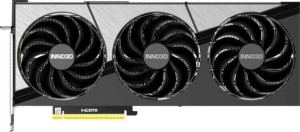
Inno3D GeForce RTX 5090 X3 OC
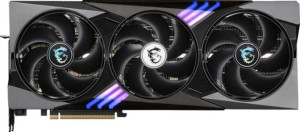
MSI GeForce RTX 5090 Gaming Trio OC

Inno3D GeForce RTX 5090 X3 OC MSI GeForce RTX 5090 Gaming Trio OC

Overview

Welcome to this in-depth specification comparison between the Inno3D GeForce RTX 5090 X3 OC and the MSI GeForce RTX 5090 Gaming Trio OC. Both cards share the same Blackwell architecture and 32GB of GDDR7 memory, yet they diverge in meaningful ways across boost clock speeds, raw compute throughput, physical dimensions, and memory bandwidth. Read on to find out which of these flagship GPUs best suits your needs.

Common Features

  • Both cards share the same base GPU clock speed of 2017 MHz.
  • Both cards have a GPU memory speed of 1750 MHz.
  • Both cards feature 21760 shading units.
  • Both cards include 680 texture mapping units (TMUs).
  • Both cards have 176 render output units (ROPs).
  • Double Precision Floating Point (DPFP) is supported on both cards.
  • Both cards have an effective memory speed of 28000 MHz.
  • Both cards come with 32GB of VRAM.
  • Both cards use GDDR7 memory.
  • Both cards feature a 512-bit memory bus width.
  • ECC memory is supported on both cards.
  • Both cards support DirectX 12 Ultimate.
  • Both cards support OpenGL version 4.6.
  • Both cards support OpenCL version 3.
  • Multi-display technology is supported on both cards.
  • Ray tracing is supported on both cards.
  • 3D support is available on both cards.
  • DLSS is supported on both cards.
  • XeSS (XMX) support is not available on either card.
  • Both cards include one HDMI 2.1b port and three DisplayPort outputs, with no USB-C or DVI outputs.
  • Both cards are based on the Blackwell GPU architecture.
  • Both cards have a Thermal Design Power (TDP) of 575W.
  • Both cards use PCIe version 5.
  • Both cards are manufactured on a 5 nm process and contain 92200 million transistors.
  • Neither card features air-water cooling.

Main Differences

  • GPU turbo clock speed is 2452 MHz on the Inno3D GeForce RTX 5090 X3 OC and 2482 MHz on the MSI GeForce RTX 5090 Gaming Trio OC.
  • Pixel rate is 431.6 GPixel/s on the Inno3D GeForce RTX 5090 X3 OC and 436.8 GPixel/s on the MSI GeForce RTX 5090 Gaming Trio OC.
  • Floating-point performance is 106.7 TFLOPS on the Inno3D GeForce RTX 5090 X3 OC and 108 TFLOPS on the MSI GeForce RTX 5090 Gaming Trio OC.
  • Texture rate is 1667.4 GTexels/s on the Inno3D GeForce RTX 5090 X3 OC and 1688 GTexels/s on the MSI GeForce RTX 5090 Gaming Trio OC.
  • Maximum memory bandwidth is 1792 GB/s on the Inno3D GeForce RTX 5090 X3 OC and 1790 GB/s on the MSI GeForce RTX 5090 Gaming Trio OC.
  • Card width is 333 mm on the Inno3D GeForce RTX 5090 X3 OC and 359 mm on the MSI GeForce RTX 5090 Gaming Trio OC.
  • Card height is 137 mm on the Inno3D GeForce RTX 5090 X3 OC and 149 mm on the MSI GeForce RTX 5090 Gaming Trio OC.
Specs Comparison
Inno3D GeForce RTX 5090 X3 OC

Inno3D GeForce RTX 5090 X3 OC

MSI GeForce RTX 5090 Gaming Trio OC

MSI GeForce RTX 5090 Gaming Trio OC

Performance:
GPU clock speed 2017 MHz 2017 MHz
GPU turbo 2452 MHz 2482 MHz
pixel rate 431.6 GPixel/s 436.8 GPixel/s
floating-point performance 106.7 TFLOPS 108 TFLOPS
texture rate 1667.4 GTexels/s 1688 GTexels/s
GPU memory speed 1750 MHz 1750 MHz
shading units 21760 21760
texture mapping units (TMUs) 680 680
render output units (ROPs) 176 176
Has Double Precision Floating Point (DPFP)

Both GPUs share the same underlying silicon configuration — identical 2017 MHz base clocks, 21,760 shading units, 680 TMUs, 176 ROPs, and 1750 MHz memory speed — confirming they are built on the same RTX 5090 die with no architectural differences between them. The only meaningful performance gap lies in the boost clock: the MSI Gaming Trio OC edges ahead at 2482 MHz versus the Inno3D X3 OC's 2452 MHz, a 30 MHz advantage that flows directly into every derived metric.

That 30 MHz difference, while modest in absolute terms, translates to the MSI delivering 108 TFLOPS of floating-point throughput against the Inno3D's 106.7 TFLOPS, and a texture fill rate of 1688 GTexels/s versus 1667.4 GTexels/s. In practice, these are roughly 1.2% gains — imperceptible in gaming frame rates but potentially relevant in sustained compute workloads like AI inference or rendering, where every sustained clock cycle compounds over time.

The MSI Gaming Trio OC holds a narrow but clear performance edge in this group, driven entirely by its higher factory boost clock. For the vast majority of gaming use cases the two cards will be functionally indistinguishable, but if maximum out-of-box clock headroom matters — whether for compute tasks or as a starting point before manual overclocking — the MSI is the marginally stronger factory tune.

Memory:
effective memory speed 28000 MHz 28000 MHz
maximum memory bandwidth 1792 GB/s 1790 GB/s
VRAM 32GB 32GB
GDDR version GDDR7 GDDR7
memory bus width 512-bit 512-bit
Supports ECC memory

The Inno3D GeForce RTX 5090 X3 OC and MSI GeForce RTX 5090 Gaming Trio OC have nearly identical memory specifications. Both GPUs feature an effective memory speed of 28000 MHz, and their VRAM capacity is the same at 32GB. The GDDR7 memory type is also shared between the two models. Both GPUs utilize a 512-bit memory bus width, ensuring a broad data pathway for optimal performance. Additionally, both products support ECC (Error Correction Code) memory, adding extra reliability in computations.

The maximum memory bandwidth is almost identical, with the Inno3D model reaching 1792 GB/s and the MSI model slightly behind at 1790 GB/s. This difference in bandwidth is minimal and unlikely to have a noticeable impact on real-world performance.

In summary, the memory specifications of these two GPUs are extremely similar, with only a very slight difference in maximum memory bandwidth, which is unlikely to affect overall usage.

Features:
DirectX version DirectX 12 Ultimate DirectX 12 Ultimate
OpenGL version 4.6 4.6
OpenCL version 3 3
Supports multi-display technology
supports ray tracing
Supports 3D
supports DLSS
has XeSS (XMX)
AMD SAM / Intel Resizable BAR Intel Resizable BAR Intel Resizable BAR
has LHR
has RGB lighting
supported displays 4 4

The Inno3D GeForce RTX 5090 X3 OC and MSI GeForce RTX 5090 Gaming Trio OC share identical feature sets. Both GPUs support DirectX 12 Ultimate, OpenGL version 4.6, and OpenCL version 3, ensuring compatibility with modern software and applications. Multi-display technology is supported on both, allowing for an expanded visual experience, and both cards offer ray tracing and 3D support for enhanced graphical performance.

Both models also support DLSS (Deep Learning Super Sampling), which boosts frame rates while maintaining visual quality. Neither GPU features XeSS (XMX), and both are compatible with Intel's Resizable BAR technology. The presence of Intel Resizable BAR allows for better utilization of the GPU's memory bandwidth, enhancing performance in supported titles.

Additional features like RGB lighting and support for up to 4 displays are present on both cards. Furthermore, neither product includes LHR (Lite Hash Rate) technology, which means both GPUs are fully capable of mining cryptocurrencies at full hash rates.

Ports:
has an HDMI output
HDMI ports 1 1
HDMI version HDMI 2.1b HDMI 2.1b
DisplayPort outputs 3 3
USB-C ports 0 0
DVI outputs 0 0
mini DisplayPort outputs 0 0

The Inno3D GeForce RTX 5090 X3 OC and MSI GeForce RTX 5090 Gaming Trio OC have identical port configurations. Both models feature one HDMI 2.1b port and three DisplayPort outputs. Neither GPU includes USB-C ports, DVI outputs, or mini DisplayPort outputs, making the HDMI and DisplayPort options the primary video outputs for both cards.

Both products support the same HDMI version, HDMI 2.1b, ensuring compatibility with high-refresh-rate displays and 4K resolution. The display setup of each card supports up to four displays, offering ample multi-monitor capabilities for demanding setups.

In summary, the ports and connectivity options are exactly the same on both the Inno3D and MSI GPUs, providing similar flexibility in terms of video output and multi-display support.

General info:
GPU architecture Blackwell Blackwell
release date April 2025 January 2025
Thermal Design Power (TDP) 575W 575W
PCI Express (PCIe) version 5 5
semiconductor size 5 nm 5 nm
number of transistors 92200 million 92200 million
Has air-water cooling
width 333 mm 359 mm
height 137 mm 149 mm

The Inno3D GeForce RTX 5090 X3 OC and MSI GeForce RTX 5090 Gaming Trio OC are very similar in their general specifications. Both GPUs are based on the Blackwell architecture, feature a 5 nm semiconductor size, and have 92,200 million transistors. They also share the same Thermal Design Power (TDP) of 575W and support PCI Express (PCIe) version 5, ensuring high-speed data transfer for modern systems.

In terms of physical dimensions, the MSI card is slightly larger, with a width of 359 mm and a height of 149 mm, compared to the Inno3D's 333 mm width and 137 mm height. Despite the size difference, neither product includes air-water cooling.

Overall, these two models are almost identical in terms of performance and architecture, with the primary difference being the slightly larger size of the MSI card.

Comparison Summary & Verdict

Both the Inno3D GeForce RTX 5090 X3 OC and the MSI GeForce RTX 5090 Gaming Trio OC are extraordinarily capable flagship cards built on the same Blackwell foundation, sharing a 575W TDP, 32GB of GDDR7 memory on a 512-bit bus, and identical feature sets including ray tracing and DLSS. Where they differ is in performance headroom and physical size. The MSI Gaming Trio OC edges ahead with a higher GPU turbo of 2482 MHz, slightly better pixel and texture rates, and 108 TFLOPS of floating-point performance, making it the stronger pick for users who want every last frame. The Inno3D X3 OC, meanwhile, holds a marginal lead in maximum memory bandwidth at 1792 GB/s and is notably more compact at 333 x 137 mm versus 359 x 149 mm, making it the smarter choice for builders working with tighter chassis constraints.

Inno3D GeForce RTX 5090 X3 OC
Buy Inno3D GeForce RTX 5090 X3 OC if...

Buy the Inno3D GeForce RTX 5090 X3 OC if you need a more compact card that fits smaller cases, or if you want a marginally higher memory bandwidth of 1792 GB/s.

MSI GeForce RTX 5090 Gaming Trio OC
Buy MSI GeForce RTX 5090 Gaming Trio OC if...

Buy the MSI GeForce RTX 5090 Gaming Trio OC if you want higher peak performance, with a faster GPU turbo clock of 2482 MHz and greater floating-point throughput of 108 TFLOPS.