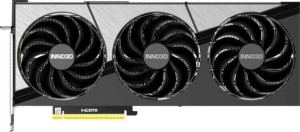
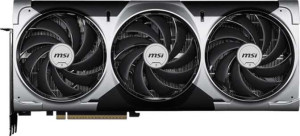
Both GPUs share the same fundamental silicon configuration — identical base clocks of 2017 MHz, the same 21,760 shading units, 680 TMUs, and 176 ROPs — which confirms they are built on the same RTX 5090 die with no hardware differences at the core level. Memory speed is also identical at 1750 MHz. The real divergence emerges at boost frequency: the Inno3D X3 OC reaches 2452 MHz turbo versus the MSI Ventus 3X at 2407 MHz, a 45 MHz gap that directly reflects Inno3D's factory overclock.
That boost clock difference cascades into every computed performance metric. The Inno3D delivers 106.7 TFLOPS of floating-point throughput against the MSI's 104.8 TFLOPS, a roughly 1.8% lead. Similarly, pixel fill rate comes in at 431.6 GPixel/s versus 423.6 GPixel/s, and texture throughput at 1667.4 GTexels/s versus 1637 GTexels/s. In practice, these margins are narrow enough that real-world gaming frame rates will rarely differ by more than 1–2%, well within run-to-run benchmark variance. Where the gap could be more perceptible is in sustained compute workloads — such as AI inference or rendering — where every sustained TFLOP accumulates over time.
Both cards support Double Precision Floating Point (DPFP), which matters for professional and scientific compute tasks rather than gaming. Overall, the Inno3D X3 OC holds a marginal but consistent performance edge across every throughput metric purely by virtue of its factory overclock. The MSI Ventus 3X is not slower in any architectural sense — it simply runs at a more conservative boost target, which may translate into slightly lower thermals or power draw under load, though those specs fall outside this group.