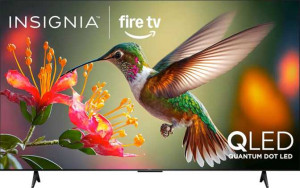
Insignia NS75-UQFL26 75"
TCL 75Q51K 75"

Insignia NS75-UQFL26 75" TCL 75Q51K 75"

Overview

Welcome to our in-depth spec comparison between the Insignia NS75-UQFL26 75″ and the TCL 75Q51K 75″ — two 75-inch QLED 4K televisions that share a remarkably similar foundation yet diverge in some meaningful areas. Both sets deliver a 3840 x 2160 resolution at 60Hz with Dolby Atmos and AirPlay support, but key battlegrounds emerge around HDR capabilities, connectivity options, and smart assistant integration. Read on to discover which of these large-screen TVs best fits your living room setup.

Common Features

  • Both TVs have a 4K UHD display resolution.
  • Both TVs use a QLED, LED-backlit, LCD display type.
  • Both TVs have a screen size of 74.5″.
  • Both TVs have a resolution of 3840 x 2160 px.
  • Both TVs have a pixel density of 59 ppi.
  • Both TVs support 1070 million display colors.
  • Both TVs have a 10-bit color depth.
  • Both TVs have a 60Hz refresh rate.
  • Bluetooth is available on both TVs.
  • Wi-Fi support is available on both TVs.
  • Both TVs have 1 USB port.
  • Both TVs have 1 RJ45 port.
  • Miracast support is available on both TVs.
  • An external memory slot is not available on either TV.
  • A VGA connector is not available on either TV.
  • A DVI connector is not available on either TV.
  • Dolby Digital support is available on both TVs.
  • Both TVs have an audio output power of 2 x 15W.
  • Digital Out support is available on both TVs.
  • Dolby Digital Plus support is available on both TVs.
  • SRS TheaterSound HD is not available on either TV.
  • Stereo speakers are present on both TVs.
  • Dolby Atmos is available on both TVs.
  • Dolby Audio is available on both TVs.
  • Both TVs have a width of 1666.2 mm.
  • Both TVs have a thickness of 73.7 mm.
  • Both TVs have a height of 960.1 mm.
  • Both TVs have a volume of 117899.262294 cm³.
  • VESA mount support is available on both TVs.
  • AirPlay is available on both TVs.
  • A built-in smart TV system is present on both TVs.
  • Alexa compatibility is available on both TVs.
  • Siri and Apple HomeKit support is not available on either TV.
  • Remote smartphone control is supported on both TVs.
  • A rechargeable remote control is not included with either TV.
  • USB recording is supported on both TVs.
  • Both TVs have a standby power consumption of 0.5W.

Main Differences

  • HDR10+ support is present on TCL 75Q51K 75″ but not available on Insignia NS75-UQFL26 75″.
  • HDMI ports number 4 on Insignia NS75-UQFL26 75″ and 3 on TCL 75Q51K 75″.
  • A 3.5 mm audio jack socket is present on Insignia NS75-UQFL26 75″ but not available on TCL 75Q51K 75″.
  • Google Assistant compatibility is available on TCL 75Q51K 75″ but not on Insignia NS75-UQFL26 75″.
  • Weight is 18189 g on Insignia NS75-UQFL26 75″ and 18198 g on TCL 75Q51K 75″.
Specs Comparison
Insignia NS75-UQFL26 75"

Insignia NS75-UQFL26 75"

TCL 75Q51K 75"

TCL 75Q51K 75"

Display:
display resolution 4K (UHD) 4K (UHD)
Display type QLED, LED-backlit, LCD QLED, LED-backlit, LCD
screen size 74.5" 74.5"
resolution 3840 x 2160 px 3840 x 2160 px
pixel density 59 ppi 59 ppi
display colors 1070 million 1070 million
bit depth 10-bit 10-bit
refresh rate 60Hz 60Hz
supports HDR10
supports HDR10+
supports Dolby Vision
supports HLG
Adaptive synchronization None None
has anti-reflection coating
has an ambient light sensor
maximum horizontal viewing angle 178º 178º
maximum vertical viewing angle 178º 178º

The Insignia NS75-UQFL26 and the TCL 75Q51K share an identical display foundation: both are 75″ QLED, LED-backlit LCD panels running at 3840×2160 (4K UHD), with the same 59 ppi pixel density, 10-bit color depth, 1.07 billion colors, and a 60Hz native refresh rate. Neither offers adaptive sync, and both carry anti-reflection coatings and ambient light sensors — so for everyday viewing comfort and core picture quality metrics, these two TVs are functionally equivalent.

The single differentiator in this group is HDR10+ support. The TCL 75Q51K supports HDR10+, while the Insignia does not. HDR10+ is a dynamic metadata standard — unlike the static tone-mapping of base HDR10, it adjusts brightness and contrast scene-by-scene or even frame-by-frame. In practice, this means the TCL can extract more nuanced highlight and shadow detail on compatible HDR10+ content, particularly in high-contrast scenes. Both TVs support Dolby Vision, which similarly uses dynamic metadata, so the gap narrows for streaming content where Dolby Vision is prevalent — but HDR10+ adds relevance for content (including some Amazon Prime Video titles and Ultra HD Blu-rays) that specifically relies on that format.

Overall, the TCL 75Q51K holds a narrow but genuine edge in this display category solely due to its additional HDR10+ support. For viewers who consume a significant amount of HDR10+ content, this matters; for those whose libraries are dominated by Dolby Vision or SDR material, both screens will perform on equal footing.
Connectivity:
Has Bluetooth
HDMI ports 4 3
supports Wi-Fi
Wi-Fi version Wi-Fi 5 (802.11ac), Wi-Fi 4 (802.11n) Wi-Fi 4 (802.11n), Wi-Fi 5 (802.11ac)
USB ports 1 1
RJ45 ports 1 1
supports Miracast
has a socket for a 3.5 mm audio jack
has an external memory slot
has a VGA connector
has a DVI connector

Wireless connectivity is effectively a wash between these two TVs — both support Wi-Fi 5 (802.11ac) and Bluetooth, delivering more than adequate bandwidth for 4K streaming and reliable peripheral pairing. Neither offers Wi-Fi 6, but Wi-Fi 5 handles the bandwidth demands of 4K HDR content without issue on a typical home network.

Where the two sets diverge is in their wired and physical port configurations. The Insignia NS75-UQFL26 includes 4 HDMI ports versus the TCL 75Q51K's 3 — a meaningful difference for users with multiple sources like a game console, soundbar, streaming stick, and Blu-ray player all connected simultaneously. The Insignia also adds a 3.5mm headphone jack, which the TCL omits entirely; for users who want to watch privately without a Bluetooth headset, or who need a direct analog audio output to a legacy device, this is a practical convenience the TCL simply cannot match.

On balance, the Insignia NS75-UQFL26 has a clear connectivity advantage in this category. An extra HDMI port reduces the need for an HDMI switch in a busy home theater setup, and the headphone jack adds flexibility the TCL lacks. Neither TV is poorly connected, but the Insignia covers more real-world use cases out of the box.

Audio:
supports Dolby Digital
audio output power 2 x 15W 2 x 15W
supports Digital Out
supports Dolby Digital Plus
has SRS TheaterSound HD
has stereo speakers
has Dolby Atmos
has Dolby Audio
supports Dolby Virtual
has a subwoofer
HDMI ARC / eARC HDMI ARC, HDMI eARC HDMI ARC, HDMI eARC

Audio is the rare category where these two TVs are in complete lockstep. Both deliver 2 × 15W of stereo output — a respectable but not exceptional power level for a 75″ screen, sufficient for average room sizes but likely to leave larger living spaces wanting more volume and bass. Neither includes a built-in subwoofer, which is typical at this price tier and reinforces that an external soundbar or speaker system will serve most users better.

The format support stack is identical as well: both handle Dolby Atmos, Dolby Digital Plus, and Dolby Audio, and both expose an HDMI eARC port alongside standard ARC. eARC is the more significant detail here — it carries enough bandwidth to pass lossless Dolby Atmos audio from a connected soundbar or AV receiver, meaning the built-in speakers' limitations become largely irrelevant once an external audio system is in play.

This group is a dead tie. Every measurable and format-level audio specification is shared between the two TVs, so audio quality cannot factor into a purchase decision between them.

Design:
width 1666.2 mm 1666.2 mm
weight 18189 g 18198 g
thickness 73.7 mm 73.7 mm
height 960.1 mm 960.1 mm
volume 117899.262294 cm³ 117899.262294 cm³
Supports VESA mount

Physically, these two TVs are as close to identical as two distinct products can be. Width, height, thickness, and total volume are exactly the same, and both support VESA mounting — meaning installation considerations, wall mount compatibility, and furniture fit will be indistinguishable between them.

The only numerical difference is weight: the Insignia NS75-UQFL26 comes in at 18,189g while the TCL 75Q51K is marginally heavier at 18,198g — a difference of just 9 grams. At roughly the weight of two nickels, this gap is physically imperceptible and carries zero practical consequence for installation, wall mount load ratings, or handling.

Design is an unambiguous tie. There is no meaningful physical distinction between these two sets, and neither offers any advantage in footprint, mounting flexibility, or form factor.

Features:
release date February 2025 April 2025
has AirPlay
has built-in smart TV
compatible with Google Assistant
works with Alexa
works with Siri/Apple HomeKit
supports a remote smartphone
has a rechargeable remote control
supports USB recording
standby power consumption 0.5W 0.5W
has a search browser
has a sleep timer
has a child lock
warranty period 1 years 1 years
has voice commands

Both TVs arrive with a well-rounded smart feature set: built-in smart TV platforms, AirPlay, Alexa integration, smartphone remote support, USB recording, and voice commands are all present on each. For households already invested in Amazon or Apple ecosystems, either set slots in without friction.

The single differentiator is Google Assistant compatibility, which the TCL 75Q51K supports and the Insignia NS75-UQFL26 does not. For users embedded in the Google ecosystem — Android phones, Google Home speakers, Nest devices — this is a genuine convenience: it enables voice control through existing Google smart home infrastructure and tighter integration with Google services without requiring a separate device to bridge the gap.

The TCL 75Q51K holds a modest edge here by virtue of supporting all three major voice platforms (Alexa, Google Assistant, and AirPlay for Siri-adjacent Apple integration), while the Insignia skips Google Assistant entirely. It is not a decisive gap for users outside the Google ecosystem, but for those inside it, the TCL is the more versatile choice.

Comparison Summary & Verdict

After examining every specification, these two 75-inch QLED TVs are closely matched siblings with a few telling differences. The TCL 75Q51K 75″ earns an edge for home cinema enthusiasts thanks to its HDR10+ support and built-in Google Assistant compatibility, making it the stronger pick for viewers who prioritize a richer, more dynamic picture and a tightly integrated smart-home ecosystem. On the other hand, the Insignia NS75-UQFL26 75″ counters with an extra HDMI port (4 vs 3) and a 3.5 mm audio jack, advantages that matter for users with multiple console or set-top-box setups or those who regularly connect wired headphones and external audio gear. Both share identical audio power, dimensions, Dolby Atmos, and AirPlay — so neither disappoints on the fundamentals.

Insignia NS75-UQFL26 75
Buy Insignia NS75-UQFL26 75" if...

Buy the Insignia NS75-UQFL26 75″ if you need more HDMI ports for multiple devices and want a 3.5 mm audio jack for wired headphones or external audio equipment.

TCL 75Q51K 75
Buy TCL 75Q51K 75" if...

Buy the TCL 75Q51K 75″ if you want a more immersive picture with HDR10+ support and prefer Google Assistant integration for a smarter, more connected home experience.