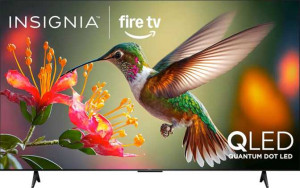
Insignia NS75-UQFL26 75"
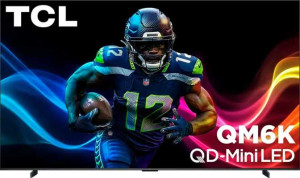
TCL 98QM6K 98"

Insignia NS75-UQFL26 75" TCL 98QM6K 98"

Overview

Welcome to our in-depth spec comparison between the Insignia NS75-UQFL26 75″ and the TCL 98QM6K 98″. These two QLED 4K televisions share a strong foundation of HDR support and smart features, yet diverge significantly when it comes to screen size, refresh rate, and display technology. Whether you are prioritizing a more compact footprint or a truly cinematic large-screen experience, this comparison will help you weigh every key specification before making your decision.

Common Features

  • Both TVs have a 4K (UHD) display resolution of 3840 x 2160 px.
  • Both TVs display 1070 million colors with a 10-bit bit depth.
  • HDR10 support is available on both products.
  • Dolby Vision support is available on both products.
  • HLG support is available on both products.
  • An anti-reflection coating is present on both products.
  • Both TVs use a QLED, LED-backlit, LCD display type as a base.
  • Bluetooth is available on both products.
  • Both TVs have 4 HDMI ports.
  • Wi-Fi support is available on both products, with both supporting Wi-Fi 4 (802.11n) and Wi-Fi 5 (802.11ac).
  • Both TVs have 1 RJ45 port.
  • Miracast support is available on both products.
  • Neither product has an external memory slot.
  • Neither product has a VGA connector.
  • Neither product has a DVI connector.
  • Dolby Digital support is available on both products.
  • DTS Surround is present on both products.
  • Digital Out support is available on both products.
  • Dolby Digital Plus support is available on both products.
  • SRS TheaterSound HD is not available on either product.
  • Stereo speakers are present on both products.
  • Dolby Atmos is available on both products.
  • Dolby Audio is available on both products.
  • Both TVs support VESA mounting.
  • AirPlay is available on both products.
  • A built-in smart TV platform is present on both products.
  • Works with Siri/Apple HomeKit is not supported on either product.
  • Remote smartphone control is supported on both products.
  • Neither product has a rechargeable remote control.
  • USB recording is supported on both products.
  • Both TVs have a standby power consumption of 0.5W.
  • A search browser is available on both products.

Main Differences

  • The Insignia NS75-UQFL26 75″ uses a QLED, LED-backlit, LCD panel, while the TCL 98QM6K 98″ also includes Mini-LED backlighting technology.
  • Screen size is 74.5″ on the Insignia NS75-UQFL26 75″ and 97.5″ on the TCL 98QM6K 98″.
  • Pixel density is 59 ppi on the Insignia NS75-UQFL26 75″ and 45 ppi on the TCL 98QM6K 98″.
  • Refresh rate is 60Hz on the Insignia NS75-UQFL26 75″ and 144Hz on the TCL 98QM6K 98″.
  • HDR10+ support is present on the TCL 98QM6K 98″ but not available on the Insignia NS75-UQFL26 75″.
  • Adaptive synchronization is not available on the Insignia NS75-UQFL26 75″, while the TCL 98QM6K 98″ supports AMD FreeSync, AMD FreeSync Premium, and AMD FreeSync Premium Pro.
  • Bluetooth version is 5 on the Insignia NS75-UQFL26 75″ and 5.4 on the TCL 98QM6K 98″.
  • USB ports number 1 on the Insignia NS75-UQFL26 75″ and 2 on the TCL 98QM6K 98″.
  • A 3.5 mm audio jack socket is present on the Insignia NS75-UQFL26 75″ but not available on the TCL 98QM6K 98″.
  • A subwoofer is not present on the Insignia NS75-UQFL26 75″, while the TCL 98QM6K 98″ includes one.
  • Width is 1666.2 mm on the Insignia NS75-UQFL26 75″ and 2180.1 mm on the TCL 98QM6K 98″.
  • Height is 960.1 mm on the Insignia NS75-UQFL26 75″ and 1246.9 mm on the TCL 98QM6K 98″.
  • Thickness is 73.7 mm on the Insignia NS75-UQFL26 75″ and 64 mm on the TCL 98QM6K 98″.
  • Weight is 18189 g on the Insignia NS75-UQFL26 75″ and 53302 g on the TCL 98QM6K 98″.
  • Volume is 117899.262294 cm³ on the Insignia NS75-UQFL26 75″ and 173975.46816 cm³ on the TCL 98QM6K 98″.
  • Google Assistant compatibility is present on the TCL 98QM6K 98″ but not available on the Insignia NS75-UQFL26 75″.
  • Alexa compatibility is present on the Insignia NS75-UQFL26 75″ but not available on the TCL 98QM6K 98″.
Specs Comparison
Insignia NS75-UQFL26 75"

Insignia NS75-UQFL26 75"

TCL 98QM6K 98"

TCL 98QM6K 98"

Display:
display resolution 4K (UHD) 4K (UHD)
Display type QLED, LED-backlit, LCD QLED, LED-backlit, LCD, Mini-LED
screen size 74.5" 97.5"
resolution 3840 x 2160 px 3840 x 2160 px
pixel density 59 ppi 45 ppi
display colors 1070 million 1070 million
bit depth 10-bit 10-bit
refresh rate 60Hz 144Hz
supports HDR10
supports HDR10+
supports Dolby Vision
supports HLG
Adaptive synchronization None AMD FreeSync, AMD FreeSync Premium, AMD FreeSync Premium Pro
has anti-reflection coating
has an ambient light sensor
maximum horizontal viewing angle 178º 178º
maximum vertical viewing angle 178º 178º

Both the Insignia NS75-UQFL26 and the TCL 98QM6K share the same 4K UHD resolution (3840 x 2160 px), 10-bit panel depth, and a broad color palette of 1,070 million colors, meaning neither has an advantage in raw color volume or pixel count. However, because the Insignia's panel measures 74.5″ versus the TCL's 97.5″, the Insignia actually achieves a higher pixel density — 59 ppi versus 45 ppi — so the same number of pixels is spread across a significantly smaller surface. In practice, this means the Insignia may render finer detail more crisply at close seating distances, while the TCL's larger canvas demands a more generous viewing distance to avoid visible pixel structure.

Where the TCL 98QM6K pulls decisively ahead is in motion handling and HDR versatility. Its 144Hz native refresh rate versus the Insignia's 60Hz means dramatically smoother motion in fast-action sports and gaming, and the TCL's support for AMD FreeSync Premium Pro adds variable refresh rate capability — eliminating screen tearing and stuttering for compatible gaming sources — while the Insignia offers no adaptive sync at all. On the HDR front, the TCL also supports HDR10+ in addition to the HDR10, Dolby Vision, and HLG formats both TVs share, giving it broader compatibility with dynamically tone-mapped HDR content. Its Mini-LED backlighting technology further enhances local dimming precision compared to the Insignia's standard LED-backlit QLED panel, which typically translates to deeper blacks and better contrast in dark scenes.

Overall, the TCL 98QM6K has a clear display advantage: its higher refresh rate, adaptive sync, additional HDR format support, Mini-LED backlight, and substantially larger screen make it the more capable panel for virtually every use case. The Insignia's edge in pixel density is real but situational — relevant mainly for viewers seated unusually close — and is not enough to offset the TCL's broader feature set. Choose the Insignia if screen size suits your room and budget is the priority; choose the TCL if display performance is paramount.
Connectivity:
Has Bluetooth
HDMI ports 4 4
supports Wi-Fi
Wi-Fi version Wi-Fi 5 (802.11ac), Wi-Fi 4 (802.11n) Wi-Fi 4 (802.11n), Wi-Fi 5 (802.11ac)
Bluetooth version 5 5.4
USB ports 1 2
RJ45 ports 1 1
supports Miracast
has a socket for a 3.5 mm audio jack
has an external memory slot
has a VGA connector
has a DVI connector

At a high level, the two TVs share a nearly identical wireless foundation — both support Wi-Fi 5 (802.11ac), Miracast screen mirroring, Bluetooth, and a single Ethernet port for wired networking. For most users, Wi-Fi 5 is more than sufficient for 4K streaming, so neither model is at a disadvantage there. The more meaningful wireless distinction is in Bluetooth: the TCL 98QM6K ships with Bluetooth 5.4 versus the Insignia's Bluetooth 5.0. Version 5.4 brings improvements in connection reliability and energy efficiency, which matters most when pairing peripherals like wireless headphones or soundbars that stay connected for extended sessions.

On the physical port side, the TCL again holds a practical edge with 2 USB ports compared to the Insignia's single USB port. One USB port is enough for a streaming stick or basic media playback, but a second port adds real convenience — simultaneously powering a device while playing media from a drive, for instance, without requiring a hub. Both televisions offer 4 HDMI ports, which is a generous and equivalent allocation for connecting consoles, set-top boxes, and AV receivers. One notable trade-off: the Insignia includes a 3.5mm headphone jack while the TCL omits it entirely. For users who rely on wired headphone listening — whether for late-night viewing or accessibility reasons — this is a tangible convenience the TCL cannot match without an adapter or Bluetooth workaround.

Connectivity is largely a wash between these two TVs, but each holds one meaningful card. The TCL 98QM6K has a slight edge in forward-looking wireless performance and everyday multi-device flexibility thanks to its newer Bluetooth version and extra USB port. The Insignia NS75-UQFL26 counters with its headphone jack, which remains a practical feature for direct wired audio output. Neither advantage is dramatic, but the TCL's combination of improvements makes it marginally more versatile for device-heavy setups.

Audio:
supports Dolby Digital
has DTS Surround
supports Digital Out
supports Dolby Digital Plus
has SRS TheaterSound HD
has stereo speakers
has Dolby Atmos
has Dolby Audio
supports Dolby Virtual
has a subwoofer
HDMI ARC / eARC HDMI ARC, HDMI eARC HDMI ARC, HDMI eARC

Across the audio format spectrum, these two televisions are essentially identical — both decode Dolby Atmos, Dolby Digital Plus, DTS Surround, and Dolby Audio, and both support digital audio output alongside HDMI ARC and eARC. The eARC port is worth highlighting as a shared strength: it carries high-bandwidth audio formats like lossless Dolby TrueHD and DTS:X back to a compatible soundbar or AV receiver over a single HDMI cable, future-proofing the connection for users who invest in premium external audio gear.

The sole hardware differentiator in this group is the TCL 98QM6K's inclusion of a built-in subwoofer, which the Insignia NS75-UQFL26 lacks. In practical terms, a dedicated subwoofer handles low-frequency reproduction — the weight behind explosions, the rumble of bass-heavy music, the depth of a film score — that stereo drivers alone struggle to deliver convincingly. For viewers who plan to use the TV's internal speakers rather than an external sound system, this distinction is meaningful and gives the TCL a richer out-of-the-box listening experience.

The TCL 98QM6K holds the edge in this category, but narrowly and with an important caveat: the advantage only matters for users relying on the TV's native audio system. Anyone connecting an external soundbar or AV receiver via eARC will bypass the internal speakers entirely, making the subwoofer irrelevant and rendering the two TVs effectively equal in audio capability for that use case.

Design:
width 1666.2 mm 2180.1 mm
weight 18189 g 53302 g
thickness 73.7 mm 64 mm
height 960.1 mm 1246.9 mm
volume 117899.262294 cm³ 173975.46816 cm³
Supports VESA mount

The size and weight gulf between these two televisions is substantial and should be a primary consideration before purchase. The TCL 98QM6K spans 2180.1 mm wide and stands 1246.9 mm tall — dimensions that demand a genuinely large wall or entertainment space to accommodate without feeling overwhelming. The Insignia NS75-UQFL26, at 1666.2 mm wide, is a more conventional footprint that fits comfortably in a broader range of living rooms and bedrooms. Neither choice is wrong, but the TCL's near-meter-tall profile makes room measurement non-negotiable before ordering.

Weight tells an equally important story for installation planning. The TCL tips the scales at 53,302 g (roughly 53 kg), nearly three times the Insignia's 18,189 g (approximately 18 kg). At that mass, wall-mounting the TCL is a multi-person job that may also require verifying wall stud capacity and using a heavy-duty mount rated for the load — a meaningful added complexity and potential cost. The Insignia, at under 20 kg, is far more manageable for a standard two-person wall installation. Notably, the Insignia is also slightly thicker at 73.7 mm versus the TCL's slimmer 64 mm profile, though this difference is minor and unlikely to affect most mounting decisions.

Both TVs support VESA mounting, so neither locks you into stand-only placement. Design-wise, this category is not about one product being superior — it is about fit. The Insignia NS75-UQFL26 is clearly the more installation-friendly option, with a lighter body and smaller footprint that suits a wider range of spaces and DIY setups. The TCL 98QM6K's dimensions are an inherent consequence of its 98-inch screen and should be treated as a prerequisite to verify, not an afterthought.

Features:
release date February 2025 March 2025
has AirPlay
has built-in smart TV
compatible with Google Assistant
works with Alexa
works with Siri/Apple HomeKit
supports a remote smartphone
has a rechargeable remote control
supports USB recording
standby power consumption 0.5W 0.5W
has a search browser
has a sleep timer
has a child lock
warranty period 1 years 1 years
has voice commands

Functionally, these two televisions are nearly identical in their feature sets — both offer a built-in smart TV platform, AirPlay, smartphone remote control, USB recording, sleep timer, child lock, and a modest 0.5W standby power consumption. The shared warranty of 1 year also puts them on equal footing for post-purchase protection. For the vast majority of everyday smart TV use cases, neither model has a meaningful edge over the other.

The one genuine differentiator in this group comes down to voice assistant ecosystem. The Insignia NS75-UQFL26 integrates with Amazon Alexa, while the TCL 98QM6K aligns with Google Assistant — and neither supports the other's platform. This is a practical consideration rather than a performance one: if your home is already built around Amazon Echo devices and Alexa routines, the Insignia slots in more naturally. Conversely, a household running Google Home speakers and Android devices will find the TCL the more seamless fit. Neither assistant is objectively superior here; the right choice depends entirely on which ecosystem you already live in.

This category is effectively a tie, with the voice assistant split being the only fork in the road. Neither TV offers a feature the other lacks in any area that would constitute a broad advantage — the decision hinges purely on whether your smart home runs on Alexa or Google Assistant.

Comparison Summary & Verdict

After examining all the specifications, both TVs deliver solid 4K QLED performance with shared support for Dolby Vision, HDR10, Dolby Atmos, and AirPlay. However, their differences reveal two distinct target audiences. The Insignia NS75-UQFL26 75″ is the more practical choice for everyday home viewing: it is significantly lighter at 18189 g, includes a 3.5 mm audio jack, and works with Alexa — making it a solid, no-fuss living room TV. The TCL 98QM6K 98″, on the other hand, is built for enthusiasts who demand more: its Mini-LED backlighting, blazing 144Hz refresh rate, AMD FreeSync Premium Pro support, HDR10+ compatibility, built-in subwoofer, and Google Assistant integration make it a powerhouse for gaming and immersive home cinema. Choose based on your space, budget priorities, and intended use.

Insignia NS75-UQFL26 75
Buy Insignia NS75-UQFL26 75" if...

Buy the Insignia NS75-UQFL26 75″ if you want a lighter, more compact 4K QLED TV for everyday viewing that includes a 3.5 mm audio jack and Alexa compatibility.

TCL 98QM6K 98
Buy TCL 98QM6K 98" if...

Buy the TCL 98QM6K 98″ if you want a massive 98-inch screen with Mini-LED backlighting, a 144Hz refresh rate, HDR10+ support, and AMD FreeSync Premium Pro for gaming or home cinema.