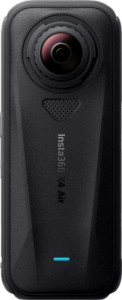
Insta360 X4 Air
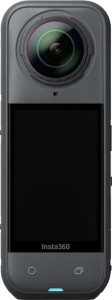
Insta360 X5

Insta360 X4 Air Insta360 X5

Overview

Welcome to our in-depth specification comparison between the Insta360 X4 Air and the Insta360 X5. Both cameras share a strong foundation — waterproofing, gyroscope stabilization, and live streaming support — but they diverge sharply when it comes to battery endurance, image resolution, and field of view. Whether you are chasing portability or maximum capture capability, this comparison will help you find the right fit.

Common Features

  • Both the Insta360 X4 Air and Insta360 X5 have a touch screen.
  • Both cameras have an external memory slot.
  • Both devices have a display.
  • Neither camera has a secondary screen.
  • Both products have a lowest potential operating temperature of -20 °C.
  • Both cameras have a waterproof depth rating of 15 m.
  • Neither device has a flip-out screen.
  • Both the Insta360 X4 Air and Insta360 X5 have a gyroscope.
  • Both cameras are compatible with Android.
  • Both cameras are compatible with iOS.
  • Both devices use Bluetooth version 5.2.
  • First-party live streaming support is available on both products.
  • Both cameras feature a USB Type-C port.
  • Neither camera has GPS.
  • Both products support Wi-Fi.
  • Both cameras support remote smartphone control.
  • Both devices have a rechargeable battery with a battery level indicator.
  • Both cameras have a stereo microphone.
  • Neither camera has a microphone input or a 3.5 mm audio jack socket.
  • Both the Insta360 X4 Air and Insta360 X5 have an adjustable field of view.
  • Both cameras feature a dual-lens main camera.
  • Both cameras use a BSI CMOS sensor.
  • A built-in HDR mode is available on both products.
  • Manual exposure and manual ISO are supported on both cameras.
  • Neither camera has a flash.
  • Both cameras record video at up to 3840 x 30 fps on the main camera.
  • A timelapse function is available on both products.
  • Both cameras support phase-detection autofocus and continuous autofocus when recording video.
  • Horizon leveling is supported on both devices.
  • A 24p cinema mode is available on both cameras.
  • Both cameras share a movie bitrate of 180 Mbps.
  • AF tracking is supported on both the Insta360 X4 Air and Insta360 X5.

Main Differences

  • Volume is 193.6876 cm³ on the Insta360 X4 Air and 218.7714 cm³ on the Insta360 X5.
  • Weight is 165 g on the Insta360 X4 Air and 200 g on the Insta360 X5.
  • Thickness is 37 mm on the Insta360 X4 Air and 38.2 mm on the Insta360 X5.
  • Height is 113.8 mm on the Insta360 X4 Air and 124.5 mm on the Insta360 X5.
  • Battery life is 1 hour on the Insta360 X4 Air and 3.08 hours on the Insta360 X5.
  • Battery power is 2010 mAh on the Insta360 X4 Air and 2400 mAh on the Insta360 X5.
  • Megapixels on the main camera are 29 MP on the Insta360 X4 Air and 72 MP on the Insta360 X5.
  • Wide aperture on the main camera is f/1.95 on the Insta360 X4 Air and f/2 on the Insta360 X5.
  • Field of view is 170° on the Insta360 X4 Air and 360° on the Insta360 X5.
Specs Comparison
Insta360 X4 Air

Insta360 X4 Air

Insta360 X5

Insta360 X5

Design:
has a touch screen
has an external memory slot
Has a display
lowest potential operating temperature -20 °C -20 °C
Has a secondary screen
waterproof depth rating 15 m 15 m
Has a flip-out screen
has a gyroscope
volume 193.6876 cm³ 218.7714 cm³
weight 165 g 200 g
thickness 37 mm 38.2 mm
width 46 mm 46 mm
height 113.8 mm 124.5 mm

The most meaningful design difference between these two cameras is size and weight. The X4 Air weighs 165 g versus the X5's 200 g — a 35 g gap that, while it sounds modest on paper, translates to a noticeably lighter feel during extended handheld shooting, selfie-stick use, or when mounted on a helmet for hours. The X4 Air is also shorter (113.8 mm vs 124.5 mm) and occupies a smaller overall volume (193.69 cm³ vs 218.77 cm³), making it the more pocketable and travel-friendly option. Width is identical at 46 mm, and thickness differs only marginally (37 mm vs 38.2 mm), so the compactness advantage is primarily in height and mass.

Where the two cameras are evenly matched, they share a genuinely impressive shared baseline: both are rated waterproof to 15 m without a housing, operate in temperatures as low as -20 °C, include a touch screen, a built-in gyroscope, and an external memory slot. Neither offers a secondary or flip-out screen, so the usability experience in that regard is identical.

For the Design group, the X4 Air holds a clear edge for users who prioritize portability and minimal carry weight — particularly relevant for action and travel use cases. The X5's larger footprint is not a flaw per se, but it is the trade-off buyers should consciously accept when choosing it over the Air.

Connectivity & Features:
release date October 2025 April 2025
Is compatible with Android
Is compatible with iOS
Bluetooth version 5.2 5.2
has first-party support for live streaming
Has USB Type-C
has GPS
supports Wi-Fi
supports a remote smartphone
has NFC

Connectivity is one area where choosing between these two cameras requires no deliberation — the spec sheets are identical across every data point. Both support Bluetooth 5.2, Wi-Fi, and USB Type-C, and both are compatible with Android and iOS for remote smartphone control. Bluetooth 5.2 is a modern, capable standard that ensures reliable pairing and stable low-latency control when using a phone as a remote viewfinder, which is a genuinely practical feature for 360° cameras where direct framing is inherently tricky.

Neither camera includes GPS or NFC. The absence of GPS is worth noting for action sport users who want location data embedded in their footage — both cameras would require an external GPS accessory or post-processing workarounds to achieve this. NFC's absence is a minor convenience trade-off but rarely a dealbreaker for this category. On the positive side, both offer first-party live streaming support, which keeps them viable for content creators who broadcast directly from the field without needing a phone as an intermediary encoder.

This group is a complete tie. There is no connectivity-based reason to favor one model over the other — any decision should rest entirely on the design, imaging, or battery differences covered in other spec groups.

Battery:
Battery life 1 hours 3.08 hours
battery power 2010 mAh 2400 mAh
has a rechargeable battery
has a battery level indicator

Battery is where the gap between these two cameras becomes most consequential for real-world use. The X5 carries a 2400 mAh cell versus the X4 Air's 2010 mAh — a roughly 19% larger capacity — but the runtime difference is far more dramatic than that figure alone suggests. Rated battery life comes in at 3.08 hours for the X5 against just 1 hour for the X4 Air, meaning the X5 lasts more than three times as long on a single charge. For a 360° action camera, where swapping batteries mid-activity is often impractical, that gap is operationally significant.

A single hour of runtime on the X4 Air places it firmly in the ″shoot in short bursts and recharge often″ category. Users planning longer sessions — a hike, a ski run, a travel day — would need to carry multiple spare batteries to match what the X5 delivers out of the box. The X5's runtime, by contrast, is workable for most half-day outings without any battery management.

The X5 wins this group decisively. The combination of higher capacity and dramatically longer rated runtime gives it a substantial practical advantage, and this is arguably the most impactful functional difference between the two models covered across all spec groups so far.

Audio:
has a stereo microphone
has a microphone input
has a socket for a 3.5 mm audio jack

Audio capabilities are identical between the two cameras, and the shared profile carries one notable limitation: neither the X4 Air nor the X5 offers a 3.5 mm audio jack or any external microphone input. Both rely exclusively on their built-in stereo microphones for audio capture. For casual use and general action footage, the onboard stereo setup is sufficient, but users who need cleaner dialogue, voiceover, or low-noise audio in wind-heavy environments will find both cameras equally constrained.

This is a complete tie — there are no audio-related grounds to prefer one model over the other. The decision here, as with connectivity, should be driven by the differences surfaced in other spec groups.

Optics:
megapixels (main camera) 29 MP 72 MP
has an adjustable field of view
wide aperture (main camera) 1.95f 2f
Has a dual-lens (or multi-lens) main camera
has a BSI sensor
has a CMOS sensor
has a built-in HDR mode
has manual exposure
has a flash
has manual ISO
has manual shutter speed
has manual white balance

Optics is where the X5 pulls ahead most visibly on paper. Its dual-lens system resolves at 72 MP compared to the X4 Air's 29 MP — a 2.5× increase in raw pixel count that directly impacts how much detail is retained when reframing or cropping a 360° capture into a flat export. For content creators who frequently punch into their footage to create traditional-looking shots from 360° originals, higher resolution provides meaningful headroom. The X4 Air's 29 MP is workable but leaves less latitude for aggressive reframing, especially at larger output sizes.

The aperture difference runs in the opposite direction: the X4 Air's f/1.95 lens is marginally wider than the X5's f/2.0. A wider aperture allows slightly more light per frame, which can benefit low-light performance, though the difference between f/1.95 and f/2.0 is extremely small in practice and unlikely to be perceptible in most shooting conditions. Where both cameras genuinely share common ground is in their imaging architecture — both use BSI CMOS sensors, both support HDR, and both offer a full suite of manual controls including ISO, shutter speed, white balance, and exposure. Adjustable field of view is also present on each, adding compositional flexibility without needing third-party software.

The X5 holds a clear optics edge on the strength of its substantially higher resolution sensor. Unless the marginal aperture advantage of the X4 Air is a deciding factor for a very specific low-light use case, the X5's 72 MP output gives it meaningfully more imaging versatility for the majority of 360° workflows.

Videography:
video recording (main camera) 3840 x 30 fps 3840 x 30 fps
field of view 170° 360°
Has timelapse function
Has phase-detection autofocus for videos
has continuous autofocus when recording movies
supports horizon leveling
has a 24p cinema mode
movie bitrate 180 Mbps 180 Mbps
has AF tracking
has a video light
has invisible selfie stick support

Nearly every videography specification is shared between these two cameras — both record at 3840 x 30 fps, both cap out at a 180 Mbps bitrate, and both offer phase-detection autofocus, continuous AF, AF tracking, horizon leveling, timelapse, a 24p cinema mode, and invisible selfie stick support. At this level of feature parity, the codec pipeline and shooting toolset will feel functionally identical in day-to-day use.

The single — but fundamental — differentiator is field of view. The X4 Air captures at 170°, while the X5 shoots a true 360°. This is not a subtle distinction. A 170° wide-angle is an extremely broad single-perspective capture, but it is still a fixed, forward-facing frame. A full 360° capture records the entire sphere simultaneously, enabling complete reframing in post, VR playback, and the invisible selfie stick effect that both cameras list as supported — though the X5's full spherical capture makes that feature considerably more versatile and immersive by nature.

The X5 has a decisive edge here for anyone whose primary intent is 360° content creation. The X4 Air's 170° mode positions it more as a wide-action camera than a true 360° device, which meaningfully changes its use case. Buyers should weigh this distinction carefully, as it arguably defines which product category each camera actually belongs to.

Comparison Summary & Verdict

After examining every specification, these two cameras serve clearly different needs. The Insta360 X4 Air stands out for its lighter 165 g build and more compact dimensions, making it the better companion for users who prioritize everyday portability and a lower carrying footprint. The Insta360 X5, on the other hand, dominates on imaging power with a substantial 72 MP main camera versus 29 MP, a much longer 3.08-hour battery life compared to just 1 hour, and a full 360° field of view versus the 170° capture on the X4 Air. If you need a lightweight action camera for shorter sessions, the X4 Air delivers. But if you demand higher resolution footage, extended shooting sessions, and true immersive 360° capture, the Insta360 X5 is the more capable choice.

Insta360 X4 Air
Buy Insta360 X4 Air if...

Buy the Insta360 X4 Air if you want a noticeably lighter and more compact camera and do not need extended battery life or full 360° capture.

Insta360 X5
Buy Insta360 X5 if...

Buy the Insta360 X5 if you need a significantly higher-resolution 72 MP camera, a much longer battery life of over 3 hours, and a true 360° field of view.