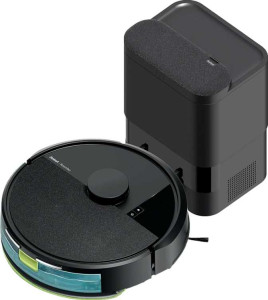
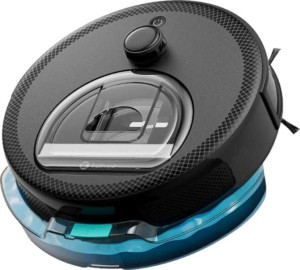
Across most features, the Roomba 104 and the M330 Pro are closely matched: both support no-go zones, obstacle and anti-fall sensors, route mapping, voice prompts, auto docking, smartphone control, and scheduling. Neither offers mopping in any form, and neither is self-emptying — so users needing hands-free bin management will have to look elsewhere regardless of which model they choose.
The meaningful splits come down to two features pulling in opposite directions. The Roomba 104 supports virtual barriers — a significant practical tool that lets users block off specific areas of a room without relying solely on app-based no-go zones, giving more flexible spatial control. The M330 Pro lacks this entirely. On the flip side, the M330 Pro includes a physical remote control, which can be genuinely useful for users who prefer not to reach for a smartphone for simple commands. The Roomba 104 has no remote. The other notable divergence is connectivity: the Roomba 104 supports Wi-Fi, enabling app-based control and cloud features, while the M330 Pro — despite listing a Wi-Fi version in the spec sheet — explicitly does not support Wi-Fi, meaning its smartphone control likely relies on Bluetooth or infrared rather than a persistent home network connection. This limits remote access when away from home.
On balance, the Roomba 104 holds a clearer feature advantage for connected, app-centric households: Wi-Fi support and virtual barriers together offer more granular control over cleaning zones and remote management. The M330 Pro's remote control is a convenience perk but a narrower benefit. Users who want robust smart home integration will find the Roomba 104 better equipped in this category.