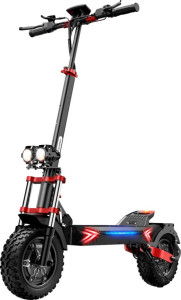
iScooter iX8
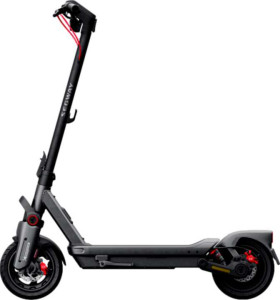
Ninebot by Segway eKickScooter Max G3

iScooter iX8 Ninebot by Segway eKickScooter Max G3

Overview

Welcome to our in-depth spec comparison between the iScooter iX8 and the Ninebot by Segway eKickScooter Max G3, two powerful adult electric scooters that share a surprisingly long list of features yet diverge sharply where it matters most. From motor power and top speed to battery capacity and charging time, these two machines represent notably different philosophies — making the choice between them anything but straightforward.

Common Features

  • Both scooters have a dedicated smartphone app.
  • Both scooters are equipped with pneumatic tires.
  • Neither scooter has a seat.
  • Both scooters can be folded.
  • Neither scooter is designed for kids.
  • Both scooters have front light(s).
  • Both scooters have rear light(s).
  • Neither scooter has dual motors.
  • Both scooters have a rear brake.
  • Both scooters have a front brake.
  • Both scooters support a maximum weight capacity of 150 kg.
  • Both scooters have a battery level indicator.
  • Both scooters feature regenerative braking.
  • Neither scooter has a removable battery.

Main Differences

  • Weight is 24900 g on iScooter iX8 and 24600 g on Ninebot by Segway eKickScooter Max G3.
  • Suspension is present on Ninebot by Segway eKickScooter Max G3 but not available on iScooter iX8.
  • Wheel diameter is 12″ on iScooter iX8 and 11″ on Ninebot by Segway eKickScooter Max G3.
  • Height is 1270 mm on iScooter iX8 and 1299 mm on Ninebot by Segway eKickScooter Max G3.
  • Width is 1240 mm on iScooter iX8 and 1218 mm on Ninebot by Segway eKickScooter Max G3.
  • Ingress Protection (IP) rating is IPX4 on iScooter iX8 and IPX6 on Ninebot by Segway eKickScooter Max G3.
  • Motor power is 2400 W on iScooter iX8 and 2000 W on Ninebot by Segway eKickScooter Max G3.
  • Top speed is 60 km/h on iScooter iX8 and 45 km/h on Ninebot by Segway eKickScooter Max G3.
  • Climbing angle is 25° on iScooter iX8 and 30° on Ninebot by Segway eKickScooter Max G3.
  • Charge time is 10 hours on iScooter iX8 and 3.5 hours on Ninebot by Segway eKickScooter Max G3.
  • Maximum distance per charge is 70 km on iScooter iX8 and 80 km on Ninebot by Segway eKickScooter Max G3.
  • Battery size is 960 Wh on iScooter iX8 and 597 Wh on Ninebot by Segway eKickScooter Max G3.
Specs Comparison
iScooter iX8

iScooter iX8

Ninebot by Segway eKickScooter Max G3

Ninebot by Segway eKickScooter Max G3

Design:
weight 24900 g 24600 g
has suspension
Has a dedicated smartphone app
has pneumatic tires
wheel diameter 12" 11"
has a seat
can be folded
is designed for kids
height 1270 mm 1299 mm
width 1240 mm 1218 mm
has front light(s)
has rear light(s)
Ingress Protection (IP) rating IPX4 IPX6
release date January 2025 January 2025

Both the iScooter iX8 and the Segway Max G3 share a broadly similar physical profile — foldable, adult-oriented builds with pneumatic tires, front and rear lighting, and smartphone app integration. Their weights are nearly identical (24,900 g vs. 24,600 g), meaning neither offers a meaningful handling advantage when it comes to carrying or storing the scooter. The dimensional differences are equally marginal and unlikely to affect everyday use.

Where the two scooters genuinely diverge is in ride quality and weather resilience. The Max G3 includes suspension, which the iX8 entirely lacks — a consequential difference on uneven urban surfaces, where an unsuspended scooter transmits every crack and bump directly to the rider. The iX8 partially compensates with slightly larger 12-inch wheels (vs. the G3's 11-inch), which do absorb minor road imperfections better by geometry alone, but this is not a substitute for dedicated suspension. On the water-resistance front, the G3's IPX6 rating — protection against powerful water jets — meaningfully outclasses the iX8's IPX4, which only guards against splashing. For riders in rainy climates or wet city streets, this gap matters.

Overall, the Segway Max G3 holds a clear design-category edge: its suspension system addresses a fundamental comfort limitation, and its superior IP rating offers broader all-weather usability. The iX8's slightly larger wheels are a genuine but limited counterpoint. Riders who prioritize ride smoothness and weather durability should favor the G3 on these specs alone.
Performance:
motor power 2400W 2000W
top speed 60 km/h 45 km/h
has dual motors
climbing angle 25° 30°
has a rear brake
has a front brake
maximum weight capacity 150kg 150kg

The most striking performance divergence between these two scooters is speed versus torque. The iScooter iX8 packs a 2,400W motor and reaches a claimed 60 km/h top speed — figures that place it firmly in high-performance territory. The Segway Max G3, by contrast, runs a 2,000W motor capped at 45 km/h. That 15 km/h gap is substantial in practice: the iX8 is meaningfully faster on open stretches, which may appeal to commuters covering longer distances, though it also raises important regulatory considerations in many jurisdictions where e-scooter speed is legally capped well below 60 km/h.

Flip the lens to hill-climbing, however, and the G3 reasserts itself. Its 30° climbing angle edges out the iX8's 25° — and this is not a trivial difference. A 30° grade is a genuinely steep incline; the G3's ability to handle it despite lower peak wattage suggests a motor tuned for sustained torque delivery rather than raw top-end speed. For riders in hilly urban environments, this translates directly to a more confident, less strained climb. Both scooters share identical 150 kg load capacities and dual front-and-rear braking systems, so neither has an edge in payload or stopping capability.

The performance verdict depends entirely on use case. The iX8 wins on outright speed, making it the more exhilarating — and potentially less road-legal — option. The Max G3 wins on gradient capability, offering a more versatile and practically tuned performance profile for varied terrain. Riders on flat commutes who prioritize pace lean toward the iX8; those navigating inclines regularly will find the G3 the more capable machine.

Battery:
charge time 10 hours 3.5 hours
maximum distance per charge 70 km 80 km
has a battery level indicator
Has regenerative braking
has a removable battery
battery size 960 Wh 597 Wh

The battery numbers here tell a genuinely counterintuitive story. The iScooter iX8 carries a substantially larger 960 Wh pack compared to the Segway Max G3's 597 Wh — a 61% capacity advantage — yet the G3 actually delivers a longer claimed range of 80 km versus the iX8's 70 km. This strongly implies that the iX8's higher-powered motor and greater top speed consume energy at a significantly less efficient rate, effectively negating its larger reservoir. In real-world terms, the G3 simply does more with less.

Charge time compounds this picture dramatically. The iX8 demands 10 hours to fully replenish — an overnight commitment at minimum — while the G3 recovers in just 3.5 hours, making mid-day top-ups entirely practical. For a daily commuter who cannot guarantee overnight charging access, this difference is operationally significant. Both scooters share regenerative braking and a battery level indicator, so neither holds an edge on those fronts, and neither offers a removable battery, ruling out the option of carrying a spare.

On balance, the Segway Max G3 holds a clear battery-category advantage. Greater real-world range combined with a charge time less than a third of the iX8's makes it the more practical choice for everyday use. The iX8's oversized pack fails to translate into superior range, and its slow replenishment rate is a meaningful daily inconvenience that the G3 simply does not impose on its rider.

Comparison Summary & Verdict

After examining the full spec sheet, both scooters prove to be capable, full-featured rides — but they clearly target different riders. The iScooter iX8 stands out with its larger 2400W motor, blistering 60 km/h top speed, and massive 960 Wh battery, making it ideal for performance-focused riders who prioritize raw power and are comfortable with a longer 10-hour charge cycle. The Ninebot by Segway eKickScooter Max G3, on the other hand, appeals to practical commuters who value its 3.5-hour fast charging, superior IPX6 water resistance, built-in suspension, and a slightly longer 80 km range despite a smaller battery. Choose the iX8 for speed and power; choose the Max G3 for everyday reliability and smarter efficiency.

iScooter iX8
Buy iScooter iX8 if...

Buy the iScooter iX8 if you want maximum power and top speed, and don't mind longer charging times in exchange for a high-capacity 960 Wh battery and a 60 km/h ride.

Ninebot by Segway eKickScooter Max G3
Buy Ninebot by Segway eKickScooter Max G3 if...

Buy the Ninebot by Segway eKickScooter Max G3 if you prioritize fast 3.5-hour charging, built-in suspension, superior IPX6 water resistance, and a longer range for everyday commuting.