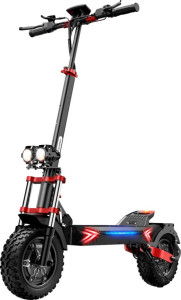
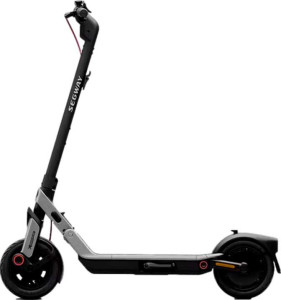
The most immediately practical difference between these two scooters is weight: the iScooter iX8 tips the scales at 24,900 g versus the Segway E3 Pro's 18,200 g — a gap of nearly 6.7 kg. Both are foldable, but that weight delta matters enormously when you need to carry the scooter up stairs, onto public transit, or into an office. The E3 Pro's lighter chassis makes it significantly more manageable as a true last-mile commuter tool, while the iX8's heft can become a genuine daily inconvenience despite its folding capability.
On ride quality, the two scooters take different approaches. The iX8 relies on its larger 12-inch pneumatic tires to absorb road vibration, while the E3 Pro pairs its 10-inch pneumatic tires with a dedicated suspension system. In practice, bigger wheels do roll over bumps and cracks more smoothly, but suspension actively dampens impacts in a way that passive tire size cannot fully replicate — especially on rougher urban surfaces. The E3 Pro's combination of suspension plus pneumatic tires gives it a more engineered ride comfort profile. The iX8's larger wheels may offer a marginal edge on very mild surface irregularities, but the E3 Pro's suspension advantage is more versatile.
Both scooters share a solid common baseline: pneumatic tires, front and rear lights, a dedicated smartphone app, and a foldable frame not designed for children. Where they diverge on weatherproofing, the E3 Pro holds a slight edge with an IPX5 rating versus the iX8's IPX4 — meaning the E3 Pro can withstand low-pressure water jets from any direction, making it more confidently usable in light rain. Overall, the Segway E3 Pro holds a clear design advantage: it is meaningfully lighter, has active suspension, and offers better water resistance — making it the more practical and refined everyday commuter of the two.