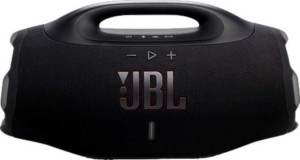
JBL Boombox 4
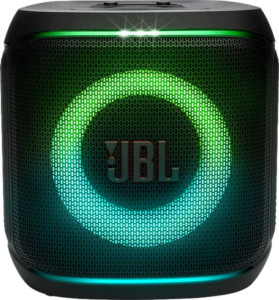
JBL Partybox Encore 2

JBL Boombox 4 JBL Partybox Encore 2

Overview

When choosing between the JBL Boombox 4 and the JBL Partybox Encore 2, you are weighing two very different takes on portable audio. Both share Bluetooth 5.4 and solid core features, yet they diverge sharply on water resistance, audio hardware, and battery endurance. This head-to-head comparison breaks down every key specification to help you decide which speaker truly fits your lifestyle.

Common Features

  • Both products have a control panel placed on the device.
  • Neither product includes a travel bag.
  • Neither product has a touch screen.
  • Neither product features RGB lighting.
  • Both products have a detachable cable.
  • Neither product is a neckband speaker.
  • Neither product comes with a remote control.
  • Both products share the same highest frequency of 20000 Hz.
  • Both products have a Signal-to-noise ratio (SNR) of 80 dB.
  • Neither product has magnetic shielding.
  • Both products have a battery level indicator.
  • Both products have a rechargeable battery.
  • Neither product has a removable battery.
  • Neither product supports wireless charging.
  • Both products use Bluetooth version 5.4.
  • Neither product supports Bluetooth pairing using NFC.
  • Neither product has a 3.5 mm audio jack socket.
  • Neither product supports aptX Lossless, LDAC, aptX Adaptive, aptX HD, or aptX.
  • Both products can be used wirelessly and support remote smartphone control.
  • Neither product has fast pairing or voice commands, but both have voice prompts and a sleep timer.

Main Differences

  • Ingress Protection rating is IP68 on JBL Boombox 4 and IPX4 on JBL Partybox Encore 2.
  • Water resistance is waterproof on JBL Boombox 4, while JBL Partybox Encore 2 is only sweat resistant.
  • Weight is 5890 g on JBL Boombox 4 and 6400 g on JBL Partybox Encore 2.
  • Height is 262.9 mm on JBL Boombox 4 and 338.6 mm on JBL Partybox Encore 2.
  • Width is 506.4 mm on JBL Boombox 4 and 319.5 mm on JBL Partybox Encore 2.
  • Thickness is 212.9 mm on JBL Boombox 4 and 263 mm on JBL Partybox Encore 2.
  • Volume is 28343.92 cm³ on JBL Boombox 4 and 28452.05 cm³ on JBL Partybox Encore 2.
  • Stereo speakers are present on JBL Boombox 4 but not available on JBL Partybox Encore 2.
  • A subwoofer is present on JBL Boombox 4 but not available on JBL Partybox Encore 2.
  • A passive radiator is present on JBL Boombox 4 but not available on JBL Partybox Encore 2.
  • Lowest frequency is 37 Hz on JBL Boombox 4 and 40 Hz on JBL Partybox Encore 2.
  • Battery power is 4584 mAh on JBL Boombox 4 and 4722 mAh on JBL Partybox Encore 2.
  • Battery life is 34 hours on JBL Boombox 4 and 15 hours on JBL Partybox Encore 2.
  • Charge time is 2 hours on JBL Boombox 4 and 3.5 hours on JBL Partybox Encore 2.
  • AUX input is available on JBL Partybox Encore 2 but not present on JBL Boombox 4.
  • Maximum Bluetooth range is 10 m on JBL Boombox 4 and 30 m on JBL Partybox Encore 2.
  • A microphone input is available on JBL Partybox Encore 2 but not present on JBL Boombox 4.
  • Stereo sound pairing support is available on JBL Partybox Encore 2 but not present on JBL Boombox 4.
Specs Comparison
JBL Boombox 4

JBL Boombox 4

JBL Partybox Encore 2

JBL Partybox Encore 2

Design:
Ingress Protection (IP) rating IP68 IPX4
volume 28343.922024 cm³ 28452.0501 cm³
control panel placed on a device
water resistance Waterproof Sweat resistant
travel bag is included
has a touch screen
has RGB lighting
has a detachable cable
is a neckband speaker
has a remote control
weight 5890 g 6400 g
height 262.9 mm 338.6 mm
width 506.4 mm 319.5 mm
thickness 212.9 mm 263 mm

The most consequential design difference between these two speakers lies in their water resistance. The JBL Boombox 4 carries an IP68 rating, meaning it is fully dustproof and can be submerged in water beyond 1 meter — a genuine outdoor and poolside companion. The JBL Partybox Encore 2, by contrast, is rated only IPX4, which covers light splashes and sweat but offers no protection against immersion or even heavy rain. For outdoor or rugged use, this is a decisive advantage for the Boombox 4.

Their physical profiles tell different stories despite nearly identical overall volumes (~28,340–28,450 cm³). The Boombox 4 is a wide, low-slung unit (506.4 × 262.9 × 212.9 mm), optimized for lying flat on a surface. The Partybox Encore 2 is taller and narrower (338.6 × 319.5 × 263 mm), giving it more of an upright party-speaker stance. Neither form factor is objectively superior — it comes down to placement preference and portability context. However, the Boombox 4 is notably lighter at 5,890 g versus the Encore 2's 6,400 g, a roughly 500 g difference that becomes meaningful when carrying the speaker over longer distances.

Both speakers share several design traits: a control panel on the device, a detachable cable, and no touch screen, RGB lighting, remote control, or included travel bag. These shared omissions mean neither product has a convenience edge in those areas. Overall, the Boombox 4 holds a clear design advantage for anyone prioritizing durability and portability, while the Partybox Encore 2's taller form factor may suit stationary indoor party setups better.
Sound quality:
has stereo speakers
has a subwoofer
highest frequency 20000 Hz 20000 Hz
lowest frequency 37 Hz 40 Hz
Has a passive radiator
Signal-to-noise ratio (SNR) 80 dB 80 dB
has a magnetic shielding

The speaker architecture gap here is significant. The JBL Boombox 4 features stereo speakers, a dedicated subwoofer, and passive radiators — a combination that delivers spatial separation between left and right channels, reinforced low-end punch, and extended bass response through the radiators' resonance. The JBL Partybox Encore 2, by contrast, is a mono speaker with no subwoofer and no passive radiators. In practice, this means the Encore 2 cannot reproduce the same sense of width or depth in a soundstage, and its bass will rely solely on its drivers without mechanical bass-enhancement support.

On frequency range, the Boombox 4 reaches down to 37 Hz versus the Encore 2's 40 Hz floor. While a 3 Hz difference is narrow on paper, it sits right in the sub-bass region where kick drums and deep bass lines live — and the Boombox 4's subwoofer and passive radiators are precisely what allow it to reproduce those frequencies with authority rather than just technically reaching them. Both top out at 20,000 Hz, so high-frequency extension is equal. The SNR of 80 dB is also identical on both, meaning background noise and signal cleanliness are comparable.

For sound quality, the Boombox 4 holds a clear and substantial advantage. Its stereo configuration, dedicated subwoofer, and passive radiators represent a fundamentally more capable acoustic architecture. The Partybox Encore 2 does not compete on the same technical level in this category — its strengths likely lie elsewhere, but purely on sound reproduction specs, it trails noticeably.

Power:
battery power 4584 mAh 4722 mAh
Battery life 34 hours 15 hours
charge time 2 hours 3.5 hours
has a battery level indicator
has a rechargeable battery
has a removable battery
has wireless charging

Despite carrying nearly identical battery capacities — 4,584 mAh for the Boombox 4 versus 4,722 mAh for the Partybox Encore 2 — the two speakers deliver dramatically different runtime results. The Boombox 4 runs for 34 hours on a single charge, while the Encore 2 manages only 15 hours. This more than 2x difference in battery life, drawn from essentially the same energy reserve, points strongly to the Encore 2 drawing significantly more power — likely driven by its amplifier demands or other internal components. For extended outdoor sessions or multi-day trips without reliable power access, this gap is very meaningful.

Charging efficiency further separates the two. The Boombox 4 fully replenishes in 2 hours, while the Encore 2 requires 3.5 hours — a 75% longer wait. Combined with its shorter runtime, this means the Encore 2 will cycle through charges more frequently and take longer to recover each time. Neither speaker offers wireless charging or a removable battery, so these charge times represent the only path to repowering both units.

The Boombox 4 holds a decisive advantage in this category. Its dramatically longer battery life and faster charge time make it a far more practical choice for untethered use, even though its raw battery capacity is fractionally smaller. The Encore 2's power efficiency is notably lower, which users should factor in if portability and all-day playback are priorities.

Connectivity:
Bluetooth version 5.4 5.4
supports Bluetooth pairing using NFC
has a socket for a 3.5 mm audio jack
has an AUX input
has aptX Lossless
has LDAC
has aptX Adaptive
has aptX HD
has aptX
has aptX Low Latency
has AAC
has AirPlay
has Chromecast built-in
has Auracast
has Bluetooth LE Audio
maximum Bluetooth range 10 m 30 m
supports Wi-Fi
USB ports 1 1
Has USB Type-C
has a 3.5mm male connector
has an external memory slot
is DLNA-certified
supports Ethernet
has a microphone input

Both speakers share a strong connectivity baseline: Bluetooth 5.4, Auracast broadcast support, a USB Type-C port, and no Wi-Fi or NFC. Neither supports any of the premium Bluetooth audio codecs (aptX, LDAC, AAC), so wireless audio quality is capped at standard SBC for both. Where they diverge is in range and physical input options — and those differences matter for specific use cases.

The Partybox Encore 2 pulls ahead on Bluetooth range at 30 m versus the Boombox 4's 10 m. A 3x range advantage is practically significant in open spaces like backyards or event halls, where a phone or source device may not stay close to the speaker. The Encore 2 also adds an AUX input and a microphone input — two features absent on the Boombox 4. The AUX jack enables wired connectivity from any analog source without depending on Bluetooth, while the microphone input opens the door to live vocal use, karaoke, or announcements — reinforcing its party-oriented positioning.

For connectivity, the Partybox Encore 2 has a clear edge. Its superior Bluetooth range, wired AUX fallback, and microphone input collectively offer more flexibility than the Boombox 4, which is notably stripped down in this category. Users who need only simple wireless streaming will find both adequate, but anyone requiring extended range or additional input options will find the Encore 2 significantly more capable.

Features:
release date July 2025 February 2025
Can be used wirelessly
supports a remote smartphone
has fast pairing
has voice commands
Has a radio
Has voice prompts
has a mute function
has a sleep timer

Across every feature spec in this category, the JBL Boombox 4 and JBL Partybox Encore 2 are identical. Both support wireless use and remote smartphone control, include voice prompts for status feedback, and offer a sleep timer for automated shutoff. Neither provides fast pairing, voice commands, a radio, or a mute function.

The shared smartphone remote support is worth noting as a practical convenience — users can manage playback from their device without physically interacting with the speaker. Voice prompts similarly add usability value by confirming connections and battery status audibly. The sleep timer is a minor but appreciated feature for overnight or background playback scenarios. None of these, however, distinguish one product from the other.

This category is a complete tie. There is no feature listed here that gives either speaker any advantage over the other — both offer the same set of capabilities and share the same omissions. Users making a decision between these two products should look to other spec groups for differentiation.

Miscellaneous:
supports pairing for stereo sound

This category comes down to a single but meaningful distinction: stereo pairing support. The JBL Partybox Encore 2 supports pairing two units together for true stereo sound, while the JBL Boombox 4 does not. For users who own or plan to own two of the same speaker, this capability allows dedicated left and right channel separation across a wider physical space — a genuine upgrade to the listening experience in larger rooms or outdoor settings.

The irony here is notable given the context of the broader comparison: the Boombox 4 already has built-in stereo speakers, meaning it delivers stereo sound from a single unit. The Encore 2, a mono speaker, can only achieve stereo by pairing two devices together. So while the Encore 2 gains a point in this category, its stereo pairing feature is essentially compensating for its single-speaker architecture rather than extending an already stereo setup.

Still, on the spec provided, the Partybox Encore 2 holds the edge here — it offers a multi-unit stereo expansion option that the Boombox 4 simply does not. For users who want to scale up coverage across a venue using two speakers, only the Encore 2 makes that possible.

Comparison Summary & Verdict

After examining every specification, these two speakers clearly target different users. The JBL Boombox 4 stands out with its IP68 full waterproof rating, impressive 34-hour battery life, faster 2-hour charge time, stereo speakers, subwoofer, and passive radiator — making it the better choice for outdoor adventurers who demand rugged durability and long-lasting audio. The JBL Partybox Encore 2, on the other hand, appeals to those who prioritize microphone and AUX input connectivity, a longer 30-metre Bluetooth range, and stereo pairing support — ideal for home gatherings and live performances. Neither product is an absolute winner; your decision should hinge on whether portability and endurance or versatile connectivity matters most to you.

JBL Boombox 4
Buy JBL Boombox 4 if...

Buy the JBL Boombox 4 if you need a fully waterproof speaker with exceptional 34-hour battery life and superior audio hardware including a subwoofer and stereo speakers.

JBL Partybox Encore 2
Buy JBL Partybox Encore 2 if...

Buy the JBL Partybox Encore 2 if you want versatile connectivity with AUX and microphone inputs, a longer Bluetooth range, and support for stereo speaker pairing.