JBL Boombox 4
LG XBoom Stage 301

JBL Boombox 4 LG XBoom Stage 301

Overview

Welcome to our in-depth spec comparison between the JBL Boombox 4 and the LG XBoom Stage 301 — two powerful portable speakers that take noticeably different approaches to audio performance, durability, and endurance. From their contrasting water resistance ratings to their strikingly different battery life figures, these two compete on multiple fronts worth examining closely before making a purchase decision.

Common Features

  • Both products have a control panel placed on the device.
  • Neither product includes a travel bag.
  • Neither product has a touch screen.
  • Both products have a detachable cable.
  • Neither product is a neckband speaker.
  • Neither product includes a remote control.
  • Both products share the same highest frequency of 20000 Hz.
  • Neither product has magnetic shielding.
  • Both products have a battery level indicator.
  • Both products have a rechargeable battery.
  • Neither product has a removable battery.
  • Neither product supports wireless charging.
  • Neither product supports Bluetooth pairing using NFC.
  • Neither product has a 3.5 mm audio jack socket.
  • Neither product has an AUX input.
  • Neither product supports aptX Lossless, LDAC, aptX Adaptive, aptX HD, or aptX.
  • Both products can be used wirelessly.
  • Both products support remote smartphone control.
  • Fast pairing is not available on either product.
  • Voice commands are not supported on either product.
  • Neither product has a radio.
  • Both products have voice prompts.
  • Neither product has a mute function.
  • Both products have a sleep timer.

Main Differences

  • Ingress Protection rating is IP68 on JBL Boombox 4 and IPX4 on LG XBoom Stage 301.
  • Volume is 28343.92 cm³ on JBL Boombox 4 and 28861.50 cm³ on LG XBoom Stage 301.
  • Water resistance is waterproof on JBL Boombox 4 and sweat resistant on LG XBoom Stage 301.
  • Built-in subwoofer size is 127 mm on JBL Boombox 4 and 165 mm on LG XBoom Stage 301.
  • RGB lighting is present on LG XBoom Stage 301 but not available on JBL Boombox 4.
  • Weight is 5890 g on JBL Boombox 4 and 6168.86 g on LG XBoom Stage 301.
  • Height is 262.9 mm on JBL Boombox 4 and 327.66 mm on LG XBoom Stage 301.
  • Width is 506.4 mm on JBL Boombox 4 and 312.42 mm on LG XBoom Stage 301.
  • Thickness is 212.9 mm on JBL Boombox 4 and 281.94 mm on LG XBoom Stage 301.
  • Stereo speakers are present on JBL Boombox 4 but not available on LG XBoom Stage 301.
  • A subwoofer is present on JBL Boombox 4 but not included on LG XBoom Stage 301.
  • Lowest frequency is 37 Hz on JBL Boombox 4 and 20 Hz on LG XBoom Stage 301.
  • Audio output power is 4 x 200W on JBL Boombox 4 and 3 x 40W on LG XBoom Stage 301.
  • Battery power is 4584 mAh on JBL Boombox 4 and 4700 mAh on LG XBoom Stage 301.
  • Battery life is 34 hours on JBL Boombox 4 and 12 hours on LG XBoom Stage 301.
  • Charge time is 2 hours on JBL Boombox 4 and 3 hours on LG XBoom Stage 301.
  • Bluetooth version is 5.4 on JBL Boombox 4 and 5.3 on LG XBoom Stage 301.
  • AAC support is present on LG XBoom Stage 301 but not available on JBL Boombox 4.
  • Stereo sound pairing support is available on LG XBoom Stage 301 but not on JBL Boombox 4.
Specs Comparison
JBL Boombox 4

JBL Boombox 4

LG XBoom Stage 301

LG XBoom Stage 301

Design:
Ingress Protection (IP) rating IP68 IPX4
volume 28343.922024 cm³ 28861.503438168 cm³
control panel placed on a device
water resistance Waterproof Sweat resistant
travel bag is included
has a touch screen
built-in subwoofer size 127 mm 165 mm
has RGB lighting
has a detachable cable
is a neckband speaker
has a remote control
weight 5890 g 6168.86 g
height 262.9 mm 327.66 mm
width 506.4 mm 312.42 mm
thickness 212.9 mm 281.94 mm

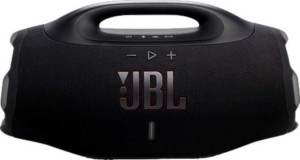
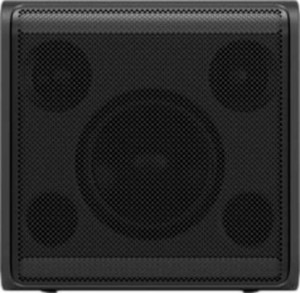
Despite occupying nearly identical overall volumes (both just under 29,000 cm³), the JBL Boombox 4 and LG XBoom Stage 301 take fundamentally different physical approaches. The Boombox 4 is built wide and low — 506.4 mm wide but only 212.9 mm deep — giving it a classic horizontal boombox silhouette that sits close to a surface. The XBoom Stage 301, by contrast, is more cubic and upright at 312.42 × 327.66 × 281.94 mm, which may suit tighter spaces or tabletop placement better. Both weigh in at the heavy end — 5,890 g versus 6,169 g — so neither is designed for easy portability; the weight difference is negligible in practice.

The most consequential design difference is water protection. The Boombox 4 carries an IP68 rating, meaning it is fully dustproof and can be submerged in water beyond 1 meter — making it genuinely pool- or beach-ready. The XBoom Stage 301 is rated only IPX4, which covers splashes and sweat but nothing more. For outdoor or wet-environment use, this is a significant gap. On the other hand, the XBoom Stage 301 includes RGB lighting, which the Boombox 4 lacks entirely — a clear aesthetic advantage for party or ambient-lighting scenarios. Its larger 165 mm built-in subwoofer (versus 127 mm on the Boombox 4) also hints at a design philosophy that prioritizes low-frequency output within the same cabinet volume.

Overall, the JBL Boombox 4 holds a clear edge for rugged, outdoor-oriented design thanks to its superior IP68 protection and lower profile form factor. The LG XBoom Stage 301 trades that durability for visual flair and a larger subwoofer driver, making it better suited for indoor entertainment settings where weather resistance is a non-issue.
Sound quality:
has stereo speakers
has a subwoofer
highest frequency 20000 Hz 20000 Hz
lowest frequency 37 Hz 20 Hz
audio output power 4 x 200W 3 x 40W
has a magnetic shielding

The raw power figures alone tell a striking story: the JBL Boombox 4 delivers 4 × 200W of audio output — 800W total — while the LG XBoom Stage 301 produces just 3 × 40W (120W total). That is a more than sixfold difference in rated output power, which in practice translates to dramatically higher maximum volume levels and greater headroom before distortion sets in. For large outdoor gatherings or filling a big room, the Boombox 4 operates in an entirely different class of loudness.

Speaker configuration reinforces this gap. The Boombox 4 features stereo speakers and a dedicated subwoofer, meaning bass, midrange, and treble are handled by purpose-built drivers with proper channel separation — a setup that produces spatial depth and punchier low-end. The XBoom Stage 301 lists neither stereo speakers nor a subwoofer in this spec group, which is a notable contrast given its larger physical subwoofer driver noted in the design specs. On frequency range, however, the LG edges narrowly ahead at the low end: 20 Hz versus 37 Hz for the Boombox 4, meaning the XBoom Stage 301 theoretically reaches deeper into sub-bass territory — though the real-world audibility of this difference depends heavily on driver performance.

The JBL Boombox 4 holds a commanding advantage in this category. Its combination of massively higher output power and a proper stereo-plus-subwoofer configuration makes it the clear choice for listeners who prioritize volume, spatial soundstage, and dynamic range. The XBoom Stage 301's slightly wider frequency floor is an interesting data point but is far outweighed by the Boombox 4's structural and power advantages.

Power:
battery power 4584 mAh 4700 mAh
Battery life 34 hours 12 hours
charge time 2 hours 3 hours
has a battery level indicator
has a rechargeable battery
has a removable battery
has wireless charging

Battery capacity is nearly identical between these two speakers — 4,584 mAh for the JBL Boombox 4 versus 4,700 mAh for the LG XBoom Stage 301 — yet their real-world battery life diverges dramatically. The Boombox 4 is rated for an exceptional 34 hours of playback, while the XBoom Stage 301 manages just 12 hours. This near-threefold difference from a near-identical cell strongly suggests that the Boombox 4 operates at significantly lower average power draw, which aligns with its much lower total amplifier wattage relative to the XBoom's configuration.

Charging efficiency also favors the Boombox 4. It replenishes fully in 2 hours compared to 3 hours for the XBoom Stage 301 — meaning not only does the JBL last far longer per charge, it also gets back to full capacity faster. For extended outdoor use or situations where access to power is limited, this combination is a meaningful practical advantage. Both speakers share the same baseline conveniences: a battery level indicator, a rechargeable non-removable cell, and no wireless charging.

The JBL Boombox 4 wins this category decisively. A 34-hour battery life that charges in 2 hours is genuinely class-leading for a speaker of this size, and the XBoom Stage 301's 12-hour runtime — while adequate for a day's use — simply cannot compete for multi-day or high-endurance scenarios.

Connectivity:
Bluetooth version 5.4 5.3
supports Bluetooth pairing using NFC
has a socket for a 3.5 mm audio jack
has an AUX input
has aptX Lossless
has LDAC
has aptX Adaptive
has aptX HD
has aptX
has aptX Low Latency
has AAC
has AirPlay
has Chromecast built-in
has Auracast
has Bluetooth LE Audio
maximum Bluetooth range 10 m 10 m
supports Wi-Fi
USB ports 1 1
Has USB Type-C
has a 3.5mm male connector
has an external memory slot
is DLNA-certified
supports Ethernet
has a microphone input

Connectivity is strikingly similar across both speakers, with a few meaningful distinctions worth unpacking. Both share a 10 m Bluetooth range, a single USB Type-C port, and support for Auracast — a Bluetooth broadcast feature that allows one source to stream simultaneously to multiple listeners or speakers, which is a forward-looking addition neither competitor commonly includes at this price tier. Neither device offers Wi-Fi, AUX input, or a 3.5mm jack, so wireless Bluetooth is the sole audio transmission path for both.

Where they diverge is in Bluetooth version and codec support. The JBL Boombox 4 runs Bluetooth 5.4, the newer standard, which brings marginal improvements in connection stability and efficiency over the Bluetooth 5.3 found in the LG XBoom Stage 301. More practically relevant is that the XBoom Stage 301 supports AAC, while the Boombox 4 does not — meaning Apple device users streaming via the LG will benefit from a higher-quality compressed audio codec rather than falling back to the baseline SBC codec. Neither speaker supports any of the higher-fidelity codecs such as aptX, LDAC, or aptX Adaptive.

This category is essentially a near-tie, with each product holding one advantage over the other. The Boombox 4 offers a marginally newer Bluetooth version, while the XBoom Stage 301's AAC support makes it a noticeably better pairing for iOS and macOS users. For everyone else, the connectivity experience is functionally identical.

Features:
release date July 2025 April 2025
Can be used wirelessly
supports a remote smartphone
has fast pairing
has voice commands
Has a radio
Has voice prompts
has a mute function
has a sleep timer

Across every feature data point provided, the JBL Boombox 4 and LG XBoom Stage 301 are a perfect match. Both support wireless operation and remote smartphone control, meaning users can manage playback from their phone without touching the speaker — a standard but welcome convenience for a device of this size. Both also include voice prompts and a sleep timer, rounding out a functionally identical feature set.

This is a complete tie. Based strictly on the provided specs, there is no differentiator in this category that favors either product — every listed capability is shared equally between the two.

Miscellaneous:
supports pairing for stereo sound

This category comes down to a single but genuinely useful differentiator: stereo pairing. The LG XBoom Stage 301 supports pairing two units together for true stereo sound, while the JBL Boombox 4 does not. For users who own — or plan to own — two of the same speaker, this capability allows one unit to handle the left channel and the other the right, creating a spatially separated soundstage that a single speaker physically cannot replicate. It is a feature that meaningfully expands the LG's versatility in home or event setups.

The LG XBoom Stage 301 takes a clear edge here. While this is the only data point in this group, it is not a trivial one — stereo pairing is a deliberate design choice that adds real value for users willing to invest in a two-speaker setup.

Comparison Summary & Verdict

After reviewing all the specifications, the JBL Boombox 4 and LG XBoom Stage 301 each carve out a distinct niche. The JBL Boombox 4 stands out with its impressive 34-hour battery life, faster 2-hour charge time, full IP68 waterproof rating, and considerably higher audio output of 4 x 200W with dedicated stereo speakers and a subwoofer — making it ideal for outdoor adventurers and audiophiles who demand power and endurance. The LG XBoom Stage 301, on the other hand, appeals to those who value deeper bass extension down to 20 Hz, a larger 165 mm subwoofer, RGB lighting, AAC codec support, and stereo sound pairing — positioning it as a strong pick for home entertainment and social gatherings where ambiance and connectivity flexibility matter most.

JBL Boombox 4
Buy JBL Boombox 4 if...

Buy the JBL Boombox 4 if you need a rugged, fully waterproof speaker with exceptional battery life of 34 hours and significantly higher audio output power for outdoor or on-the-go use.

LG XBoom Stage 301
Buy LG XBoom Stage 301 if...

Buy the LG XBoom Stage 301 if you prefer deeper bass extension down to 20 Hz, RGB lighting ambiance, AAC support, and the ability to pair two units for stereo sound in a home or social setting.