JBL Boombox 4
Sony ULT Field 5

JBL Boombox 4 Sony ULT Field 5

Overview

Welcome to our in-depth specification comparison between the JBL Boombox 4 and the Sony ULT Field 5. These two portable Bluetooth speakers take notably different approaches to outdoor audio, and choosing between them is far from straightforward. In this head-to-head, we examine the key battlegrounds: build size and durability, sound engineering, battery endurance, and connectivity options — to help you determine which speaker truly fits your lifestyle.

Common Features

  • Both products have a control panel placed on the device.
  • Neither product includes a travel bag.
  • Neither product has a touch screen.
  • Neither product is a neckband speaker.
  • Neither product has a remote control.
  • Both products reach a highest frequency of 20000 Hz.
  • Both products feature a passive radiator.
  • Both products have a battery level indicator.
  • Both products have a rechargeable battery.
  • Neither product has a removable battery.
  • Neither product supports wireless charging.
  • Neither product supports Bluetooth pairing using NFC.
  • Neither product has a 3.5 mm audio jack socket.
  • Neither product supports aptX Lossless, aptX Adaptive, aptX HD, aptX, aptX Low Latency, or AAC.
  • Both products can be used wirelessly.
  • Both products support remote smartphone control.
  • Neither product has fast pairing.
  • Neither product supports voice commands.
  • Neither product has a radio.
  • Both products have voice prompts, a mute function is absent on both, and both include a sleep timer.

Main Differences

  • The Ingress Protection rating is IP68 on the JBL Boombox 4 and IP66 on the Sony ULT Field 5.
  • The volume is 28343.922024 cm³ on the JBL Boombox 4 and 5760 cm³ on the Sony ULT Field 5.
  • The JBL Boombox 4 is fully waterproof, while the Sony ULT Field 5 is only water resistant.
  • RGB lighting is present on the Sony ULT Field 5 but not available on the JBL Boombox 4.
  • A detachable cable is available on the JBL Boombox 4 but not on the Sony ULT Field 5.
  • The weight is 5890 g on the JBL Boombox 4 and 3300 g on the Sony ULT Field 5.
  • The height is 262.9 mm on the JBL Boombox 4 and 144 mm on the Sony ULT Field 5.
  • The width is 506.4 mm on the JBL Boombox 4 and 320 mm on the Sony ULT Field 5.
  • The thickness is 212.9 mm on the JBL Boombox 4 and 125 mm on the Sony ULT Field 5.
  • A subwoofer is present on the JBL Boombox 4 but not on the Sony ULT Field 5.
  • The lowest frequency is 37 Hz on the JBL Boombox 4 and 20 Hz on the Sony ULT Field 5.
  • Battery life is 34 hours on the JBL Boombox 4 and 25 hours on the Sony ULT Field 5.
  • The Bluetooth version is 5.4 on the JBL Boombox 4 and 5.3 on the Sony ULT Field 5.
  • An AUX input is available on the Sony ULT Field 5 but not on the JBL Boombox 4.
  • LDAC support is present on the Sony ULT Field 5 but not available on the JBL Boombox 4.
  • Auracast support is present on the JBL Boombox 4 but not available on the Sony ULT Field 5.
  • Stereo sound pairing is supported on the Sony ULT Field 5 but not on the JBL Boombox 4.
Specs Comparison
JBL Boombox 4

JBL Boombox 4

Sony ULT Field 5

Sony ULT Field 5

Design:
Ingress Protection (IP) rating IP68 IP66
volume 28343.922024 cm³ 5760 cm³
control panel placed on a device
water resistance Waterproof Water resistant
travel bag is included
has a touch screen
has RGB lighting
has a detachable cable
is a neckband speaker
has a remote control
weight 5890 g 3300 g
height 262.9 mm 144 mm
width 506.4 mm 320 mm
thickness 212.9 mm 125 mm

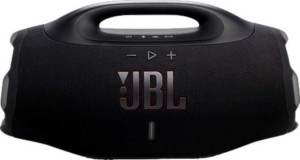
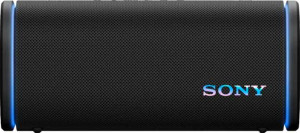
The most defining design difference between these two speakers is sheer scale. The JBL Boombox 4 is a large, party-grade unit measuring 506 × 262 × 212 mm and weighing 5,890 g, giving it a volume of roughly 28,344 cm³. The Sony ULT Field 5, by contrast, is a far more compact and portable proposition at 320 × 144 × 125 mm and 3,300 g — less than half the weight and roughly one-fifth the physical volume. In practice, this means the Boombox 4 is a carry-to-the-beach, set-it-down speaker, while the ULT Field 5 can realistically be tossed into a backpack without a second thought.

On weather protection, the JBL holds a meaningful edge: its IP68 rating means it can be submerged in water, whereas the Sony's IP66 rating covers only powerful water jets and rain — not submersion. For poolside or boat use where the speaker might actually go underwater, this distinction matters. One counterpoint in Sony's favor is its RGB lighting, absent on the JBL, which adds visual flair for evening or indoor settings. The JBL's detachable cable is also a practical advantage the Sony lacks, making replacement or custom setups easier.

Overall, the JBL Boombox 4 has a clear edge in ruggedness and water protection, while the Sony ULT Field 5 wins decisively on portability and adds RGB aesthetics. The choice between them hinges on use case: if you need a robust, high-mass speaker that can survive full immersion, the JBL is the stronger design; if portability and visual personality matter more, the Sony is the more practical everyday companion.
Sound quality:
has a subwoofer
highest frequency 20000 Hz 20000 Hz
lowest frequency 37 Hz 20 Hz
Has a passive radiator

Both speakers share the same upper limit of 20,000 Hz, covering the full range of human hearing on the high end. The more telling difference is at the low end: the Sony ULT Field 5 reaches down to 20 Hz, the very floor of audible bass, while the JBL Boombox 4 bottoms out at 37 Hz. On paper, that gives the Sony a lower frequency floor — but context matters here, since both products use a passive radiator to reinforce bass output without a dedicated ported enclosure, which is a well-regarded approach for tight, punchy low-end extension in sealed cabinets.

Where the JBL asserts a structural advantage is its dedicated subwoofer driver, which the Sony lacks entirely. A discrete subwoofer is purpose-built to move air at low frequencies with greater efficiency and authority than a full-range driver handling bass on the side. In real-world listening, this typically translates to bass that feels more physical and room-filling — especially relevant given the Boombox 4's much larger cabinet, which can accommodate a bigger driver with more excursion. The Sony's lower rated frequency floor is interesting, but without a subwoofer to back it up, sustaining clean, high-volume output at 20 Hz is considerably more demanding on its drivers.

For sound quality in this category, the JBL Boombox 4 holds the edge. Its combination of a dedicated subwoofer and passive radiator represents a more capable hardware architecture for reproducing deep bass convincingly at volume. The Sony's extended frequency rating is a noteworthy spec, but the absence of a subwoofer means the JBL is the stronger choice for users who prioritize impactful, low-frequency performance.

Power:
Battery life 34 hours 25 hours
has a battery level indicator
has a rechargeable battery
has a removable battery
has wireless charging

Battery life is where these two speakers diverge most clearly in this category. The JBL Boombox 4 is rated for 34 hours of playback, versus 25 hours for the Sony ULT Field 5 — a gap of nearly a full third more runtime. For extended outdoor use, festivals, or multi-day trips where access to a power outlet is limited, that extra nine hours is a genuinely meaningful buffer rather than a marginal difference.

Beyond that headline figure, both speakers are evenly matched in their power architecture: both feature rechargeable, non-removable batteries, no wireless charging, and a battery level indicator. The indicator is a small but practical inclusion on both, letting users gauge remaining runtime without guessing. The absence of wireless charging on either device is unsurprising given their size class and outdoor focus, where Qi pads are rarely at hand anyway.

The JBL Boombox 4 takes a clear edge in this group purely on endurance. With no other differentiating power features between them, the 34-hour rating is the deciding factor — making it the stronger choice for anyone who prioritizes going longer between charges.

Connectivity:
Bluetooth version 5.4 5.3
supports Bluetooth pairing using NFC
has a socket for a 3.5 mm audio jack
has an AUX input
has aptX Lossless
has LDAC
has aptX Adaptive
has aptX HD
has aptX
has aptX Low Latency
has AAC
has AirPlay
has Chromecast built-in
has Auracast
has Bluetooth LE Audio
maximum Bluetooth range 10 m 10 m
supports Wi-Fi
USB ports 1 1
Has USB Type-C
has a 3.5mm male connector
has an external memory slot
is DLNA-certified
supports Ethernet
has a microphone input

Connectivity between these two speakers is largely symmetric, but a handful of meaningful differences emerge on closer inspection. Both operate over the same 10 m Bluetooth range and share a USB Type-C port, while neither supports Wi-Fi, NFC pairing, AirPlay, or Chromecast. The JBL runs Bluetooth 5.4 versus the Sony's 5.3 — a minor generational step that brings marginal improvements in connection efficiency, though neither difference is dramatic enough to be perceptible in everyday use.

The more consequential split is in codec and input support. The Sony ULT Field 5 supports LDAC, Sony's high-resolution audio codec capable of transmitting up to three times the data of standard Bluetooth SBC — a real advantage when streaming from a compatible Android source, delivering noticeably higher audio fidelity wirelessly. It also includes an AUX input, which the JBL entirely lacks, making it the only option here for wired playback from devices without Bluetooth. The JBL Boombox 4 counters with Auracast support, a Bluetooth broadcast feature that allows audio to be shared simultaneously with multiple listeners or speakers — useful in public or group settings, but a niche advantage compared to the Sony's more universally applicable additions.

On balance, the Sony ULT Field 5 holds the connectivity edge for most users. LDAC delivers tangible audio quality benefits for compatible sources, and the AUX input adds a wired fallback that the JBL simply cannot match. The JBL's Auracast capability is a forward-looking feature, but one with limited practical utility today, making the Sony the more versatile option in this category.

Features:
release date July 2025 April 2025
Can be used wirelessly
supports a remote smartphone
has fast pairing
has voice commands
Has a radio
Has voice prompts
has a mute function
has a sleep timer

Across every feature tracked in this category, the JBL Boombox 4 and Sony ULT Field 5 are in complete lockstep. Both support wireless operation and smartphone remote control, allowing users to manage playback from their phone without touching the speaker — a standard but welcome convenience for either device placed across a room or at a distance outdoors. Both also include voice prompts and a sleep timer, rounding out a feature set that is functionally identical between them.

This is a clear tie. There is not a single differentiating feature within this spec group to separate the two products, and declaring an edge for either would be unsupported by the data. Users evaluating these speakers on features alone should look to other categories — connectivity, sound quality, or design — to inform their decision.

Miscellaneous:
supports pairing for stereo sound

This category comes down to a single but genuinely useful capability: stereo pairing. The Sony ULT Field 5 supports pairing two units together to create a dedicated left/right stereo setup, while the JBL Boombox 4 does not offer this feature at all. For users who already own — or plan to own — two of the same speaker, this unlocks a meaningfully wider, more spatially immersive soundstage compared to what any single mono or internally-stereo speaker can produce on its own.

The practical value of stereo pairing scales with the listening environment. In a larger outdoor space or a living room setting, true separated stereo channels add depth and directionality to music that a single enclosure simply cannot replicate. The absence of this feature on the Boombox 4 is a real limitation for users interested in expanding their setup over time.

The Sony ULT Field 5 holds the clear edge here. With stereo pairing being the sole data point in this group, it is an unambiguous advantage — one that adds long-term flexibility the JBL cannot match.

Comparison Summary & Verdict

After reviewing every specification, it is clear that the JBL Boombox 4 and the Sony ULT Field 5 are built for very different audiences. The Boombox 4 dominates in raw scale and resilience, offering a full IP68 waterproof rating, a dedicated subwoofer, an impressive 34-hour battery life, and Auracast support — making it the go-to choice for those who demand serious, long-lasting audio power in demanding environments. The Sony ULT Field 5, on the other hand, prioritizes portability and versatility: it is significantly lighter at 3300 g, supports LDAC high-resolution audio, includes an AUX input, enables stereo pairing, and even adds RGB lighting for a more expressive look. Choose the JBL Boombox 4 if sheer endurance and maximum protection are your priorities. Opt for the Sony ULT Field 5 if you value a more compact, feature-rich, and connectivity-flexible speaker for everyday use.

JBL Boombox 4
Buy JBL Boombox 4 if...

Buy the JBL Boombox 4 if you need a fully waterproof (IP68), high-endurance speaker with a built-in subwoofer and up to 34 hours of battery life for extended outdoor sessions.

Sony ULT Field 5
Buy Sony ULT Field 5 if...

Buy the Sony ULT Field 5 if you want a lighter, more portable speaker with LDAC support, stereo pairing, an AUX input, and RGB lighting for versatile everyday use.