JBL Flip 7
LG XBoom Grab

JBL Flip 7 LG XBoom Grab

Overview

Welcome to our detailed spec comparison between the JBL Flip 7 and the LG XBoom Grab — two portable Bluetooth speakers that share a waterproof build but take notably different approaches to size, battery life, and connectivity features. Whether you value a more compact form factor or extended playback time, this side-by-side breakdown will help you find the right fit for your listening lifestyle.

Common Features

  • Both products have a control panel placed on the device.
  • Both products are waterproof.
  • Neither product includes a travel bag.
  • Neither product has a touch screen.
  • Both products have a detachable cable.
  • Neither product is a neckband speaker.
  • Neither product has a remote control.
  • Neither product has stereo speakers.
  • Both products have a passive radiator.
  • Neither product has a noise-canceling microphone.
  • Both products have a battery level indicator.
  • Both products have a rechargeable battery.
  • Neither product has a removable battery.
  • Neither product supports wireless charging.
  • Neither product supports Bluetooth pairing using NFC.
  • Neither product has a 3.5 mm audio jack socket or AUX input.
  • Neither product supports aptX, aptX HD, aptX Adaptive, aptX Lossless, or LDAC.
  • Both products can be used wirelessly and support remote smartphone control.
  • Neither product has fast pairing or a built-in radio.
  • Both products have voice prompts, a sleep timer, and support stereo sound pairing.
  • Neither product works as a power bank.

Main Differences

  • The Ingress Protection rating is IP68 on the JBL Flip 7 and IP67 on the LG XBoom Grab.
  • The volume is 906.89 cm³ on the JBL Flip 7 and 1143.87 cm³ on the LG XBoom Grab.
  • The weight is 560 g on the JBL Flip 7 and 680.39 g on the LG XBoom Grab.
  • The height is 182.5 mm on the JBL Flip 7 and 73.66 mm on the LG XBoom Grab.
  • The width is 71.5 mm on the JBL Flip 7 and 210.82 mm on the LG XBoom Grab.
  • The thickness is 69.5 mm on the JBL Flip 7 and 73.66 mm on the LG XBoom Grab.
  • Battery life is 16 hours on the JBL Flip 7 and 20 hours on the LG XBoom Grab.
  • Charge time is 2.5 hours on the JBL Flip 7 and 3 hours on the LG XBoom Grab.
  • AAC support is present on the LG XBoom Grab but not available on the JBL Flip 7.
  • Voice commands are supported on the LG XBoom Grab but not available on the JBL Flip 7.
Specs Comparison
JBL Flip 7

JBL Flip 7

LG XBoom Grab

LG XBoom Grab

Design:
Ingress Protection (IP) rating IP68 IP67
volume 906.888125 cm³ 1143.866228392 cm³
control panel placed on a device
water resistance Waterproof Waterproof
travel bag is included
has a touch screen
has a detachable cable
is a neckband speaker
has a remote control
weight 560 g 680.39 g
height 182.5 mm 73.66 mm
width 71.5 mm 210.82 mm
thickness 69.5 mm 73.66 mm

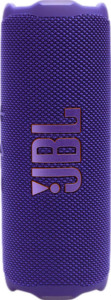
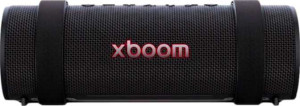
The most telling design difference between these two speakers is their form factor. The JBL Flip 7 follows a vertical, cylindrical layout (182.5 × 71.5 × 69.5 mm) while the LG XBoom Grab stretches horizontally (210.82 × 73.66 × 73.66 mm). This isn't just aesthetic — it affects how and where you place them. The Flip 7's upright profile makes it easier to tuck into a bag pocket or stand on a narrow surface, whereas the XBoom Grab's wider footprint suits flat surfaces like tables or shelves where stereo-like sound dispersion benefits from horizontal spread.

On portability, the Flip 7 holds a clear advantage: it weighs 560 g versus the XBoom Grab's 680 g, and its volume is meaningfully smaller at roughly 907 cm³ compared to 1,144 cm³. That 120-gram difference is noticeable when carrying the speaker in a bag all day. Both lack an included travel bag, so neither gets extra credit for out-of-box portability accessories. Water resistance is where the gap is smaller but still real — the Flip 7 carries an IP68 rating, meaning it can withstand submersion beyond the 1-meter depth that the XBoom Grab's IP67 certification covers. For poolside or shower use this distinction is minor, but for accidental drops in deeper water, the Flip 7 offers a marginal safety buffer.

Overall, the JBL Flip 7 has the design edge for users who prioritize portability and ruggedness — it is lighter, more compact, and better sealed against water. The LG XBoom Grab makes sense for those who prefer a larger, more stationary presence and don't mind the extra bulk. Shared traits — on-device controls, a detachable cable, and no touch screen or remote — mean neither product differentiates itself on interface convenience.
Sound quality:
has stereo speakers
Has a passive radiator
has a noise-canceling microphone

When it comes to sound quality architecture, the JBL Flip 7 and LG XBoom Grab are built from the same blueprint. Both are mono speakers — neither produces true stereo separation — and both rely on a passive radiator to extend low-frequency response without requiring a larger enclosure. That passive radiator is a meaningful design choice: it allows each speaker to punch below its physical size in terms of bass output, reinforcing lower frequencies that a driver alone would struggle to reproduce convincingly at these compact dimensions.

The absence of a noise-canceling microphone on both devices is worth noting for anyone planning to use them for calls or voice assistant interaction. Without active noise cancellation on the mic, performance in windy or loud outdoor environments will be limited — captured audio may include significant ambient noise. This isn't a dealbreaker for pure music playback use cases, but it's a practical constraint for hands-free calling scenarios.

Across every spec in this group, the two speakers are identically matched. This is a clear tie — neither the Flip 7 nor the XBoom Grab holds any advantage in sound quality architecture based on the available data. Buyers should look to other specification groups, such as driver size or output wattage, for further differentiation in audio performance.

Power:
Battery life 16 hours 20 hours
charge time 2.5 hours 3 hours
has a battery level indicator
has a rechargeable battery
has a removable battery
has wireless charging

Battery life is where the LG XBoom Grab pulls ahead in a meaningful way. Its 20-hour rated playtime outpaces the JBL Flip 7's 16 hours by a quarter — a gap that translates to roughly an extra full evening of listening before you need to reach for a cable. For multi-day camping trips or extended outdoor use where charging opportunities are scarce, that buffer is genuinely useful rather than just a spec sheet bragging point.

The trade-off is charge time. The XBoom Grab takes 3 hours to fully replenish versus 2.5 hours for the Flip 7 — a 30-minute difference that is relatively minor in practice, since most users charge overnight. Neither speaker supports wireless charging, and both have non-removable batteries, so there are no shortcuts to topping up on either side. The shared battery level indicator on both devices at least ensures you won't be caught off guard by a sudden shutdown.

The LG XBoom Grab holds a clear edge in this category. Its longer playback window makes it the stronger choice for users who plan extended sessions away from a power source, and the slightly longer charge time is a reasonable cost for those extra four hours of runtime.

Connectivity:
supports Bluetooth pairing using NFC
has a socket for a 3.5 mm audio jack
has an AUX input
has aptX Lossless
has LDAC
has aptX Adaptive
has aptX HD
has aptX
has aptX Low Latency
has AAC
has AirPlay
has Chromecast built-in
has Auracast
has Bluetooth LE Audio
maximum Bluetooth range 10 m 10 m
supports Wi-Fi
USB ports 1 1
Has USB Type-C
has a 3.5mm male connector
has an external memory slot
is DLNA-certified
supports Ethernet
has a microphone input

Connectivity on both speakers is deliberately streamlined — no Wi-Fi, no AUX input, no 3.5mm jack, and a shared 10-meter Bluetooth range. Neither supports advanced high-resolution codecs like LDAC or aptX HD, which keeps the wireless audio pipeline fairly standard. Both include USB-C for charging and share support for Auracast, Bluetooth's broadcast audio standard that allows a single source to stream simultaneously to multiple compatible speakers or hearing devices — a forward-looking feature that becomes genuinely useful in multi-speaker setups or public audio sharing scenarios.

The one concrete differentiator here is codec support: the LG XBoom Grab supports AAC, while the JBL Flip 7 does not. AAC matters most for Apple device users, as iOS prioritizes AAC over the standard SBC codec, delivering noticeably more efficient compression and slightly better audio fidelity over Bluetooth. For Android users the gap is less significant, since AAC implementation varies across Android devices. The Flip 7's lack of AAC means it will default to SBC regardless of the source device, which is functional but represents a missed optimization for a large portion of the market.

On balance, the LG XBoom Grab has a narrow but real advantage in connectivity, driven entirely by its AAC support. For iPhone users in particular, this difference is worth factoring into the decision. Everything else in this category is evenly matched between the two speakers.

Features:
release date March 2025 April 2025
Can be used wirelessly
supports a remote smartphone
has fast pairing
has voice commands
Has a radio
Has voice prompts
works as a power bank
has a sleep timer

Feature parity between these two speakers is high — both support wireless use, smartphone remote control via a companion app, voice prompts, and a sleep timer. The sleep timer is a small but practical convenience for bedside or relaxation use, automatically cutting playback after a set duration without requiring manual intervention. Voice prompts keep the user informed of connection status and battery levels without needing to check a display.

The single feature that separates them is voice command support, available on the LG XBoom Grab but absent on the JBL Flip 7. This enables hands-free control — adjusting volume, skipping tracks, or triggering a paired voice assistant — without physically touching the speaker. In practice, this is most valuable in situations where your hands are occupied, such as cooking, working out, or outdoor activities where the speaker is placed at a distance. Neither speaker supports fast pairing, so the initial Bluetooth setup process will follow the standard pairing routine on both.

The LG XBoom Grab holds a modest edge here on account of its voice command capability, which adds a meaningful layer of hands-free convenience that the Flip 7 simply doesn't offer. For users who regularly interact with their speaker from across the room or with hands full, this difference has genuine practical value.

Miscellaneous:
supports pairing for stereo sound

Both the JBL Flip 7 and LG XBoom Grab support stereo pairing — the ability to link two units of the same speaker together, with one handling the left channel and the other the right. This is a worthwhile capability for users willing to invest in a second unit, as it converts what is otherwise a mono listening experience into true stereo separation, noticeably widening the soundstage for music playback in a room or outdoor setting.

Since this is the only data point available for this group and both speakers share it equally, this category results in a complete tie. Neither product holds any advantage over the other here. Users prioritizing the stereo pairing feature can consider either speaker with equal confidence based solely on this specification.

Comparison Summary & Verdict

Both the JBL Flip 7 and the LG XBoom Grab deliver a solid foundation: waterproof construction, passive radiator-enhanced sound, rechargeable batteries, and wireless stereo pairing support. However, their differences reveal distinct personalities. The JBL Flip 7 stands out with a superior IP68 rating, a lighter and more compact body at just 560 g, and a faster 2.5-hour charge time — ideal for users who prioritize portability and durability. The LG XBoom Grab counters with a longer 20-hour battery life, AAC codec support, and the added convenience of voice command functionality, making it the better pick for those who want more endurance and smart features in a larger package.

JBL Flip 7
Buy JBL Flip 7 if...

Buy the JBL Flip 7 if you want a lighter, more compact speaker with a higher IP68 waterproof rating and faster charging at 2.5 hours.

LG XBoom Grab
Buy LG XBoom Grab if...

Buy the LG XBoom Grab if you prioritize longer battery life at 20 hours, AAC audio support, and the convenience of built-in voice commands.