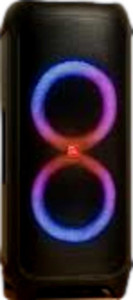
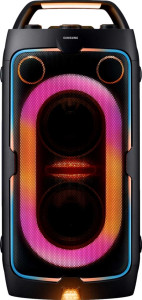
The most striking design contrast between these two speakers is their physical scale and form factor. The Samsung ST40F is a true floor-standing tower, measuring 620 × 303 × 310 mm with a volume of roughly 58,237 cm³, making it a room-anchoring piece of equipment meant to stay in one place. The JBL PartyBox 720, by contrast, presents a drastically smaller footprint at 94.2 × 41.6 × 40.6 mm and a volume of just 159 cm³, suggesting a far more compact and portable chassis. This difference in volume is not incremental — it is a fundamental distinction in how each product is intended to be used and placed.
On weight, the gap reverses in an interesting way: the JBL tips the scale at a substantial 31,000 g (31 kg), while the Samsung comes in considerably lighter at 8,000 g (8 kg). Despite its towering dimensions, the ST40F is meaningfully easier to move and reposition. The PartyBox 720's much heavier build likely reflects denser internal components or cabinetry, but it does make relocation a two-person task. Both units share IPX4 water resistance, detachable cables, and on-device control panels, so neither has an edge on those practical, everyday usability fronts.
Where the Samsung earns a clear design advantage is its inclusion of RGB lighting, which the JBL entirely lacks. For users seeking a visual, party-ready aesthetic, this is a meaningful differentiator — RGB arrays on tower speakers contribute directly to ambiance in low-light environments. Overall, the ST40F holds the design edge for those prioritizing visual flair and easier handling, while the PartyBox 720 is the denser, more compact unit — a trade-off that matters most depending on whether portability or presence in a room is the priority.