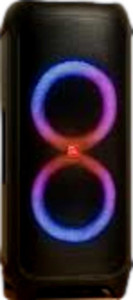
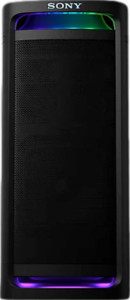
The most striking design difference between these two speakers is their physical scale. The Sony ULT Tower 9AC is a full-sized tower unit, standing 910 mm tall with a volume of roughly 170,134 cm³, making it a stationary floor speaker built for dedicated room placement. The JBL PartyBox 720, by contrast, occupies a dramatically smaller footprint at just 159 cm³ of volume. This difference in form factor is fundamental: the Sony is designed to live in one spot as part of a home audio setup, while the JBL is comparatively compact and repositionable.
Despite the Sony's much larger enclosure, the PartyBox 720 is actually the heavier unit at 31,000 g versus the Tower 9AC's 28,500 g, suggesting the JBL packs denser internal components into its smaller chassis. On shared design traits, both speakers offer only sweat resistance rather than full weatherproofing, have no RGB lighting, no touch screen, and no bundled remote — meaning neither is optimized for outdoor or hands-free control scenarios. One practical differentiator is that the JBL includes a detachable cable, which simplifies replacement and storage, while the Sony does not.
Overall, the design edge depends entirely on use case. The Sony ULT Tower 9AC is purpose-built as a large, fixed installation speaker, whereas the JBL PartyBox 720 offers a more manageable form factor with the added convenience of a detachable cable. Neither product stands out on premium design features like RGB or touch controls, so the decision here is essentially about form factor fit rather than feature richness.