JBL Tune Buds 2
JBL Tune Flex 2

JBL Tune Buds 2 JBL Tune Flex 2

Overview

Welcome to our in-depth specification comparison between the JBL Tune Buds 2 and the JBL Tune Flex 2. Both earbuds share a strong common foundation — IP54 water resistance, active noise cancellation, and Bluetooth 5.3 — yet they take meaningfully different approaches in areas like fit style, noise isolation, and battery endurance with ANC enabled. Whether comfort or passive noise reduction matters most to you, this breakdown will help you find your ideal match.

Common Features

  • Both products have an IP54 ingress protection rating.
  • Both products are water resistant.
  • Both products are completely wireless with no cables.
  • Neither product uses a neckband design.
  • Neither product includes wingtips.
  • Neither product features RGB lighting.
  • Both products have stereo speakers.
  • Neither product includes a UV light.
  • Both products support active noise cancellation (ANC).
  • The lowest frequency on both products is 20 Hz.
  • The highest frequency on both products is 20000 Hz.
  • Both products support spatial audio.
  • Neither product supports Dolby Atmos.
  • Neither product supports Dirac Virtuo.
  • The sound pressure level is 95 dB/mW on both products.
  • Neither product uses a neodymium magnet.
  • Both products offer 12 hours of battery life.
  • The charging case provides 36 hours of battery life on both products.
  • Both products take 2 hours to fully charge.
  • Neither product supports wireless charging.
  • Neither product has a solar power battery.
  • Both products include a battery level indicator.
  • Both products have a rechargeable battery.
  • Both products support fast pairing.
  • Both products use USB Type-C charging.
  • The Bluetooth version on both products is 5.3.
  • Neither product supports LDAC.
  • Neither product supports LDHC.
  • Neither product supports Bluetooth LE Audio.
  • Neither product supports aptX Adaptive.
  • Neither product supports aptX Low Latency.
  • Both products feature an ambient sound mode.
  • Neither product has in/on-ear detection.
  • Both products include a find device feature.
  • Both products support fast charging.
  • Both products support multipoint connection with up to 2 devices.
  • Neither product can read notifications aloud.
  • Neither product includes a built-in translator.
  • Both products have a mute function.
  • Both products are equipped with 6 microphones.
  • Both products feature a noise-canceling microphone.

Main Differences

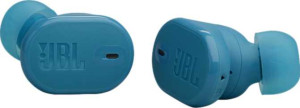
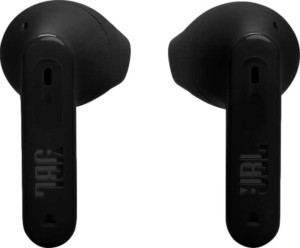
  • The fit type is in-ear on the JBL Tune Buds 2 and earbud on the JBL Tune Flex 2.
  • The weight is 11 g on the JBL Tune Buds 2 and 8.8 g on the JBL Tune Flex 2.
  • Passive noise reduction is present on the JBL Tune Buds 2 but not available on the JBL Tune Flex 2.
  • The driver unit size is 10 mm on the JBL Tune Buds 2 and 12 mm on the JBL Tune Flex 2.
  • The impedance is 16 Ohms on the JBL Tune Buds 2 and 13 Ohms on the JBL Tune Flex 2.
  • Battery life with ANC enabled is 10 hours on the JBL Tune Buds 2 and 8 hours on the JBL Tune Flex 2.
Specs Comparison
JBL Tune Buds 2

JBL Tune Buds 2

JBL Tune Flex 2

JBL Tune Flex 2

Design:
Fit In-ear Earbud
Ingress Protection (IP) rating IP54 IP54
water resistance Water resistant Water resistant
weight 11 g 8.8 g
has no wires or cables
are neckband earbuds
wingtips included
has RGB lighting
has stereo speakers
has UV light
Has a display

Both the JBL Tune Buds 2 and the JBL Tune Flex 2 share a strong baseline of design features: fully wireless builds, IP54 water and dust resistance, and stereo speaker setups. In practical terms, IP54 means both can handle sweat and light rain comfortably, making either a reasonable companion for workouts or commutes, though neither is suited for submersion.

The most meaningful divergence lies in fit style and weight. The Tune Buds 2 uses an in-ear fit — meaning it seats directly in the ear canal — which typically offers better passive noise isolation and a more secure hold during movement. The Tune Flex 2, by contrast, adopts an earbud fit that rests at the outer ear canal without fully inserting, a style generally preferred by users who find deep-insertion earbuds uncomfortable for extended wear. Complementing this, the Tune Flex 2 comes in lighter at 8.8 g per earbud versus the Tune Buds 2's 11 g — a roughly 20% weight reduction that can meaningfully reduce ear fatigue over long listening sessions.

On design, the Tune Flex 2 holds a slight edge for users who prioritize comfort and all-day wearability, thanks to its lighter weight and less intrusive earbud fit. The Tune Buds 2, however, may appeal to those who need a more sealed, secure in-ear fit — particularly during physical activity. The choice ultimately comes down to personal fit preference, as both products are otherwise evenly matched on protection, wireless design, and form factor essentials.
Sound quality:
has active noise cancellation (ANC)
has passive noise reduction
driver unit size 10 mm 12 mm
lowest frequency 20 Hz 20 Hz
highest frequency 20000 Hz 20000 Hz
supports spatial audio
has Dolby Atmos
has Dirac Virtuo
impedance 16 Ohms 13 Ohms
sound pressure level 95 dB/mW 95 dB/mW
has a neodymium magnet

At the foundation, both earbuds cover the full human hearing range of 20 Hz to 20,000 Hz, deliver identical 95 dB/mW sensitivity, and support ANC alongside spatial audio — meaning neither product is at a disadvantage on paper when it comes to loudness or audio breadth. The real story, however, emerges in the details beneath those shared numbers.

Driver size is where the two diverge most notably. The Tune Flex 2 houses a larger 12 mm driver compared to the Tune Buds 2's 10 mm unit. A bigger driver generally has more physical surface area to move air, which can translate to fuller bass response and a more expansive sound stage — though real-world output depends heavily on tuning. On the flip side, the Tune Buds 2 compensates with a meaningful structural advantage: passive noise reduction, a feature the Tune Flex 2 lacks entirely. Because the Tune Buds 2 uses an in-ear fit that physically seals the ear canal, it blocks ambient sound mechanically — independent of ANC — which can improve perceived audio clarity even with ANC switched off. The Tune Flex 2, with its open earbud fit, relies solely on ANC for noise management. Impedance is close enough (16 Ohms vs. 13 Ohms) that both will drive easily from any smartphone without amplification concerns.

For sound quality, the edge is split by use case. The Tune Flex 2 holds an advantage for raw driver capability and potential low-end weight, while the Tune Buds 2 offers a more noise-isolated listening environment thanks to its passive noise reduction — making it the stronger pick in louder environments where audio immersion matters most.

Power:
Battery life 12 hours 12 hours
Battery life of charging case 36 hours 36 hours
Battery life (ANC) 10 hours 8 hours
charge time 2 hours 2 hours
has wireless charging
Has a solar power battery
has a battery level indicator
has a rechargeable battery

Strip away the differences and the two products are remarkably aligned on power: both deliver 12 hours of playback per charge, top up in 2 hours, and carry a combined case-plus-earbud total of 48 hours of listening. For most users — commuters, gym-goers, or office workers — that daily endurance is more than sufficient to go several days without touching a charging cable.

The one meaningful split comes when ANC is activated. The Tune Buds 2 sustains 10 hours with ANC on, while the Tune Flex 2 drops to 8 hours under the same conditions. That two-hour gap represents a roughly 20% reduction in ANC stamina for the Tune Flex 2, which matters most for users who rely heavily on noise cancellation during long flights, extended work sessions, or noisy commutes. Neither model offers wireless charging, which puts both at a slight disadvantage relative to premium-tier competitors but is a common omission at this price segment.

On balance, the Tune Buds 2 holds a clear edge in power efficiency specifically for ANC users. For those who rarely engage noise cancellation, the two products are effectively tied — but heavy ANC users will find the Tune Buds 2 the more dependable all-day option.

Connectivity:
has fast pairing
Has USB Type-C
Bluetooth version 5.3 5.3
has LDAC
has LDHC
has Bluetooth LE Audio
has aptX Adaptive
has aptX Low Latency
has aptX HD
has aptX
has aptX Lossless
has aptX Voice
has Auracast
maximum Bluetooth range 10 m 10 m
supports Bluetooth pairing using NFC
Can be used wirelessly
has AAC

Connectivity is the rare category where there is simply nothing to separate these two products. The JBL Tune Buds 2 and Tune Flex 2 are spec-for-spec identical: both run Bluetooth 5.3, cap out at a 10 m wireless range, support fast pairing, and charge via USB-C. Bluetooth 5.3 is a modern, capable standard that offers stable connections and improved power efficiency over older versions, so both earbuds are well-equipped for everyday wireless use.

Worth noting is what neither product offers: there is no support for advanced audio codecs such as LDAC, aptX, or AAC, nor any Bluetooth LE Audio or Auracast capability. This means audio is transmitted over standard SBC by default — functional and reliable, but not optimized for the highest possible wireless audio quality. Users who prioritize lossless or high-resolution wireless streaming will find both products similarly limited in this regard.

This group is an unambiguous tie. Every connectivity specification is identical across the two models, and the decision between them should rest entirely on the differences found in other categories.

Features:
release date March 2025 March 2025
has ambient sound mode
has in/on-ear detection
has find device feature
Supports fast charging
multipoint count 2 2
can read notifications
Has a built-in translator
has a mute function
can be used as a headset
control panel placed on a device
Has voice prompts
travel bag is included
Has an in-line control panel
Has a temperature sensor
Has a built-in camera remote control function

Much like connectivity, the features category offers no ground for differentiation — the JBL Tune Buds 2 and Tune Flex 2 are completely identical across every listed specification. Both support multipoint connection for up to 2 devices simultaneously, a genuinely practical feature that allows seamless switching between, say, a laptop and a smartphone without manual re-pairing. Both also include fast charging, ambient sound mode, a mute function, and full headset capability for calls.

A few shared features are worth highlighting for their everyday utility. The inclusion of a travel bag on both models adds tangible value at this price point, and voice prompts combined with on-device controls make both earbuds easy to operate without reaching for a phone. The find device feature is a practical safety net for users prone to misplacing their earbuds. Notably, neither model includes in-ear detection — meaning audio will not automatically pause when an earbud is removed, which is a convenience omission that some users may notice.

This is a second consecutive tie. The feature sets are a carbon copy of one another, and no advantage can be awarded to either product based on this data alone. Buyers should weigh design, sound quality, and ANC endurance — categories where the two do diverge — to guide their final decision.

Microphone:
number of microphones 6 6
has a noise-canceling microphone

Microphone hardware is another area of complete parity. Both the JBL Tune Buds 2 and Tune Flex 2 carry 6 microphones and noise-canceling microphone technology — a respectable array at this tier. A six-mic setup typically enables beamforming, where the earbuds can isolate the user's voice by triangulating sound direction, resulting in cleaner call quality in noisy environments compared to simpler single or dual-mic configurations.

The verdict here is a straightforward tie. With identical microphone counts and the same noise-canceling capability, neither earbud holds any advantage for call quality or voice pickup based on the available data. Users for whom microphone performance is a priority can treat both models as equivalent on this front.

Comparison Summary & Verdict

After examining all available specifications, it is clear that both the JBL Tune Buds 2 and the JBL Tune Flex 2 are capable, well-equipped earbuds that share a great deal in common. However, the details reveal two distinct personalities. The JBL Tune Buds 2 stands out with its in-ear fit and passive noise reduction, making it the stronger choice for listeners who want more thorough sound isolation in noisy environments. It also offers a longer ANC battery life of 10 hours versus 8 hours on its sibling. On the other hand, the JBL Tune Flex 2 is notably lighter at 8.8g and features a larger 12mm driver, which may appeal to those who prioritize all-day wearing comfort and a more open, airy earbud fit. Neither product is a clear-cut winner — your decision should hinge on whether you value noise isolation and stamina, or a lighter feel and a more relaxed fit style.

JBL Tune Buds 2
Buy JBL Tune Buds 2 if...

Buy the JBL Tune Buds 2 if you want a secure in-ear fit with passive noise reduction and longer battery life when using ANC.

JBL Tune Flex 2
Buy JBL Tune Flex 2 if...

Buy the JBL Tune Flex 2 if you prefer a lighter, more comfortable earbud-style fit and a larger 12mm driver for your daily listening.