JBL Vibe Beam 2
JBL Vibe Flex 2

JBL Vibe Beam 2 JBL Vibe Flex 2

Overview

When choosing between the JBL Vibe Beam 2 and the JBL Vibe Flex 2, the decision comes down to more than just a name. Both earbuds share a strong foundation of features, yet they diverge in meaningful ways around fit style, driver size, and situational awareness capabilities. Whether you value a secure in-ear seal or a more open earbud feel, this comparison breaks down every specification to help you find the right match for your lifestyle.

Common Features

  • Both products have an IP54 ingress protection rating.
  • Both products are sweat resistant.
  • Neither product uses wires or cables.
  • Neither product is a neckband earbud design.
  • Wingtips are not included with either product.
  • Neither product features RGB lighting.
  • Both products have stereo speakers.
  • Neither product includes a UV light.
  • Neither product has active noise cancellation.
  • Both products share a frequency range of 20 Hz to 20000 Hz.
  • Spatial audio is not supported on either product.
  • Neither product supports Dolby Atmos.
  • Neither product features Dirac Virtuo.
  • Both products have an impedance of 16 Ohms.
  • Both products have a sound pressure level of 95 dB/mW.
  • Both products offer 10 hours of battery life.
  • Both products provide 30 hours of battery life from the charging case.
  • Both products have a charge time of 2 hours.
  • Wireless charging is not available on either product.
  • Neither product has a solar power battery.
  • Both products include a battery level indicator.
  • Both products have a rechargeable battery.
  • Both products support fast pairing.
  • Both products use USB Type-C.
  • Both products have Bluetooth version 5.3.
  • LDAC support is not available on either product.
  • Neither product supports LDHC.
  • Bluetooth LE Audio is not supported on either product.
  • aptX Adaptive support is not available on either product.
  • aptX Low Latency support is not available on either product.
  • In/on-ear detection is not present on either product.
  • Both products include a find device feature.
  • Both products support fast charging.
  • Both products support multipoint connection with up to 2 devices.
  • Neither product can read notifications.
  • Both products have a mute function.
  • Both products can be used as a headset.
  • Both products have a control panel placed on the device.
  • Both products have 4 microphones.
  • Both products feature a noise-canceling microphone.

Main Differences

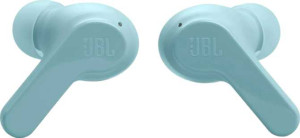
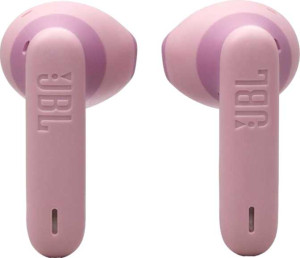
  • The fit style is in-ear on JBL Vibe Beam 2 and earbud on JBL Vibe Flex 2.
  • The weight is 8.6 g on JBL Vibe Beam 2 and 8.24 g on JBL Vibe Flex 2.
  • Passive noise reduction is present on JBL Vibe Beam 2 but not available on JBL Vibe Flex 2.
  • The driver unit size is 8 mm on JBL Vibe Beam 2 and 12 mm on JBL Vibe Flex 2.
  • The battery power is 50 mAh on JBL Vibe Beam 2 and 45 mAh on JBL Vibe Flex 2.
  • The charging case battery power is 550 mAh on JBL Vibe Beam 2 and 500 mAh on JBL Vibe Flex 2.
  • Ambient sound mode is available on JBL Vibe Flex 2 but not present on JBL Vibe Beam 2.
Specs Comparison
JBL Vibe Beam 2

JBL Vibe Beam 2

JBL Vibe Flex 2

JBL Vibe Flex 2

Design:
Fit In-ear Earbud
Ingress Protection (IP) rating IP54 IP54
water resistance Sweat resistant Sweat resistant
weight 8.6 g 8.24 g
has no wires or cables
are neckband earbuds
wingtips included
has RGB lighting
has stereo speakers
has UV light
Has a display

The most meaningful design distinction between the JBL Vibe Beam 2 and the JBL Vibe Flex 2 lies in their fit style. The Beam 2 uses an in-ear form factor, meaning the eartip sits inside the ear canal to create a seal, while the Flex 2 adopts an earbud fit, which rests at the entrance of the ear canal without creating that same seal. In practice, in-ear designs typically offer better passive noise isolation and a more secure fit during physical activity, while earbud-style fits tend to feel less fatiguing for extended wear and suit users who prefer a more open, ambient sound experience.

On weight, the difference is negligible: the Beam 2 comes in at 8.6 g versus the Flex 2 at 8.24 g per earbud. A gap of under half a gram is imperceptible during real-world use and should not factor into a buying decision. Both models share an identical IP54 ingress protection rating, meaning they offer equivalent resistance to sweat and light moisture splashes — a reasonable level of protection for workouts and everyday use, though neither is suited for submersion.

All other design attributes — wireless construction, absence of a neckband, no wingtips, no RGB lighting, and no display — are identical across both products. The Beam 2 holds a design edge for users who prioritize noise isolation and a secure fit, while the Flex 2 is the more appropriate choice for those who find in-ear seals uncomfortable or who prefer a more casual, open wearing experience.
Sound quality:
has active noise cancellation (ANC)
has passive noise reduction
driver unit size 8 mm 12 mm
lowest frequency 20 Hz 20 Hz
highest frequency 20000 Hz 20000 Hz
supports spatial audio
has Dolby Atmos
has Dirac Virtuo
impedance 16 Ohms 16 Ohms
sound pressure level 95 dB/mW 95 dB/mW
has a neodymium magnet

The most significant differentiator in this group is driver size. The Vibe Flex 2 houses a notably larger 12 mm driver compared to the 8 mm driver in the Vibe Beam 2. Larger drivers generally move more air, which can translate to fuller low-end response and greater overall dynamic range — though driver size alone does not guarantee superior sound, as tuning plays an equally important role. Still, all else being equal, the Flex 2's larger driver gives it a theoretical advantage in bass presence and soundstage width.

Where noise isolation is concerned, the Beam 2 carries a meaningful practical edge: it lists passive noise reduction, while the Flex 2 does not. Given that neither model offers active noise cancellation, the Beam 2's in-ear seal becomes the only mechanism for blocking ambient sound. For commuters or gym users who want to minimize external distractions, this is a real-world advantage that the Flex 2 simply cannot match on paper.

Beyond these two points, both earbuds share identical frequency range (20 Hz–20,000 Hz), impedance (16 Ohms), and sensitivity (95 dB/mW), meaning they are equally easy to drive and theoretically capable of reproducing the full audible spectrum. Overall, the sound quality comparison comes down to a trade-off: the Flex 2 has the driver size advantage for potential bass and dynamics, while the Beam 2 has the isolation advantage for focused listening in noisy environments.

Power:
Battery life 10 hours 10 hours
Battery life of charging case 30 hours 30 hours
charge time 2 hours 2 hours
battery power 50 mAh 45 mAh
battery power (charging case) 550mAh 500mAh
has wireless charging
Has a solar power battery
has a battery level indicator
has a rechargeable battery

Both the JBL Vibe Beam 2 and the JBL Vibe Flex 2 offer the same battery life of 10 hours for the earbuds themselves and 30 hours when using the charging case. The charge time for both products is also the same at 2 hours.

When it comes to battery power, the Vibe Beam 2 has a 50 mAh battery in the earbuds and a 550 mAh battery in the charging case. The Vibe Flex 2 has slightly smaller batteries, with a 45 mAh battery in the earbuds and a 500 mAh battery in the case.

Neither product supports wireless charging or solar power, but both models feature a battery level indicator and have rechargeable batteries.

Connectivity:
has fast pairing
Has USB Type-C
Bluetooth version 5.3 5.3
has LDAC
has LDHC
has Bluetooth LE Audio
has aptX Adaptive
has aptX Low Latency
has aptX HD
has aptX
has aptX Lossless
has aptX Voice
has Auracast
maximum Bluetooth range 10 m 10 m
supports Bluetooth pairing using NFC
Can be used wirelessly
has AAC

The JBL Vibe Beam 2 and the JBL Vibe Flex 2 have identical connectivity features. Both models support fast pairing and come with USB Type-C for charging. They also use Bluetooth version 5.3 for a reliable wireless connection, and both have a maximum Bluetooth range of 10 meters.

Neither product supports advanced Bluetooth audio technologies like LDAC, LDHC, Bluetooth LE Audio, or aptX (including aptX Adaptive, Low Latency, HD, Lossless, and Voice), and neither includes support for Bluetooth pairing using NFC.

Additionally, both models can be used wirelessly and do not support AAC audio codec.

Features:
release date March 2025 March 2025
has ambient sound mode
has in/on-ear detection
has find device feature
Supports fast charging
multipoint count 2 2
can read notifications
has a mute function
can be used as a headset
control panel placed on a device
Has voice prompts
travel bag is included
Has an in-line control panel
Has a temperature sensor
Has a built-in camera remote control function

The JBL Vibe Beam 2 and the JBL Vibe Flex 2 share several features, such as support for the find device feature, fast charging, multipoint connectivity (with support for 2 devices), the ability to be used as a headset, a mute function, and a control panel placed on the device. Both models also include voice prompts, come with a travel bag, and do not feature an in-line control panel or temperature sensor. Neither model has a built-in camera remote control function.

However, the Vibe Flex 2 has one notable addition: ambient sound mode, which the Vibe Beam 2 lacks. Both products do not feature in/on-ear detection or the ability to read notifications.

Microphone:
number of microphones 4 4
has a noise-canceling microphone

Both the Vibe Beam 2 and the Vibe Flex 2 are identically equipped in this category: each features 4 microphones and noise-canceling mic technology. A quad-mic setup at this price tier is a solid offering — more microphones allow the earbuds to use beamforming techniques to better isolate the user's voice and suppress wind or ambient noise during calls. Paired with noise-canceling microphone processing, both models are positioned to deliver reasonably clean call quality in moderately noisy environments.

This is a straightforward tie. There is no differentiator between the two products on microphone specifications, and neither holds any advantage over the other for voice calls, virtual meetings, or voice assistant interactions.

Comparison Summary & Verdict

After examining the full specification set, both earbuds deliver identical core performance in areas like battery life, Bluetooth 5.3 connectivity, and microphone quality. However, their differences define distinct use cases. The JBL Vibe Beam 2 stands out with its in-ear fit and passive noise reduction, making it the stronger choice for commuters or gym-goers who want natural isolation from surrounding noise. The JBL Vibe Flex 2, on the other hand, counters with a larger 12mm driver and an ambient sound mode, appealing to users who need to stay aware of their environment while listening. Its slightly lighter weight is an added comfort bonus. Neither product supports ANC or wireless charging, so neither holds an edge there. Ultimately, your ideal pick hinges on whether you prefer passive isolation or situational awareness as your primary listening priority.

JBL Vibe Beam 2
Buy JBL Vibe Beam 2 if...

Buy the JBL Vibe Beam 2 if you prefer an in-ear fit with passive noise reduction to block out ambient sound during workouts or commutes.

JBL Vibe Flex 2
Buy JBL Vibe Flex 2 if...

Buy the JBL Vibe Flex 2 if you want a larger 12mm driver and an ambient sound mode to stay aware of your surroundings while you listen.