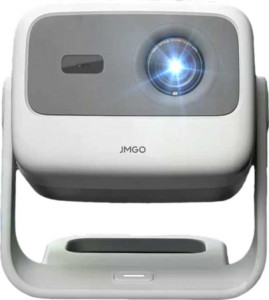
JMGO N1S 4K
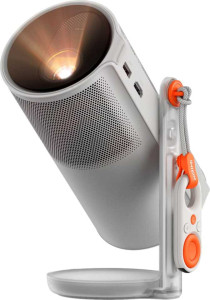
XGIMI MoGo 4 Laser

JMGO N1S 4K XGIMI MoGo 4 Laser

Overview

Welcome to our in-depth spec comparison between the JMGO N1S 4K and the XGIMI MoGo 4 Laser — two laser projectors that share a surprising amount of common ground while diverging in some critical areas. Both bring laser light sources, smart TV platforms, and a rich connectivity suite to the table, yet they take notably different approaches when it comes to output resolution, physical footprint, and portability. Read on to see how they stack up across projection quality, features, and connectivity.

Common Features

  • Both projectors use a laser light source.
  • Both projectors have a dedicated smartphone app.
  • Both projectors can display 3D content with glasses.
  • The maximum projection size is 200″ on both projectors.
  • HDR10+ support is not available on either projector.
  • Both projectors have a 60Hz refresh rate.
  • Dolby Vision support is not available on either projector.
  • Both projectors support HDR10.
  • Both projectors have one HDMI port.
  • AirPlay is supported on both projectors.
  • Bluetooth is available on both projectors.
  • Both projectors support Wi-Fi.
  • Chromecast built-in is present on both projectors.
  • Neither projector has a VGA connector.
  • Neither projector has a DVI connector.
  • Both projectors support Miracast.
  • Both projectors have stereo speakers.
  • Vertical lens shift is not available on either projector.
  • Horizontal lens shift is not available on either projector.
  • Both projectors include a remote control.
  • Both projectors have a built-in smart TV platform.
  • Both projectors have a built-in speaker.
  • Both projectors have a 3.5mm audio jack socket.
  • Dolby Atmos is supported on both projectors.

Main Differences

  • Output resolution is 4K on JMGO N1S 4K and 1080p on XGIMI MoGo 4 Laser.
  • Response time is 17ms on JMGO N1S 4K and 20ms on XGIMI MoGo 4 Laser.
  • Minimum throw distance is 1.6m on JMGO N1S 4K and 1m on XGIMI MoGo 4 Laser.
  • Width is 170mm on JMGO N1S 4K and 96.5mm on XGIMI MoGo 4 Laser.
  • Height is 190mm on JMGO N1S 4K and 207.6mm on XGIMI MoGo 4 Laser.
  • Thickness is 190mm on JMGO N1S 4K and 96.5mm on XGIMI MoGo 4 Laser.
  • Weight is 2000g on JMGO N1S 4K and 1310g on XGIMI MoGo 4 Laser.
  • Volume is 6137 cm³ on JMGO N1S 4K and 1933.22 cm³ on XGIMI MoGo 4 Laser.
  • USB ports number is 1 on JMGO N1S 4K and 2 on XGIMI MoGo 4 Laser.
  • Audio output power is 2 x 5W on JMGO N1S 4K and 2 x 6W on XGIMI MoGo 4 Laser.
  • Voice commands are supported on JMGO N1S 4K but not available on XGIMI MoGo 4 Laser.
Specs Comparison
JMGO N1S 4K

JMGO N1S 4K

XGIMI MoGo 4 Laser

XGIMI MoGo 4 Laser

General info:
has laser light source
release date April 2025 June 2025
width 170 mm 96.5 mm
height 190 mm 207.6 mm
thickness 190 mm 96.5 mm
weight 2000 g 1310 g
Has a dedicated smartphone app
volume 6137 cm³ 1933.2231 cm³

Both the JMGO N1S 4K and the XGIMI MoGo 4 Laser share two meaningful baseline features: a laser light source and a dedicated smartphone app. The laser light source is a notable common ground, as it typically delivers superior color accuracy, longer lifespan, and faster warm-up times compared to traditional lamp or LED-based projectors. App support on both units means users can expect remote control functionality and potentially content management from their phones — a convenience feature that is now table stakes in this category.

Where these two projectors diverge significantly is in their physical footprint and mass. The JMGO N1S 4K occupies roughly 6137 cm³ of volume and weighs 2000 g, making it a decidedly desktop-oriented device. The MoGo 4 Laser, by contrast, compresses into just 1933 cm³ — less than one-third the volume — and tips the scale at only 1310 g, a difference of 690 g. In practical terms, the MoGo 4 Laser is genuinely portable: it can slip into a backpack, sit comfortably on a small shelf, or be repositioned around a room with minimal effort. The N1S 4K, while not immovable, is better suited to a semi-permanent setup on a desk or dedicated surface.

For this group, the XGIMI MoGo 4 Laser holds a clear edge in portability and space efficiency. If compact form factor and ease of transport are priorities, it wins outright. The JMGO N1S 4K's larger chassis may accommodate more internal hardware — but based solely on the general specs provided here, there is no advantage to its greater size and weight.

Projection quality:
output resolution 4K 1080p
response time 17 ms 20 ms
displays 3D with glasses
maximum projection size 200" 200"
supports HDR10+
minimum throw distance 1.6 m 1 m
refresh rate 60Hz 60Hz
supports Dolby Vision
supports HDR10

The single most impactful differentiator in this group is output resolution. The JMGO N1S 4K delivers a native 4K image, while the XGIMI MoGo 4 Laser tops out at 1080p. At typical living-room projection sizes — and especially as image size grows toward the shared maximum of 200″ — 4K resolves noticeably finer detail, tighter text, and a more cinematic image. The gap becomes most visible on large screens viewed at close-to-moderate distances; at smaller sizes or from farther back, the difference narrows.

On the remaining specs, the two projectors are remarkably well-matched. Both cap out at a 60Hz refresh rate and support HDR10 while lacking HDR10+ and Dolby Vision, so their high dynamic range capabilities are equivalent. Response times sit close together — 17 ms for the N1S 4K versus 20 ms for the MoGo 4 Laser — a difference too small to matter for movies or casual gaming. Both also support 3D playback with glasses. Where the MoGo 4 Laser does reclaim a modest practical advantage is in throw distance: its 1 m minimum versus the N1S 4K's 1.6 m minimum means it can fill the same screen in tighter spaces, which aligns well with its portable profile established in the general specs.

Overall, the JMGO N1S 4K holds a clear and meaningful edge in this group. Resolution is the cornerstone of projection quality, and a native 4K output is a substantial step up for anyone prioritizing image sharpness and detail. The MoGo 4 Laser's shorter minimum throw is a useful practical concession, but it does not offset the resolution gap for users who care primarily about picture fidelity.

Connectivity:
HDMI ports 1 1
has AirPlay
Has Bluetooth
supports Wi-Fi
USB ports 1 2
has Chromecast built-in
has a VGA connector
has a DVI connector
supports Miracast
RJ45 ports 0 0
Has S/PDIF Out port

Connectivity is one of the most evenly matched categories between these two projectors. Both carry identical wireless credentials — Wi-Fi, Bluetooth, AirPlay, Chromecast built-in, and Miracast — meaning users of either device enjoy the full suite of modern screen-mirroring and casting options, whether they are in the Apple, Android, or Windows ecosystem. For a wireless-first usage pattern, there is genuinely no gap here.

On the wired side, both share a single HDMI port and no Ethernet, which keeps cabling options lean but adequate for most use cases — one HDMI input covers a streaming stick, gaming console, or laptop. The only concrete differentiator is USB: the XGIMI MoGo 4 Laser offers 2 USB ports versus the JMGO N1S 4K's 1. In practice, a second USB port matters when you want to simultaneously power a streaming dongle and read from a USB drive, or connect two peripherals without reaching for a hub.

The MoGo 4 Laser takes a narrow edge in this group purely on the strength of that extra USB port. It is not a decisive advantage, but for a device marketed around portability and flexible setups, the additional port adds genuine day-to-day convenience that the N1S 4K simply does not match here.

Features:
has stereo speakers
has lens shift (vertical)
has lens shift (horizontal)
has a remote control
has built-in smart TV
has a built-in speaker
audio output power 2 x 5W 2 x 6W
has a socket for a 3.5 mm audio jack
has Dolby Atmos
has an external memory slot
has voice commands

At a feature level, these two projectors share a very solid common foundation: stereo speakers, a built-in smart TV platform, a remote control, a 3.5 mm audio jack, and Dolby Atmos support. For most users, that checklist covers everyday needs entirely — you get a self-contained smart projection system with spatially enhanced audio decoding, no external devices required.

The audio output numbers are close but not identical. The XGIMI MoGo 4 Laser edges out at 2 × 6W versus the JMGO N1S 4K's 2 × 5W. A 1W difference per channel is modest and unlikely to produce a dramatic loudness gap in a quiet room, but it does suggest the MoGo 4 Laser can push slightly higher volume before distortion — relevant in noisier environments or larger spaces. The more meaningful feature gap, however, runs the other direction: the N1S 4K includes voice commands, while the MoGo 4 Laser does not. Hands-free control — launching apps, adjusting settings, or searching content by voice — is a tangible usability convenience, particularly when the remote is out of reach.

This group ends in a genuine trade-off rather than a clean win for either side. The MoGo 4 Laser delivers marginally more audio headroom; the N1S 4K counters with voice control, which many users will find more impactful day-to-day. Buyers who prioritize smart assistant convenience should lean toward the JMGO N1S 4K, while those who simply want the loudest built-in sound from this pair have a slight reason to favor the MoGo 4 Laser.
Comparison Summary & Verdict

After examining every specification, it becomes clear that these two laser projectors target subtly different audiences. The JMGO N1S 4K stands out for its native 4K resolution, slightly faster 17ms response time, and built-in voice command support, making it the stronger pick for a dedicated home cinema setup where image sharpness is the priority. The XGIMI MoGo 4 Laser, on the other hand, is considerably lighter at 1310g, more compact in volume, requires a shorter minimum throw distance of 1m, offers an extra USB port, and delivers marginally more audio output at 2x6W — all of which point to a projector built for on-the-go or space-constrained use. If raw picture quality and smart integration matter most, lean toward the JMGO; if portability and flexible placement are your priorities, the XGIMI is the more practical companion.

JMGO N1S 4K
Buy JMGO N1S 4K if...

Buy the JMGO N1S 4K if you want a native 4K image, faster response time, and the convenience of built-in voice commands for a dedicated home cinema room.

XGIMI MoGo 4 Laser
Buy XGIMI MoGo 4 Laser if...

Buy the XGIMI MoGo 4 Laser if you need a lightweight, compact projector with a shorter throw distance and an extra USB port for flexible, on-the-go use.