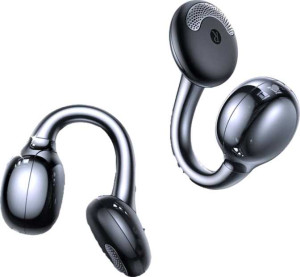
Joyroom JR-OE3
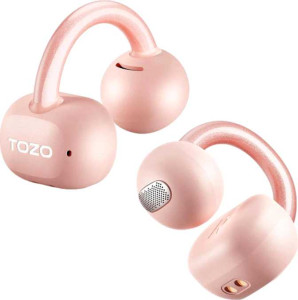
Tozo Open EarRing

Joyroom JR-OE3 Tozo Open EarRing

Overview

When choosing between the Joyroom JR-OE3 and the Tozo Open EarRing, shoppers are looking at two open-ear wireless earbuds that share a strong foundation of features yet diverge in several meaningful ways. Both deliver a cable-free, open-ear experience with fast charging, noise-canceling microphones, and USB Type-C connectivity, but the competition heats up when examining battery endurance, water resistance ratings, and a few unique extras that set each apart. Which one earns a place in your ears depends heavily on your daily priorities.

Common Features

  • Both products use an open-ear fit design.
  • Neither product has wires or cables.
  • Neither product is a neckband earbud style.
  • Neither product includes wingtips.
  • Neither product features RGB lighting.
  • Both products have stereo speakers.
  • Neither product includes a UV light.
  • Neither product has active noise cancellation (ANC).
  • Neither product has passive noise reduction.
  • Both products have a lowest frequency of 20 Hz.
  • Both products have a highest frequency of 20000 Hz.
  • Neither product supports spatial audio.
  • Neither product has Dolby Atmos.
  • Neither product has a neodymium magnet.
  • Both products share a charging case battery capacity of 400 mAh.
  • Neither product supports wireless charging.
  • Both products have a battery level indicator.
  • Both products have a rechargeable battery.
  • Neither product supports fast pairing.
  • Both products feature a USB Type-C connection.
  • Neither product has LDAC support.
  • Neither product has Bluetooth LE Audio support.
  • Neither product has aptX Adaptive support.
  • Neither product has aptX Low Latency support.
  • Neither product has aptX HD support.
  • Neither product has an ambient sound mode.
  • Neither product has in/on-ear detection.
  • Both products support fast charging.
  • Neither product can read notifications.
  • Both products have a mute function.
  • Both products can be used as a headset.
  • Both products have a control panel placed on the device.
  • Both products have voice prompts.
  • Both products have a noise-canceling microphone.

Main Differences

  • Ingress Protection rating is IPX4 on Joyroom JR-OE3 and IPX5 on Tozo Open EarRing.
  • Water resistance is sweat resistant on Joyroom JR-OE3 and water resistant on Tozo Open EarRing.
  • Weight is 9.8 g on Joyroom JR-OE3 and 11.2 g on Tozo Open EarRing.
  • A display is present on Tozo Open EarRing but not available on Joyroom JR-OE3.
  • Driver unit size is 13 mm on Joyroom JR-OE3 and 12 mm on Tozo Open EarRing.
  • Battery life is 6 hours on Joyroom JR-OE3 and 10 hours on Tozo Open EarRing.
  • Battery life of the charging case is 16 hours on Joyroom JR-OE3 and 30 hours on Tozo Open EarRing.
  • Charge time is 2 hours on Joyroom JR-OE3 and 1.5 hours on Tozo Open EarRing.
  • Earbud battery power is 40 mAh on Joyroom JR-OE3 and 60 mAh on Tozo Open EarRing.
  • Bluetooth version is 5.4 on Joyroom JR-OE3 and 5.3 on Tozo Open EarRing.
  • A find device feature is available on Joyroom JR-OE3 but not present on Tozo Open EarRing.
Specs Comparison
Joyroom JR-OE3

Joyroom JR-OE3

Tozo Open EarRing

Tozo Open EarRing

Design:
Fit Open-ear Open-ear
Ingress Protection (IP) rating IPX4 IPX5
water resistance Sweat resistant Water resistant
weight 9.8 g 11.2 g
has no wires or cables
are neckband earbuds
wingtips included
has RGB lighting
has stereo speakers
has UV light
Has a display

Both the Joyroom JR-OE3 and the Tozo Open EarRing share the same fundamental design philosophy: open-ear, fully wireless, no wingtips, and stereo speakers — making them structurally comparable at a high level. Neither adds RGB lighting or a UV light, keeping the focus on function over flair.

Where the two diverge meaningfully is in water resistance and weight. The JR-OE3 carries an IPX4 rating, meaning it handles sweat and light splashes, which is adequate for most workouts. The Open EarRing steps up to IPX5, offering protection against sustained, low-pressure water jets — a tangible advantage for outdoor use in rain or intense training sessions. On the flip side, the JR-OE3 is notably lighter at 9.8 g versus the Open EarRing's 11.2 g. While a 1.4 g difference sounds trivial, in open-ear designs that rest on the outer ear without a canal seal, lower weight directly translates to less fatigue and a more secure feel during extended wear.

The Open EarRing also includes a display, which the JR-OE3 lacks entirely — useful for checking battery level or settings at a glance without reaching for a phone. Overall, neither product dominates outright: the Tozo Open EarRing has a clear edge in water resistance and adds the convenience of a display, while the Joyroom JR-OE3 wins on wearability comfort thanks to its lighter build.

Sound quality:
has active noise cancellation (ANC)
has passive noise reduction
driver unit size 13 mm 12 mm
lowest frequency 20 Hz 20 Hz
highest frequency 20000 Hz 20000 Hz
supports spatial audio
has Dolby Atmos
has Dirac Virtuo
has a neodymium magnet

In terms of sound quality specs, the Joyroom JR-OE3 and the Tozo Open EarRing are remarkably close. Both cover the full standard audible range of 20 Hz to 20,000 Hz, and neither offers ANC, passive noise reduction, spatial audio, Dolby Atmos, or Dirac Virtuo — a reminder that both are tuned for ambient-aware, open-ear listening rather than immersive isolation.

The only measurable differentiator here is driver size: the JR-OE3 uses a 13 mm driver versus the Open EarRing's 12 mm. A larger driver has the theoretical potential to move more air, which can contribute to fuller bass response and overall loudness — but a 1 mm difference is marginal, and real-world output depends far more on tuning, driver quality, and acoustic chamber design, none of which are captured in these specs alone. Neither product lists a neodymium magnet, which is a common efficiency and clarity booster in premium drivers, so both sit on equal footing in that regard as well.

Taken strictly on the provided data, this category is essentially a tie. The JR-OE3 holds a very slight theoretical edge from its fractionally larger driver, but the gap is too small and too contingent on other unlisted factors to constitute a meaningful advantage. Buyers prioritizing sound quality should look beyond these specs to hands-on listening tests.

Power:
Battery life 6 hours 10 hours
Battery life of charging case 16 hours 30 hours
charge time 2 hours 1.5 hours
battery power 40 mAh 60 mAh
battery power (charging case) 400mAh 400mAh
has wireless charging
Has a solar power battery
has a battery level indicator
has a rechargeable battery

Battery life is where the Tozo Open EarRing pulls decisively ahead. Its earbuds last 10 hours on a single charge compared to the 6 hours on the Joyroom JR-OE3 — a 67% advantage that translates directly into fewer interruptions during long commutes, workdays, or travel. The Open EarRing's larger 60 mAh earbud battery (versus the JR-OE3's 40 mAh) explains the gap, and with the case extending total playback to 30 hours versus the JR-OE3's 16 hours, the difference compounds significantly for users who go multiple days between charges.

Charging speed also favors the Open EarRing, which refills in 1.5 hours compared to the JR-OE3's 2 hours. Faster charging matters most when you need a quick top-up before heading out — the Open EarRing's shorter turnaround adds a practical convenience edge on top of its already superior capacity. The one area where both products are level is the case battery: both pack a 400 mAh case, meaning the Open EarRing simply squeezes more cycles out of the same case capacity thanks to its more efficient distribution across charges.

Neither product offers wireless charging, so users will need to rely on wired top-ups regardless of choice. Overall, the Tozo Open EarRing holds a clear and meaningful advantage in this category across every power metric that matters — capacity, longevity, and recharge speed.

Connectivity:
has fast pairing
Has USB Type-C
Bluetooth version 5.4 5.3
has LDAC
has LDHC
has Bluetooth LE Audio
has aptX Adaptive
has aptX Low Latency
has aptX HD
has aptX
has aptX Lossless
has aptX Voice
has Auracast
maximum Bluetooth range 10 m 10 m
supports Bluetooth pairing using NFC
Can be used wirelessly
has AAC

Connectivity between these two is largely a wash, with one minor but notable distinction: the Joyroom JR-OE3 runs on Bluetooth 5.4 while the Tozo Open EarRing uses Bluetooth 5.3. In practice, both versions offer stable, low-latency wireless performance well beyond what most users will notice day-to-day, but 5.4 does introduce improvements in connection efficiency and broadcast audio handling. Given that neither product supports Bluetooth LE Audio or Auracast, those architectural advances go largely untapped — making the version gap more of a future-proofing footnote than a present-day differentiator.

Shared across both is AAC codec support, a 10 m Bluetooth range, and USB-C charging. AAC is a solid mid-tier codec that delivers better audio quality than the baseline SBC, and it pairs well with Apple devices in particular. The absence of higher-fidelity codecs like LDAC or aptX on either product is consistent with their open-ear, lifestyle-oriented positioning — neither is targeting audiophile wireless streaming. The identical range means neither has a reach advantage in real-world environments like offices or kitchens.

On balance, this category is effectively a tie. The JR-OE3 edges ahead on Bluetooth version, but the practical impact is negligible given how closely matched every other connectivity spec is. Neither product offers fast pairing or NFC, so the out-of-box pairing experience should be comparable on both.

Features:
release date June 2025 January 2025
has ambient sound mode
has in/on-ear detection
has find device feature
Supports fast charging
can read notifications
has a mute function
can be used as a headset
control panel placed on a device
Has voice prompts
travel bag is included
Has an in-line control panel
Has a temperature sensor
Has a built-in camera remote control function

Feature sets here are nearly identical, with one practical exception: the Joyroom JR-OE3 includes a find device function, while the Tozo Open EarRing does not. For users who frequently misplace small earbuds around the house or in a bag, this is a genuinely useful safety net — and its absence on the Open EarRing is a minor but real omission given how common the feature has become even on mid-range earbuds.

Everything else aligns closely. Both support fast charging, include on-device controls, offer voice prompts, ship with a travel bag, and can function as a headset with mute — a solid, well-rounded feature package for everyday use. The shared inclusion of a travel bag is a small but appreciated convenience for commuters, and on-device controls mean neither requires a companion app for basic playback and call management.

The Joyroom JR-OE3 takes a narrow edge in this category purely on the strength of its find device feature. It is the only functional differentiator between the two, but for users prone to losing small accessories, it could be a meaningful tiebreaker.

Microphone:
has a noise-canceling microphone

With only one data point available for this category, the conclusion is straightforward: both the Joyroom JR-OE3 and the Tozo Open EarRing feature a noise-canceling microphone, placing them on equal footing for calls and voice input. For open-ear designs — which by nature sit in acoustically exposed environments — microphone noise cancellation is especially valuable, as it helps filter out ambient sound that the ear canal seal of traditional earbuds would otherwise partially block.

This category is a tie. No additional microphone specs are provided to distinguish between the two, so neither product holds a demonstrable advantage here based on the available data alone.

Comparison Summary & Verdict

After a thorough look at the specs, both earbuds prove themselves as capable open-ear companions, but they target slightly different users. The Joyroom JR-OE3 stands out with its marginally lighter 9.8 g build, the newer Bluetooth 5.4 standard, and a handy find device feature — making it a smart pick for those who value cutting-edge connectivity and peace of mind against misplacement. The Tozo Open EarRing, on the other hand, dominates on endurance, offering 10 hours of battery life and a 30-hour charging case, a superior IPX5 water resistance rating, faster 1.5-hour charging, and a built-in display for at-a-glance status checks. Active users or commuters who spend long hours away from a charger will find the Tozo the more practical daily driver.

Joyroom JR-OE3
Buy Joyroom JR-OE3 if...

Buy the Joyroom JR-OE3 if you want the latest Bluetooth 5.4 connectivity, a lighter fit at 9.8 g, and the added security of a built-in find device feature.

Tozo Open EarRing
Buy Tozo Open EarRing if...

Buy the Tozo Open EarRing if you need longer battery life with 10 hours of playback and 30 hours from the case, faster charging, a stronger IPX5 water resistance rating, and a display for quick status checks.