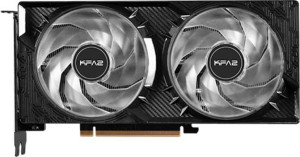
KFA2 GeForce RTX 5060 1-Click OC
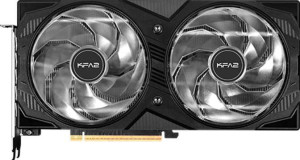
KFA2 GeForce RTX 5060 EX

KFA2 GeForce RTX 5060 1-Click OC KFA2 GeForce RTX 5060 EX

Overview

Choosing between the KFA2 GeForce RTX 5060 1-Click OC and the KFA2 GeForce RTX 5060 EX is no simple task, as both cards are built on the same Blackwell architecture, share 8GB of GDDR7 memory, and deliver an identical feature set including ray tracing and DLSS support. The real comparison centers on peak GPU turbo clock speeds and physical card dimensions, two factors that could decisively influence your buying decision depending on your setup.

Common Features

  • Both cards share a base GPU clock speed of 2280 MHz.
  • Both cards have a GPU memory speed of 1750 MHz.
  • Both cards feature 3840 shading units.
  • Both cards include 120 texture mapping units (TMUs).
  • Both cards have 48 render output units (ROPs).
  • Double Precision Floating Point (DPFP) is supported on both cards.
  • Both cards have an effective memory speed of 28000 MHz.
  • Both cards offer a maximum memory bandwidth of 448 GB/s.
  • Both cards come with 8GB of VRAM.
  • Both cards use GDDR7 memory.
  • Both cards have a 128-bit memory bus width.
  • ECC memory is supported on both cards.
  • Both cards support DirectX 12 Ultimate.
  • Both cards have an OpenGL version of 4.6.
  • Both cards support OpenCL version 3.
  • Multi-display technology is supported on both cards.
  • Ray tracing is supported on both cards.
  • 3D support is available on both cards.
  • DLSS is supported on both cards.
  • XeSS (XMX) support is not available on either card.
  • Both cards have one HDMI 2.1b output.
  • Both cards include three DisplayPort outputs.
  • Neither card has USB-C ports, DVI outputs, or mini DisplayPort outputs.
  • Both cards are based on the Blackwell GPU architecture.
  • Both cards have a Thermal Design Power (TDP) of 145W.
  • Both cards use PCIe version 5.
  • Both cards are manufactured on a 5 nm semiconductor process.
  • Both cards contain 21900 million transistors.
  • Air-water cooling is not available on either card.

Main Differences

  • GPU turbo clock speed is 2512 MHz on the KFA2 GeForce RTX 5060 1-Click OC and 2535 MHz on the KFA2 GeForce RTX 5060 EX.
  • Pixel rate is 120.6 GPixel/s on the KFA2 GeForce RTX 5060 1-Click OC and 121.7 GPixel/s on the KFA2 GeForce RTX 5060 EX.
  • Floating-point performance is 19.29 TFLOPS on the KFA2 GeForce RTX 5060 1-Click OC and 19.47 TFLOPS on the KFA2 GeForce RTX 5060 EX.
  • Texture rate is 301.4 GTexels/s on the KFA2 GeForce RTX 5060 1-Click OC and 304.2 GTexels/s on the KFA2 GeForce RTX 5060 EX.
  • Card width is 237 mm on the KFA2 GeForce RTX 5060 1-Click OC and 267 mm on the KFA2 GeForce RTX 5060 EX.
  • Card height is 131 mm on the KFA2 GeForce RTX 5060 1-Click OC and 142.5 mm on the KFA2 GeForce RTX 5060 EX.
Specs Comparison
KFA2 GeForce RTX 5060 1-Click OC

KFA2 GeForce RTX 5060 1-Click OC

KFA2 GeForce RTX 5060 EX

KFA2 GeForce RTX 5060 EX

Performance:
GPU clock speed 2280 MHz 2280 MHz
GPU turbo 2512 MHz 2535 MHz
pixel rate 120.6 GPixel/s 121.7 GPixel/s
floating-point performance 19.29 TFLOPS 19.47 TFLOPS
texture rate 301.4 GTexels/s 304.2 GTexels/s
GPU memory speed 1750 MHz 1750 MHz
shading units 3840 3840
texture mapping units (TMUs) 120 120
render output units (ROPs) 48 48
Has Double Precision Floating Point (DPFP)

Both the KFA2 GeForce RTX 5060 1-Click OC and the EX share an identical foundation: the same 2280 MHz base clock, 3840 shading units, 120 TMUs, 48 ROPs, and 1750 MHz memory speed. This means the underlying GPU silicon and memory subsystem are configured identically, and neither card holds an architectural advantage over the other.

The only differentiator within this group comes down to the GPU boost clock. The EX reaches a turbo of 2535 MHz versus 2512 MHz on the 1-Click OC — a gap of just 23 MHz, or roughly 0.9%. This marginal difference cascades into similarly slim leads across every derived metric: the EX edges ahead with 19.47 TFLOPS of floating-point performance versus 19.29 TFLOPS, and a texture rate of 304.2 GTexels/s compared to 301.4 GTexels/s. In real-world gaming or compute workloads, a sub-1% throughput difference of this kind is effectively imperceptible — it falls well within frame-to-frame variance and would not produce a measurable FPS difference in practice.

On paper, the EX holds a technical edge in performance purely by virtue of its higher boost clock, but the margin is so negligible that it should carry little weight in a purchase decision. Both cards are, for all practical purposes, performance-equivalent in this group.

Memory:
effective memory speed 28000 MHz 28000 MHz
maximum memory bandwidth 448 GB/s 448 GB/s
VRAM 8GB 8GB
GDDR version GDDR7 GDDR7
memory bus width 128-bit 128-bit
Supports ECC memory

When it comes to memory, the KFA2 RTX 5060 1-Click OC and EX are completely identical — there is not a single differentiating figure between them. Both carry 8GB of GDDR7 running at an effective 28000 MHz across a 128-bit bus, delivering 448 GB/s of memory bandwidth. That bandwidth figure is the headline: GDDR7 extracts substantially more throughput from a 128-bit interface than prior generations could, partially compensating for the relatively narrow bus width in a modern GPU context.

The practical implication is that neither card will have a memory-related advantage over the other in any workload. At 1080p and 1440p, 8GB remains viable for the majority of current titles, though highly texture-rich games at maximum settings are beginning to push against that ceiling. The ECC memory support shared by both cards is a minor but noteworthy inclusion, adding a layer of data integrity useful in compute or professional workloads — though it has no bearing on gaming performance.

This group is a complete tie. Every memory specification is shared verbatim between the two cards, so memory should play no role whatsoever in choosing between them.

Features:
DirectX version DirectX 12 Ultimate DirectX 12 Ultimate
OpenGL version 4.6 4.6
OpenCL version 3 3
Supports multi-display technology
supports ray tracing
Supports 3D
supports DLSS
has XeSS (XMX)
AMD SAM / Intel Resizable BAR Intel Resizable BAR Intel Resizable BAR
has LHR
has RGB lighting
supported displays 4 4

Feature parity is absolute here. The KFA2 RTX 5060 1-Click OC and EX share an identical feature set across every listed specification. Most notably, both support DirectX 12 Ultimate and ray tracing, meaning neither card is limited in its ability to run modern rendering pipelines — DX12 Ultimate is the current ceiling for API compatibility, covering hardware-accelerated ray tracing, mesh shaders, and variable-rate shading.

Both cards also support DLSS, which is arguably the most impactful software feature on this list. DLSS allows the GPU to render at a lower internal resolution and upscale intelligently, delivering a significant framerate boost with minimal visual quality loss — particularly valuable given the 8GB VRAM ceiling identified in the memory group. Support for up to 4 simultaneous displays and multi-display technology rounds out a capable feature set for productivity-oriented multi-monitor setups as well. The inclusion of Intel Resizable BAR on both cards enables the CPU to access the full GPU frame buffer at once, which can yield modest performance gains in supported titles.

With no feature exclusive to either card, this group is a complete tie by every available data point. The feature set itself is strong and modern, but it offers no basis for differentiation between the two SKUs.

Ports:
has an HDMI output
HDMI ports 1 1
HDMI version HDMI 2.1b HDMI 2.1b
DisplayPort outputs 3 3
USB-C ports 0 0
DVI outputs 0 0
mini DisplayPort outputs 0 0

Connectivity is another area where the two cards are indistinguishable. Both the 1-Click OC and the EX offer an identical port layout: one HDMI 2.1b output and three DisplayPort outputs, totaling four physical display connections — consistent with the four-display limit noted in the Features group. The absence of USB-C, DVI, and mini DisplayPort outputs is the same across both cards.

The quality of these ports matters as much as the count. HDMI 2.1b is the latest HDMI revision, supporting up to 10K resolution and high refresh rates at 4K — relevant for users connecting to high-end televisions or monitors via HDMI. The three DisplayPort outputs comfortably accommodate multi-monitor productivity setups or high-refresh-rate gaming displays, which typically favor DisplayPort for bandwidth headroom.

There is no differentiator to speak of in this group — both cards are a complete tie with identical port types, counts, and versions. Connectivity should have no influence on choosing between these two SKUs.

General info:
GPU architecture Blackwell Blackwell
release date May 2025 May 2025
Thermal Design Power (TDP) 145W 145W
PCI Express (PCIe) version 5 5
semiconductor size 5 nm 5 nm
number of transistors 21900 million 21900 million
Has air-water cooling
width 237 mm 267 mm
height 131 mm 142.5 mm

At the silicon level, these two cards are identical siblings. Both are built on the Blackwell architecture using a 5nm process node with 21,900 million transistors, and both carry a 145W TDP — meaning power delivery requirements and expected thermals are the same. PCIe 5.0 support is shared as well, though this has no practical impact on GPU performance in current systems.

The one concrete difference in this group is physical size. The 1-Click OC measures 237 × 131 mm, while the EX is noticeably larger at 267 × 142.5 mm — about 30mm longer and 11.5mm taller. That difference is meaningful for builders working with compact mid-tower or mini-ITX cases, where clearance is tight. The larger EX cooler shroud may also suggest a more substantial cooling solution, though the shared 145W TDP means both cards are dissipating the same amount of heat regardless of cooler size.

For case compatibility, the 1-Click OC holds a practical edge — its smaller footprint makes it the more flexible option for space-constrained builds. In a standard full or mid-tower with ample clearance, the size difference is irrelevant, and both cards are otherwise general-info equals.

Comparison Summary & Verdict

After a thorough look at the specs, the KFA2 GeForce RTX 5060 1-Click OC and the KFA2 GeForce RTX 5060 EX prove to be remarkably similar cards sharing the same Blackwell GPU architecture, 8GB GDDR7 memory, 145W TDP, and an identical suite of features and ports. Where they diverge is in two meaningful areas: the KFA2 GeForce RTX 5060 EX holds a slight performance edge with a higher GPU turbo clock of 2535 MHz, translating into marginally better pixel rate, texture rate, and floating-point output. On the other hand, the KFA2 GeForce RTX 5060 1-Click OC is the more compact card at just 237 mm wide and 131 mm tall, compared to 267 mm and 142.5 mm on the EX. Builders working with space-constrained cases will appreciate the smaller footprint of the 1-Click OC, while those chasing every last frame will find the EX the marginally stronger performer.

KFA2 GeForce RTX 5060 1-Click OC
Buy KFA2 GeForce RTX 5060 1-Click OC if...

Buy the KFA2 GeForce RTX 5060 1-Click OC if you are building in a compact or small-form-factor case and need a shorter, narrower card without sacrificing core features or memory capacity.

KFA2 GeForce RTX 5060 EX
Buy KFA2 GeForce RTX 5060 EX if...

Buy the KFA2 GeForce RTX 5060 EX if you want the highest possible GPU turbo clock speed and marginally better pixel rate, texture rate, and floating-point performance, and have sufficient case clearance for its larger dimensions.