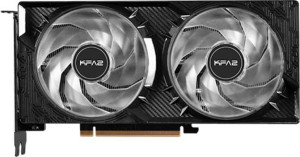
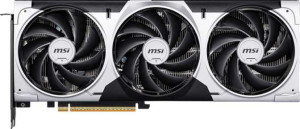
At their core, the KFA2 RTX 5060 1-Click OC and the MSI RTX 5060 Ventus 3X OC are built on identical silicon: both share 3840 shading units, 120 TMUs, 48 ROPs, a base clock of 2280 MHz, and the same 1750 MHz memory speed. This means any performance gap between them is determined entirely by how aggressively each card boosts under load.
The one meaningful differentiator in this group is the GPU turbo (boost) clock. The MSI Ventus 3X OC reaches 2535 MHz, versus 2512 MHz on the KFA2 — a difference of 23 MHz, or roughly 0.9%. Because pixel rate, texture rate, and floating-point throughput are all directly derived from the boost clock, the MSI card leads across every computed metric: 19.47 TFLOPS vs. 19.29 TFLOPS, 304.2 GTexels/s vs. 301.4 GTexels/s, and 121.7 GPixel/s vs. 120.6 GPixel/s. In practice, a sub-1% clock advantage of this magnitude will not produce a perceptible framerate difference in gaming — it falls well within run-to-run variance on any benchmark.
In summary, the MSI Ventus 3X OC holds a technical edge on paper, but it is marginal to the point of being inconsequential in real-world use. Both cards offer the same rasterization muscle, the same compute throughput class, and identical double-precision floating-point support. For buyers deciding between these two purely on performance, the specs in this group are effectively a tie; other factors such as cooling solution, acoustics, or price should drive the final decision.