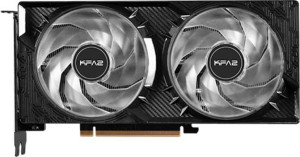
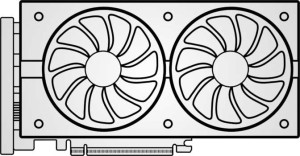
KFA2 GeForce RTX 5060 1-Click OC
Nvidia GeForce RTX 5060

KFA2 GeForce RTX 5060 1-Click OC Nvidia GeForce RTX 5060

Overview

Welcome to this detailed spec comparison between the KFA2 GeForce RTX 5060 1-Click OC and the Nvidia GeForce RTX 5060. Both cards are built on the same Blackwell architecture and share a great deal of common ground, making the choice between them a nuanced one. In this page, we examine the key battlegrounds: boosted clock speeds, physical dimensions, aesthetic features like RGB lighting, and the finer performance metrics that separate a factory-overclocked card from its reference counterpart.

Common Features

  • Both products have a base GPU clock speed of 2280 MHz.
  • Both products have a GPU memory speed of 1750 MHz.
  • Both products feature 3840 shading units.
  • Both products include 120 texture mapping units (TMUs).
  • Both products have 48 render output units (ROPs).
  • Double Precision Floating Point (DPFP) is supported on both products.
  • Both products have an effective memory speed of 28000 MHz.
  • Both products offer a maximum memory bandwidth of 448 GB/s.
  • Both products come with 8 GB of VRAM.
  • Both products use GDDR7 memory.
  • Both products use a 128-bit memory bus width.
  • ECC memory support is available on both products.
  • Both products support DirectX 12 Ultimate.
  • Both products support OpenGL version 4.6.
  • Both products support OpenCL version 3.
  • Multi-display technology is supported on both products.
  • Ray tracing is supported on both products.
  • 3D support is available on both products.
  • DLSS support is available on both products.
  • Both products support Intel Resizable BAR.
  • Both products include one HDMI 2.1b output.
  • Both products include three DisplayPort outputs.
  • Neither product includes USB-C, DVI, or mini DisplayPort outputs.
  • Both products are built on the Blackwell GPU architecture.
  • Both products have a Thermal Design Power (TDP) of 145W.
  • Both products use PCIe version 5.
  • Both products are manufactured on a 5 nm semiconductor process.
  • Both products contain 21,900 million transistors.
  • Air-water cooling is not available on either product.

Main Differences

  • GPU turbo clock speed is 2512 MHz on KFA2 GeForce RTX 5060 1-Click OC and 2500 MHz on Nvidia GeForce RTX 5060.
  • Pixel rate is 120.6 GPixel/s on KFA2 GeForce RTX 5060 1-Click OC and 120 GPixel/s on Nvidia GeForce RTX 5060.
  • Floating-point performance is 19.29 TFLOPS on KFA2 GeForce RTX 5060 1-Click OC and 19.2 TFLOPS on Nvidia GeForce RTX 5060.
  • Texture rate is 301.4 GTexels/s on KFA2 GeForce RTX 5060 1-Click OC and 300 GTexels/s on Nvidia GeForce RTX 5060.
  • RGB lighting is present on KFA2 GeForce RTX 5060 1-Click OC but not available on Nvidia GeForce RTX 5060.
  • Width is 237 mm on KFA2 GeForce RTX 5060 1-Click OC and 241 mm on Nvidia GeForce RTX 5060.
  • Height is 131 mm on KFA2 GeForce RTX 5060 1-Click OC and 111 mm on Nvidia GeForce RTX 5060.
Specs Comparison
KFA2 GeForce RTX 5060 1-Click OC

KFA2 GeForce RTX 5060 1-Click OC

Nvidia GeForce RTX 5060

Nvidia GeForce RTX 5060

Performance:
GPU clock speed 2280 MHz 2280 MHz
GPU turbo 2512 MHz 2500 MHz
pixel rate 120.6 GPixel/s 120 GPixel/s
floating-point performance 19.29 TFLOPS 19.2 TFLOPS
texture rate 301.4 GTexels/s 300 GTexels/s
GPU memory speed 1750 MHz 1750 MHz
shading units 3840 3840
texture mapping units (TMUs) 120 120
render output units (ROPs) 48 48
Has Double Precision Floating Point (DPFP)

At their core, both the KFA2 RTX 5060 1-Click OC and the Nvidia RTX 5060 share identical silicon foundations: the same 3840 shading units, 120 TMUs, 48 ROPs, and a base GPU clock of 2280 MHz. This means their theoretical compute architectures are indistinguishable at rest, and both support Double Precision Floating Point — a feature more relevant to workstation and compute tasks than gaming.

The only measurable separation between these two cards lives in their boost behavior. The KFA2's 1-Click OC profile raises the GPU turbo to 2512 MHz versus the reference 2500 MHz — a 12 MHz delta. This cascades into marginally higher derived metrics: 19.29 TFLOPS vs 19.2 TFLOPS floating-point, and 301.4 GTexels/s vs 300 GTexels/s texture throughput. In practice, a sub-1% clock advantage of this magnitude sits well within frame-to-frame variance and would be imperceptible in real-world gaming or rendering workloads.

The KFA2 1-Click OC technically edges out the reference Nvidia card on every performance metric in this group, but the margin is cosmetic rather than meaningful. Buyers choosing between these two should look beyond raw performance numbers — factors like cooling solution, power delivery, acoustics, and price will have a far greater real-world impact than the negligible factory overclock advantage the KFA2 holds here.

Memory:
effective memory speed 28000 MHz 28000 MHz
maximum memory bandwidth 448 GB/s 448 GB/s
VRAM 8GB 8GB
GDDR version GDDR7 GDDR7
memory bus width 128-bit 128-bit
Supports ECC memory

Memory is where these two cards stop competing entirely — every single specification in this group is identical. Both the KFA2 RTX 5060 1-Click OC and the Nvidia RTX 5060 ship with 8GB of GDDR7 over a 128-bit bus, running at an effective 28000 MHz to deliver 448 GB/s of peak bandwidth. There is nothing to differentiate here; the KFA2 is using the exact same memory subsystem as the reference design.

That shared spec sheet is still worth contextualizing. GDDR7 is a meaningful generational leap in memory efficiency, allowing the 128-bit bus — a width that would have been considered a bottleneck in previous generations — to sustain bandwidth figures that rival wider GDDR6X implementations. The 448 GB/s ceiling comfortably supports high-resolution texture streaming and modern rendering techniques like ray tracing at 1080p and 1440p. ECC memory support is a bonus for users doing compute or professional workloads, where data integrity matters more than raw throughput.

This group is a dead heat. Neither card offers any memory advantage over the other, and no amount of factory overclocking changes the underlying memory configuration. A buyer hoping to find an edge here should focus their attention on other specification groups.

Features:
DirectX version DirectX 12 Ultimate DirectX 12 Ultimate
OpenGL version 4.6 4.6
OpenCL version 3 3
Supports multi-display technology
supports ray tracing
Supports 3D
supports DLSS
AMD SAM / Intel Resizable BAR Intel Resizable BAR Intel Resizable BAR
has LHR
has RGB lighting
supported displays 4 4

On the software and API feature front, these two cards are functionally identical. Both support DirectX 12 Ultimate, ray tracing, and DLSS — the trifecta that defines a modern Nvidia GPU experience. DirectX 12 Ultimate ensures compatibility with the full suite of current-gen rendering features, while DLSS provides AI-driven upscaling that can significantly boost frame rates with minimal visual quality trade-off. Neither card carries LHR restrictions, and both support up to 4 simultaneous displays alongside Intel Resizable BAR for improved CPU-to-GPU data throughput.

The one concrete differentiator in this group is purely aesthetic: the KFA2 1-Click OC includes RGB lighting, while the reference Nvidia RTX 5060 does not. For builders who care about case aesthetics or sync their components through a lighting ecosystem, this is a tangible, if non-functional, advantage. For those indifferent to visual flair, it carries no practical weight whatsoever.

Functionally, this group is a tie — every capability that affects gaming performance, compatibility, or display output is shared equally. The KFA2 holds a narrow edge solely on the basis of its RGB lighting, which is a meaningful differentiator only for aesthetics-focused buyers.

Ports:
has an HDMI output
HDMI ports 1 1
HDMI version HDMI 2.1b HDMI 2.1b
DisplayPort outputs 3 3
USB-C ports 0 0
DVI outputs 0 0
mini DisplayPort outputs 0 0

Port configurations are a mirror image between these two cards. Both offer 1 HDMI 2.1b and 3 DisplayPort outputs, totaling four physical display connections — consistent with the four-display limit noted in their features specs. Legacy outputs like DVI and mini DisplayPort are absent on both, reflecting the industry's full pivot away from older standards at this product tier.

The inclusion of HDMI 2.1b is worth highlighting. It supports up to 4K at high refresh rates and 8K output, making both cards future-ready for high-bandwidth display setups. The triple DisplayPort configuration is equally practical for multi-monitor productivity or gaming arrays without requiring adapters. The absence of USB-C is the only notable omission, which could matter to users with USB-C monitors or VR headsets that rely on that connection — but this limitation applies equally to both cards.

This group is a complete tie. The port layout is identical in every respect, so display compatibility and connectivity options offer no basis for choosing one card over the other.

General info:
GPU architecture Blackwell Blackwell
release date May 2025 May 2025
Thermal Design Power (TDP) 145W 145W
PCI Express (PCIe) version 5 5
semiconductor size 5 nm 5 nm
number of transistors 21900 million 21900 million
Has air-water cooling
width 237 mm 241 mm
height 131 mm 111 mm

Fundamentally, these two cards are built from the same blueprint. Both are based on the Blackwell architecture, manufactured on a 5nm process with 21.9 billion transistors, draw 145W TDP, and connect via PCIe 5.0. The 5nm node delivers strong efficiency at this power envelope, and PCIe 5.0 ensures maximum forward compatibility with current and near-future motherboard platforms — though at this performance tier, PCIe 4.0 bandwidth would rarely be a bottleneck in practice.

Physical dimensions are where the two diverge in a way that actually matters for some buyers. The KFA2 1-Click OC measures 237 × 131 mm, while the reference RTX 5060 is 241 × 111 mm. The KFA2 is slightly shorter in length but notably taller — 20mm taller, in fact. This height difference is significant in small form factor or mini-ITX builds where vertical GPU clearance can be a hard constraint, and the reference card's slimmer profile may be easier to accommodate in tighter chassis.

For general compatibility and platform specs, this group is effectively a tie. The dimensional differences are the only decision-relevant distinction, and which card ″wins″ depends entirely on the target case: the Nvidia reference card's shorter height gives it a practical edge in space-constrained builds, while the KFA2's slightly reduced length could matter in cases with limited depth.

Comparison Summary & Verdict

After a thorough look at the specifications, it is clear that the KFA2 GeForce RTX 5060 1-Click OC and the Nvidia GeForce RTX 5060 are closely matched in almost every meaningful way, sharing identical memory configurations, feature sets, power envelopes, and port layouts. The KFA2 card edges ahead with a marginally higher GPU turbo clock of 2512 MHz, resulting in slightly better pixel rate, texture rate, and floating-point performance, alongside RGB lighting for those who value aesthetics. It is also the narrower of the two at 237 mm. The Nvidia reference card, however, is notably shorter at 111 mm versus 131 mm, making it the better fit for compact or space-constrained builds. Buyers who want every last drop of out-of-the-box performance and a visual flair should lean toward the KFA2, while those prioritizing a lower-profile form factor and a cleaner look will find the reference Nvidia card more accommodating.

KFA2 GeForce RTX 5060 1-Click OC
Buy KFA2 GeForce RTX 5060 1-Click OC if...

Buy the KFA2 GeForce RTX 5060 1-Click OC if you want a factory-overclocked boost in clock speed and floating-point performance straight out of the box, and appreciate RGB lighting on your GPU.

Nvidia GeForce RTX 5060
Buy Nvidia GeForce RTX 5060 if...

Buy the Nvidia GeForce RTX 5060 if you need a more compact card that fits tighter cases, thanks to its significantly shorter 111 mm height, and prefer a clean design without RGB lighting.