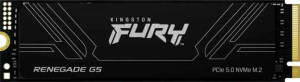
Kingston Fury Renegade G5 1TB
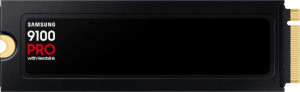
Samsung 9100 Pro 1TB

Kingston Fury Renegade G5 1TB Samsung 9100 Pro 1TB

Overview

Welcome to our in-depth specification face-off between the Kingston Fury Renegade G5 1TB and the Samsung 9100 Pro 1TB. Both are cutting-edge PCIe 5.0 NVMe M.2 SSDs targeting enthusiasts and professionals who demand the absolute best in storage performance. In this comparison, we examine their key battlegrounds: sequential and random speeds, endurance ratings, and the controller technology powering each drive.

Common Features

  • Both drives use the M.2 form factor.
  • Both drives are equipped with a DRAM cache.
  • Both drives are NVMe SSDs.
  • Both drives use NVMe version 2.
  • Both drives offer 1000GB of internal storage.
  • Both drives use TLC NAND flash storage.
  • Both drives use PCI Express (PCIe) version 5.
  • Both drives feature 8 controller channels.

Main Differences

  • Sequential read speed is 14200 MB/s on Kingston Fury Renegade G5 1TB and 14700 MB/s on Samsung 9100 Pro 1TB.
  • Random read speed is 2200000 IOPS on Kingston Fury Renegade G5 1TB and 1850000 IOPS on Samsung 9100 Pro 1TB.
  • Sequential write speed is 11000 MB/s on Kingston Fury Renegade G5 1TB and 13300 MB/s on Samsung 9100 Pro 1TB.
  • Random write speed is 2150000 IOPS on Kingston Fury Renegade G5 1TB and 2600000 IOPS on Samsung 9100 Pro 1TB.
  • The controller is the Silicon Motion SM2508 on Kingston Fury Renegade G5 1TB and the Samsung Presto (S4LY027) on Samsung 9100 Pro 1TB.
  • Terabytes Written (TBW) is 1000 TB on Kingston Fury Renegade G5 1TB and 600 TB on Samsung 9100 Pro 1TB.
  • MTBF is 2 million hours on Kingston Fury Renegade G5 1TB and 1.5 million hours on Samsung 9100 Pro 1TB.
Specs Comparison
Kingston Fury Renegade G5 1TB

Kingston Fury Renegade G5 1TB

Samsung 9100 Pro 1TB

Samsung 9100 Pro 1TB

Read speed:
sequential read speed 14200 MB/s 14700 MB/s
random read speed 2200000 IOPS 1850000 IOPS

Both drives operate at the top tier of consumer NVMe performance, but they diverge in an interesting way: the Samsung 9100 Pro leads in sequential read speed at 14700 MB/s versus 14200 MB/s for the Kingston Fury Renegade G5 — a roughly 3.5% gap that matters most when transferring very large, contiguous files such as video exports or disk images.

The picture flips entirely for random reads. The Kingston Fury Renegade G5 delivers 2,200,000 IOPS compared to 1,850,000 IOPS on the Samsung — an approximately 19% advantage. Random read IOPS govern how quickly a drive handles the fragmented, small-block workloads that dominate everyday computing: OS responsiveness, application launches, game level loads, and database queries. In those scenarios, the Kingston's lead is both larger and more practically felt.

Neither drive has a clean sweep here. The Samsung holds the edge for sustained large-file throughput, while the Kingston is the stronger performer for the mixed, latency-sensitive workloads most users encounter daily. If your workload skews toward creative media pipelines with massive sequential transfers, the Samsung has a slight advantage; for general-purpose or high-IOPS workloads, the Kingston Fury Renegade G5 is the better choice.

Write speed:
sequential write speed 11000 MB/s 13300 MB/s
random write speed 2150000 IOPS 2600000 IOPS

Write performance tells a more one-sided story than read performance did. The Samsung 9100 Pro pulls ahead on both fronts: its sequential write speed of 13300 MB/s outpaces the Kingston Fury Renegade G5's 11000 MB/s by roughly 21% — a gap large enough to be consistently noticeable when ingesting large volumes of data, such as copying 4K footage to the drive or writing a large VM snapshot.

More striking is the random write advantage. The Samsung reaches 2,600,000 IOPS versus 2,150,000 IOPS for the Kingston — about a 21% lead there as well. High random write IOPS reduce latency during write-heavy operations like compiling large codebases, running databases, or heavy multitasking with frequent disk writes. Unlike the read comparison where each drive had its own strength, here the Samsung leads across both metrics by a consistent and meaningful margin.

The write speed category has a clear winner: the Samsung 9100 Pro. Its advantage is not marginal — a ~21% edge in both sequential and random writes is substantial enough to translate into real-world differences for content creators, developers, and power users who write data as intensively as they read it. The Kingston Fury Renegade G5 remains competitive in absolute terms, but it concedes this round without ambiguity.

General info:
type M2 M2
SSD cache DRAM cache DRAM cache
Is an NVMe SSD
NVMe version 2 2
internal storage 1000GB 1000GB
release date April 2025 February 2025
controller Silicon Motion SM2508 Samsung Presto (S4LY027)
SSD storage type TLC TLC
PCI Express (PCIe) version 5 5
Controller channels 8 8
Terabytes Written (TBW) 1000 600
MTBF 2million hours 1.5million hours
warranty period 5 years 5 years
Has an integrated heatsink
has RGB lighting

At the architectural level, these two drives are remarkably alike: both are M.2 NVMe SSDs running PCIe 5.0 with NVMe 2.0, DRAM cache, TLC NAND, 8 controller channels, and a 5-year warranty. That foundation means neither has a structural advantage in terms of interface bandwidth ceiling or cache architecture — they are built for the same performance tier from the ground up.

Where the general specs diverge meaningfully is in long-term endurance. The Kingston Fury Renegade G5 is rated for 1000 TBW (Terabytes Written) compared to 600 TBW for the Samsung 9100 Pro — a 67% higher write endurance rating. Similarly, Kingston's MTBF stands at 2,000,000 hours versus 1,500,000 hours for the Samsung. TBW is particularly relevant for users who write large amounts of data regularly, such as video editors, database administrators, or anyone using the drive as a primary working scratch disk; a higher rating signals the drive is designed to sustain heavier write cycles over its lifetime before NAND wear becomes a concern.

For general configuration, these drives are effectively matched — same form factor, same interface, same cache type, same NAND. The deciding factor in this group is durability: the Kingston Fury Renegade G5 holds a clear edge in both TBW and MTBF, making it the stronger choice for write-intensive, mission-critical use cases where longevity and reliability carry extra weight.

Comparison Summary & Verdict

Both the Kingston Fury Renegade G5 1TB and the Samsung 9100 Pro 1TB are elite PCIe 5.0 SSDs sharing the same M.2 form factor, TLC NAND, DRAM cache, and NVMe 2.0 specification. However, their strengths differ meaningfully. The Kingston Fury Renegade G5 1TB stands out with a superior random read speed of 2,200,000 IOPS, a significantly higher TBW endurance of 1,000 TB, and a longer MTBF of 2 million hours, making it the stronger choice for workloads demanding longevity and sustained random read performance. Meanwhile, the Samsung 9100 Pro 1TB leads in sequential write speed at 13,300 MB/s and random write speed at 2,600,000 IOPS, alongside a faster sequential read of 14,700 MB/s, giving it the edge for large file transfers and write-intensive tasks.

Kingston Fury Renegade G5 1TB
Buy Kingston Fury Renegade G5 1TB if...

Buy the Kingston Fury Renegade G5 1TB if you prioritize higher random read performance, greater long-term endurance with a 1,000 TB TBW rating, and a longer MTBF of 2 million hours.

Samsung 9100 Pro 1TB
Buy Samsung 9100 Pro 1TB if...

Buy the Samsung 9100 Pro 1TB if you need faster sequential and random write speeds, making it the better fit for large file transfers and write-heavy workloads.