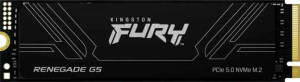
Kingston Fury Renegade G5 1TB
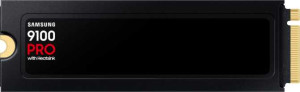
Samsung 9100 Pro 1TB (With Heatsink)

Kingston Fury Renegade G5 1TB Samsung 9100 Pro 1TB (With Heatsink)

Overview

Welcome to our in-depth comparison of the Kingston Fury Renegade G5 1TB and the Samsung 9100 Pro 1TB (With Heatsink) — two of the most powerful PCIe 5.0 NVMe SSDs on the market today. Both drives share the same M.2 form factor, TLC NAND, and DRAM cache foundation, yet they diverge in meaningful ways across sequential and random performance, endurance ratings, and thermal design. Read on to see how these flagship drives stack up across every key specification.

Common Features

  • Both drives use the M.2 form factor.
  • Both drives feature a DRAM cache.
  • Both drives are NVMe SSDs.
  • Both drives use NVMe version 2.
  • Both drives offer 1000GB of internal storage.
  • Both drives use TLC NAND flash storage.
  • Both drives connect via PCIe version 5.
  • Both drives use an 8-channel controller.

Main Differences

  • Sequential read speed is 14200 MB/s on Kingston Fury Renegade G5 1TB and 14700 MB/s on Samsung 9100 Pro 1TB (With Heatsink).
  • Random read speed is 2200000 IOPS on Kingston Fury Renegade G5 1TB and 1850000 IOPS on Samsung 9100 Pro 1TB (With Heatsink).
  • Sequential write speed is 11000 MB/s on Kingston Fury Renegade G5 1TB and 13300 MB/s on Samsung 9100 Pro 1TB (With Heatsink).
  • Random write speed is 2150000 IOPS on Kingston Fury Renegade G5 1TB and 2600000 IOPS on Samsung 9100 Pro 1TB (With Heatsink).
  • The controller is Silicon Motion SM2508 on Kingston Fury Renegade G5 1TB and Samsung Presto (S4LY027) on Samsung 9100 Pro 1TB (With Heatsink).
  • Terabytes Written (TBW) is 1000 TB on Kingston Fury Renegade G5 1TB and 600 TB on Samsung 9100 Pro 1TB (With Heatsink).
  • MTBF is 2 million hours on Kingston Fury Renegade G5 1TB and 1.5 million hours on Samsung 9100 Pro 1TB (With Heatsink).
  • An integrated heatsink is included on Samsung 9100 Pro 1TB (With Heatsink) but is not present on Kingston Fury Renegade G5 1TB.
Specs Comparison
Kingston Fury Renegade G5 1TB

Kingston Fury Renegade G5 1TB

Samsung 9100 Pro 1TB (With Heatsink)

Samsung 9100 Pro 1TB (With Heatsink)

Read speed:
sequential read speed 14200 MB/s 14700 MB/s
random read speed 2200000 IOPS 1850000 IOPS

Both drives operate at the top tier of NVMe performance, but they diverge in an interesting way depending on the workload type. The Samsung 9100 Pro holds a narrow lead in sequential read speed at 14700 MB/s versus 14200 MB/s for the Kingston Fury Renegade G5 — a roughly 3.5% difference that will be imperceptible in most real-world file transfers or game loads, where other system bottlenecks dominate long before the drive's ceiling is reached.

The more meaningful split comes in random read performance. The Kingston Fury Renegade G5 pulls significantly ahead here with 2,200,000 IOPS compared to the Samsung's 1,850,000 IOPS — a gap of nearly 19%. Random IOPS directly reflects how fast a drive handles the small, scattered read requests that dominate everyday computing: launching applications, loading operating system assets, accessing databases, or handling many simultaneous file reads. A higher IOPS ceiling means the drive stays more responsive under mixed or queue-heavy workloads.

In summary, neither drive has a clean sweep. The Samsung 9100 Pro has a marginal edge in peak sequential throughput — relevant mainly for large sequential transfers like video editing pipelines — while the Kingston Fury Renegade G5 has a clear and more practically meaningful advantage in random read performance. For users prioritizing snappy, responsive system behavior under varied workloads, the Kingston's random read lead is the more impactful differentiator.

Write speed:
sequential write speed 11000 MB/s 13300 MB/s
random write speed 2150000 IOPS 2600000 IOPS

Write performance is where the Samsung 9100 Pro asserts a commanding lead across both metrics. Its sequential write speed of 13300 MB/s outpaces the Kingston Fury Renegade G5's 11000 MB/s by over 20% — a gap substantial enough to matter in sustained write-heavy tasks like ingesting large RAW video files, writing virtual machine images, or bulk data migrations where the drive must maintain throughput over extended periods.

The random write gap tells a similar story. The Samsung reaches 2,600,000 IOPS versus the Kingston's 2,150,000 IOPS, a roughly 21% advantage. In practice, strong random write IOPS translate to faster save operations, snappier compile times for large codebases, and more consistent performance under mixed read-write workloads — scenarios where the drive is constantly updating small blocks of data rather than streaming a single large file.

Unlike the read speed comparison where each drive claimed a different metric, the Samsung 9100 Pro wins both write categories by a consistent and significant margin. For content creators, developers, or power users whose workflows involve heavy write activity, this is a meaningful real-world advantage — not a paper spec edge.

General info:
type M2 M2
SSD cache DRAM cache DRAM cache
Is an NVMe SSD
NVMe version 2 2
internal storage 1000GB 1000GB
release date April 2025 February 2025
controller Silicon Motion SM2508 Samsung Presto (S4LY027)
SSD storage type TLC TLC
PCI Express (PCIe) version 5 5
Controller channels 8 8
Terabytes Written (TBW) 1000 600
MTBF 2million hours 1.5million hours
warranty period 5 years 5 years
Has an integrated heatsink
has RGB lighting

At the foundational level, these two drives share an identical architecture blueprint: M.2 form factor, PCIe 5.0 interface, NVMe 2.0 protocol, DRAM cache, 8-channel controllers, TLC NAND, and a 5-year warranty. For the buyer, this means both occupy the same performance tier and target the same platform requirements — the differentiators are in the details.

The most striking gap in this group is endurance. The Kingston Fury Renegade G5 is rated for 1000 TBW (Terabytes Written) against the Samsung 9100 Pro's 600 TBW — a 67% advantage. Paired with a higher MTBF of 2 million hours versus 1.5 million, the Kingston presents a meaningfully stronger long-term reliability profile on paper. TBW matters most to users who write large volumes of data regularly, such as video editors, database administrators, or anyone running sustained workloads; for typical consumer use, both ratings are more than sufficient over a 5-year lifespan.

One practical tradeoff worth noting: the Samsung 9100 Pro ships with an integrated heatsink — as its full product name indicates — while the Kingston does not. In thermally constrained builds or motherboards without their own M.2 heatsink, this gives the Samsung a plug-and-play convenience advantage. Overall though, on endurance and rated reliability alone, the Kingston holds the edge in this group.

Comparison Summary & Verdict

Both the Kingston Fury Renegade G5 1TB and the Samsung 9100 Pro 1TB (With Heatsink) are elite PCIe 5.0 drives, but they cater to slightly different priorities. The Kingston Fury Renegade G5 1TB stands out with a significantly higher TBW rating of 1000 TB and a superior MTBF of 2 million hours, making it the stronger choice for users who demand long-term reliability and write-heavy workloads. On the other hand, the Samsung 9100 Pro 1TB pulls ahead in sequential write speed (13300 MB/s) and random write IOPS, and includes an integrated heatsink out of the box for users who want plug-and-play thermal management. Choose the Kingston if endurance is your top concern; choose the Samsung if peak sustained write throughput and thermal convenience matter most.

Kingston Fury Renegade G5 1TB
Buy Kingston Fury Renegade G5 1TB if...

Buy the Kingston Fury Renegade G5 1TB if long-term drive endurance is your priority — it offers a significantly higher TBW rating of 1000 TB and a longer MTBF of 2 million hours compared to the Samsung.

Samsung 9100 Pro 1TB (With Heatsink)
Buy Samsung 9100 Pro 1TB (With Heatsink) if...

Buy the Samsung 9100 Pro 1TB (With Heatsink) if you need faster sequential and random write performance, and want the convenience of a built-in heatsink without purchasing one separately.