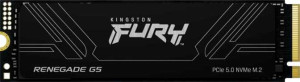
Kingston Fury Renegade G5 4TB
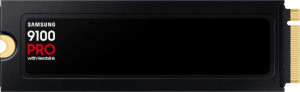
Samsung 9100 Pro 1TB

Kingston Fury Renegade G5 4TB Samsung 9100 Pro 1TB

Overview

When choosing between the Kingston Fury Renegade G5 4TB and the Samsung 9100 Pro 1TB, you are looking at two of the fastest PCIe 5.0 NVMe SSDs on the market. Both share a strong foundation of TLC storage, DRAM caching, and NVMe 2.0 support, yet they diverge in key areas such as storage capacity, endurance ratings, and specific read and write performance characteristics. This comparison breaks down every relevant specification to help you make the right choice.

Common Features

  • Both products use the M2 form factor.
  • Both products include a DRAM cache.
  • Both products are NVMe SSDs.
  • Both products use NVMe version 2.
  • Both products use TLC storage type.
  • Both products use PCIe version 5.
  • Both products have 8 controller channels.
  • Both products come with a 5-year warranty.

Main Differences

  • Sequential read speed is 14800 MB/s on Kingston Fury Renegade G5 4TB and 14700 MB/s on Samsung 9100 Pro 1TB.
  • Random read speed is 2200000 IOPS on Kingston Fury Renegade G5 4TB and 1850000 IOPS on Samsung 9100 Pro 1TB.
  • Sequential write speed is 14000 MB/s on Kingston Fury Renegade G5 4TB and 13300 MB/s on Samsung 9100 Pro 1TB.
  • Random write speed is 2200000 IOPS on Kingston Fury Renegade G5 4TB and 2600000 IOPS on Samsung 9100 Pro 1TB.
  • Internal storage capacity is 4000GB on Kingston Fury Renegade G5 4TB and 1000GB on Samsung 9100 Pro 1TB.
  • The controller is Silicon Motion SM2508 on Kingston Fury Renegade G5 4TB and Samsung Presto (S4LY027) on Samsung 9100 Pro 1TB.
  • Terabytes Written (TBW) is 4000 TB on Kingston Fury Renegade G5 4TB and 600 TB on Samsung 9100 Pro 1TB.
  • MTBF is 2 million hours on Kingston Fury Renegade G5 4TB and 1.5 million hours on Samsung 9100 Pro 1TB.
Specs Comparison
Kingston Fury Renegade G5 4TB

Kingston Fury Renegade G5 4TB

Samsung 9100 Pro 1TB

Samsung 9100 Pro 1TB

Read speed:
sequential read speed 14800 MB/s 14700 MB/s
random read speed 2200000 IOPS 1850000 IOPS

In sequential read performance, the two drives are remarkably close: the Kingston Fury Renegade G5 4TB reaches 14800 MB/s versus 14700 MB/s for the Samsung 9100 Pro 1TB. A 100 MB/s gap at this tier is essentially imperceptible in practice — both drives sit at the very top of Gen 5 throughput, and neither will bottleneck large file transfers or workloads like video editing and game asset streaming.

The more meaningful differentiator is random read performance, where the Fury Renegade G5 pulls ahead with 2,200,000 IOPS compared to the 9100 Pro's 1,850,000 IOPS — a roughly 19% advantage. Random IOPS governs how a drive handles the small, scattered read requests typical of OS boot, application launches, and database queries. For everyday desktop use the gap is unlikely to be felt, but in workstation or server environments with heavy concurrent workloads, the Fury Renegade G5's lead translates into measurably snappier responsiveness.

Overall, sequential read speed is effectively a tie, but the Kingston Fury Renegade G5 holds a clear edge in random reads. Users prioritizing multitasking throughput or I/O-intensive workloads will benefit from that IOPS advantage, while users focused purely on large sequential transfers will find both drives essentially equivalent.

Write speed:
sequential write speed 14000 MB/s 13300 MB/s
random write speed 2200000 IOPS 2600000 IOPS

Sequential write speed favors the Kingston Fury Renegade G5 4TB, which sustains 14000 MB/s against the Samsung 9100 Pro 1TB's 13300 MB/s — a roughly 5% lead. At this performance tier both figures are exceptional, but the Fury Renegade G5's advantage becomes tangible when pushing large, sustained writes: think multi-gigabyte RAW video exports, large backup jobs, or moving hefty game libraries. The delta is real, if not transformative for typical desktop workloads.

Random write performance tells the opposite story. The 9100 Pro counters with 2,600,000 IOPS versus the Fury Renegade G5's 2,200,000 IOPS — an 18% advantage that is hard to ignore. Random writes underpin the workloads that stress drives most in real use: database transactions, virtual machine disk I/O, and OS-level file system activity. That IOPS lead means the 9100 Pro can handle a higher volume of small, concurrent write operations without queuing delays, which directly benefits responsiveness under mixed workloads.

Write performance ends in a split decision. The Fury Renegade G5 leads on sequential throughput, making it the stronger choice for content creators and anyone moving large files regularly. The Samsung 9100 Pro holds the edge in random writes, giving it an advantage in enterprise-adjacent or heavily multitasked environments. Neither drive is definitively superior here — the right choice depends on whether your workload is dominated by bulk transfers or small, scattered I/O.
General info:
type M2 M2
SSD cache DRAM cache DRAM cache
Is an NVMe SSD
NVMe version 2 2
internal storage 4000GB 1000GB
release date April 2025 February 2025
controller Silicon Motion SM2508 Samsung Presto (S4LY027)
SSD storage type TLC TLC
PCI Express (PCIe) version 5 5
Controller channels 8 8
Terabytes Written (TBW) 4000 600
MTBF 2million hours 1.5million hours
warranty period 5 years 5 years
Has an integrated heatsink
has RGB lighting

At the architectural level, these two drives share a remarkably similar foundation: both are M.2 NVMe 2.0 SSDs running on PCIe 5.0 with DRAM cache, 8 controller channels, and TLC NAND — meaning neither has a meaningful platform advantage over the other. Where they diverge is in the details that matter for long-term ownership. The Kingston Fury Renegade G5 ships with a Silicon Motion SM2508 controller, while the Samsung 9100 Pro uses Samsung's in-house Presto (S4LY027) — a vertically integrated solution that gives Samsung tight control over the full signal chain from controller to NAND.

Endurance is where the gap becomes stark. The Fury Renegade G5 4TB is rated for 4000 TBW against the 9100 Pro 1TB's 600 TBW. Capacity alone explains part of this difference, but even normalized per terabyte the Kingston leads — roughly 1 TBW per GB versus approximately 0.6 TBW per GB for the Samsung. This matters for write-heavy workloads like NAS use, video production, or continuous logging, where drive lifespan is a genuine concern. The Fury Renegade G5 also carries a higher MTBF of 2 million hours versus 1.5 million, reinforcing its edge in rated reliability.

Both drives share a 5-year warranty and neither includes an integrated heatsink, so thermal management falls to the motherboard or user. Overall, the Fury Renegade G5 holds a clear advantage in endurance and rated reliability — a decisive factor for power users and prosumers. The 9100 Pro's appeal in this group rests primarily on Samsung's tightly integrated controller-NAND stack, which can offer consistency benefits that raw specs alone don't fully capture.

Comparison Summary & Verdict

Both drives deliver elite-tier PCIe 5.0 performance, but they serve different user profiles. The Kingston Fury Renegade G5 4TB stands out with its massive 4TB capacity, a significantly higher TBW rating of 4000 TB, and a superior MTBF of 2 million hours, making it the better long-term investment for power users, content creators, or anyone who needs high endurance alongside vast storage. The Samsung 9100 Pro 1TB, on the other hand, edges ahead in random write speed at 2,600,000 IOPS, which can benefit workloads with heavy simultaneous write operations. If raw capacity and durability are your priorities, Kingston leads; if you need the best random write throughput in a 1TB footprint, Samsung is the sharper tool for that specific job.

Kingston Fury Renegade G5 4TB
Buy Kingston Fury Renegade G5 4TB if...

Buy the Kingston Fury Renegade G5 4TB if you need maximum storage capacity combined with outstanding endurance, as its 4TB size and 4000 TBW rating far exceed what the Samsung 9100 Pro 1TB offers.

Samsung 9100 Pro 1TB
Buy Samsung 9100 Pro 1TB if...

Buy the Samsung 9100 Pro 1TB if your workload demands the highest possible random write performance, as its 2,600,000 IOPS random write speed outpaces the Kingston Fury Renegade G5 4TB.