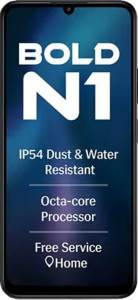
Lava Bold N1
Xiaomi Redmi A5 4G

Lava Bold N1 Xiaomi Redmi A5 4G

Overview

Welcome to our detailed spec comparison between the Lava Bold N1 and the Xiaomi Redmi A5 4G — two budget-friendly Android smartphones that share a surprising number of traits yet diverge in meaningful ways. In this head-to-head, we explore how these two devices stack up across key battlegrounds including performance and chipset capability, display refresh rate, camera resolution, battery capacity, and software features to help you decide which one truly fits your needs.

Common Features

  • Both phones are water resistant.
  • Neither phone has a rugged build.
  • Neither phone can be folded.
  • Both phones feature an LCD IPS display.
  • Both phones have a pixel density of 260 ppi.
  • Neither phone has branded damage-resistant glass.
  • Neither phone supports HDR10.
  • Neither phone supports HDR10+.
  • Neither phone has an Always-On Display.
  • Neither phone supports Dolby Vision.
  • Neither phone has a secondary screen.
  • Both phones have integrated LTE.
  • Both phones support 64-bit processing.
  • Both phones use big.LITTLE CPU technology with 8 threads.
  • Both phones use eMMC 5.1 storage.
  • Neither phone has a dual-lens main camera.
  • Neither phone has built-in optical image stabilization.
  • Both phones can record video at 1080p 30 fps.
  • Neither phone has a BSI sensor.
  • Both phones have a CMOS sensor.
  • Both phones support continuous autofocus when recording video.
  • Both phones include clipboard warnings.
  • Both phones have location privacy options.
  • Both phones have camera and microphone privacy options.
  • Neither phone has Mail Privacy Protection.
  • Both phones support theme customization.
  • Both phones can block app tracking.
  • Neither phone blocks cross-site tracking.
  • Both phones have on-device machine learning.
  • Neither phone supports wireless charging.
  • Both phones support fast charging.
  • Neither phone has a removable battery.
  • Both phones have a battery level indicator.
  • Both phones have a rechargeable battery.
  • Both phones have a 3.5 mm audio jack.
  • Neither phone has stereo speakers.
  • Neither phone supports LDAC.
  • Neither phone supports aptX Lossless.
  • Neither phone supports 5G.
  • Both phones support Wi-Fi 4 (802.11n) and Wi-Fi 5 (802.11ac).
  • Both phones have dual SIM support.
  • Both phones have an external memory slot.
  • Both phones have USB Type-C.
  • Neither phone has NFC.
  • Both phones have a download speed of 300 MBits/s and upload speed of 150 MBits/s.
  • Both phones have a video light.
  • Neither phone has a sapphire glass display.
  • Neither phone has a curved display.
  • Neither phone has an e-paper display.

Main Differences

  • Weight is 200 g on Lava Bold N1 and 193 g on Xiaomi Redmi A5 4G.
  • Thickness is 8.8 mm on Lava Bold N1 and 8.3 mm on Xiaomi Redmi A5 4G.
  • Width is 76.1 mm on Lava Bold N1 and 77.8 mm on Xiaomi Redmi A5 4G.
  • Height is 165 mm on Lava Bold N1 and 171.7 mm on Xiaomi Redmi A5 4G.
  • Ingress Protection rating is IP54 on Lava Bold N1 and IP52 on Xiaomi Redmi A5 4G.
  • Screen size is 6.75″ on Lava Bold N1 and 6.88″ on Xiaomi Redmi A5 4G.
  • Resolution is 720 x 1600 px on Lava Bold N1 and 720 x 1640 px on Xiaomi Redmi A5 4G.
  • Refresh rate is 90Hz on Lava Bold N1 and 120Hz on Xiaomi Redmi A5 4G.
  • Internal storage is 64GB on Lava Bold N1 and 128GB on Xiaomi Redmi A5 4G.
  • RAM is 4GB on Lava Bold N1 and 6GB on Xiaomi Redmi A5 4G.
  • Chipset is Unisoc SC9863A on Lava Bold N1 and Unisoc T7250 on Xiaomi Redmi A5 4G.
  • GPU is PowerVR GE8322 on Lava Bold N1 and Mali G57 on Xiaomi Redmi A5 4G.
  • CPU speed is 4 x 1.6 & 4 x 1.2 GHz on Lava Bold N1 and 2 x 1.8 & 6 x 1.6 GHz on Xiaomi Redmi A5 4G.
  • Geekbench 6 multi-core score is 725 on Lava Bold N1 and 1461 on Xiaomi Redmi A5 4G.
  • Geekbench 6 single-core score is 164 on Lava Bold N1 and 437 on Xiaomi Redmi A5 4G.
  • GPU clock speed is 550 MHz on Lava Bold N1 and 850 MHz on Xiaomi Redmi A5 4G.
  • RAM speed is 933 MHz on Lava Bold N1 and 1866 MHz on Xiaomi Redmi A5 4G.
  • Semiconductor size is 28 nm on Lava Bold N1 and 12 nm on Xiaomi Redmi A5 4G.
  • Main camera resolution is 13 MP on Lava Bold N1 and 32 MP on Xiaomi Redmi A5 4G.
  • Front camera resolution is 5 MP on Lava Bold N1 and 8 MP on Xiaomi Redmi A5 4G.
  • Android version is Android 14 on Lava Bold N1 and Android 15 on Xiaomi Redmi A5 4G.
  • App offloading is not available on Lava Bold N1 but is supported on Xiaomi Redmi A5 4G.
  • Battery capacity is 5000 mAh on Lava Bold N1 and 5200 mAh on Xiaomi Redmi A5 4G.
  • Charging speed is 10W on Lava Bold N1 and 15W on Xiaomi Redmi A5 4G.
  • FM radio is present on Lava Bold N1 but not available on Xiaomi Redmi A5 4G.
  • Bluetooth version is 4.2 on Lava Bold N1 and 5.2 on Xiaomi Redmi A5 4G.
Specs Comparison
Lava Bold N1

Lava Bold N1

Xiaomi Redmi A5 4G

Xiaomi Redmi A5 4G

Design:
water resistance Water resistant Water resistant
weight 200 g 193 g
thickness 8.8 mm 8.3 mm
width 76.1 mm 77.8 mm
height 165 mm 171.7 mm
volume 110.4972 cm³ 110.873558 cm³
Ingress Protection (IP) rating IP54 IP52
has a rugged build
can be folded

Both the Lava Bold N1 and the Xiaomi Redmi A5 4G share a water-resistant build with an IP rating, and neither is rugged or foldable — so they occupy similar ground in terms of overall design philosophy. The key distinction in protection lies in the IP rating: the Lava carries an IP54 certification, while the Redmi holds IP52. In practical terms, IP54 offers protection against dust ingress from any direction (the ″5″ digit) along with splash resistance, whereas IP52 only guards against limited dust contact. This gives the Lava a modest but real-world meaningful edge in dusty or outdoor environments.

On physical dimensions, the two phones diverge in interesting ways. The Redmi A5 is noticeably taller (171.7 mm vs. 165 mm) and slightly wider (77.8 mm vs. 76.1 mm), suggesting a larger display footprint. The Lava, however, is thicker (8.8 mm vs. 8.3 mm) and heavier (200 g vs. 193 g). Despite these differences, their total volumes are nearly identical — roughly 110.5 cm³ for the Lava and 110.9 cm³ for the Redmi — meaning the mass is distributed differently rather than one being a clearly bulkier device.

In terms of design, the Redmi A5 edges out on slimness and lightness, which can translate to a more comfortable in-hand feel over extended use. However, the Lava Bold N1 counters with superior dust and splash protection via its higher IP54 rating. Users who prioritize a sleeker, lighter form factor will lean toward the Redmi, while those in dustier or more demanding everyday environments will find the Lava′s IP54 rating the more practical choice.

Display:
Display type LCD, IPS LCD, IPS
screen size 6.75" 6.88"
pixel density 260 ppi 260 ppi
resolution 720 x 1600 px 720 x 1640 px
refresh rate 90Hz 120Hz
has branded damage-resistant glass
supports HDR10
supports HDR10+
Always-On Display
supports Dolby Vision
Has a secondary screen
has a touch screen

At the panel level, these two phones are essentially twins — both use an LCD IPS display, land at the same 260 ppi pixel density, and lack premium additions like HDR10, Dolby Vision, or damage-resistant glass. That shared foundation means neither has a meaningful edge in color accuracy, brightness technology, or screen durability at the glass level. The sharpness experience in daily use will also feel identical to the human eye.

Where they diverge is in screen size and, more importantly, refresh rate. The Redmi A5 offers a slightly larger 6.88″ panel versus the Lava′s 6.75″, which is a minor but noticeable difference for media consumption and reading. The far more impactful distinction, however, is the refresh rate: the Redmi runs at 120Hz while the Lava tops out at 90Hz. In real-world use, 120Hz produces visibly smoother scrolling, more fluid animations, and a more responsive touch feel compared to 90Hz — a difference that becomes apparent almost immediately during everyday navigation.

The Redmi A5 4G holds a clear advantage in this category. While neither display is a premium offering, the combination of a larger screen and a faster 120Hz refresh rate gives the Redmi a meaningfully better day-to-day visual experience — particularly for users who spend significant time scrolling through social media, browsing, or gaming.

Performance:
internal storage 64GB 128GB
RAM 4GB 6GB
Chipset (SoC) name Unisoc SC9863A Unisoc T7250
GPU name PowerVR GE8322 Mali G57
CPU speed 4 x 1.6 & 4 x 1.2 GHz 2 x 1.8 & 6 x 1.6 GHz
Geekbench 6 result (multi) 725 1461
Geekbench 6 result (single) 164 437
Geekbench 5 result (multi) 2956 1350
Geekbench 5 result (single) 901 357
GPU clock speed 550 MHz 850 MHz
Has integrated LTE
RAM speed 933 MHz 1866 MHz
semiconductor size 28 nm 12 nm
Supports 64-bit
Has integrated graphics
OpenGL ES version 3.2 3.2
Uses big.LITTLE technology
CPU threads 8 threads 8 threads
OpenCL version 2 2
eMMC version 5.1 5.1
maximum memory amount 6GB 12GB
GPU execution units 4 2
Thermal Design Power (TDP) 3W 10W
DDR memory version 4 4
shading units 128 64
L3 cache 0.512 MB 1 MB

The chipset gap here is substantial. The Lava Bold N1 runs on the Unisoc SC9863A, a processor built on an aging 28nm process node, while the Redmi A5 4G uses the Unisoc T7250 on a much more modern 12nm node. A smaller semiconductor process generally means better power efficiency and higher performance headroom — and the benchmark numbers confirm this decisively. In Geekbench 6, the Redmi scores 1461 multi-core and 437 single-core, compared to the Lava′s 725 and 164 respectively — roughly double the performance across the board. For everyday tasks like app switching, loading pages, or running moderately demanding apps, this gap is noticeable in real use.

Memory and storage tell the same story. The Redmi ships with 6GB of RAM at 1866 MHz and 128GB of internal storage, versus the Lava′s 4GB RAM at 933 MHz and 64GB storage. Faster RAM means the system can feed the CPU data more quickly, reducing lag during multitasking, while double the storage is a practical advantage for users who keep large media libraries or many apps. The Redmi′s maximum supported memory of 12GB also gives it more headroom for future-proofing compared to the Lava′s 6GB ceiling.

The GPU picture is more nuanced. The Lava′s PowerVR GE8322 runs at a lower 550 MHz clock with 128 shading units, while the Redmi′s Mali G57 clocks in at 850 MHz with 64 shading units — a trade-off between parallelism and clock speed that typically favors the T7250 in modern workloads. Overall, the Redmi A5 4G holds a commanding performance advantage in this category, making it the stronger choice for users who value responsiveness, multitasking, and longevity.

Cameras:
megapixels (main camera) 13 MP 32 MP
Has a dual-lens (or multi-lens) main camera
megapixels (front camera) 5MP 8MP
has built-in optical image stabilization
video recording (main camera) 1080 x 30 fps 1080 x 30 fps
Has a dual-tone LED flash
number of flash LEDs 1 1
has a BSI sensor
has a CMOS sensor
has continuous autofocus when recording movies
Has phase-detection autofocus for photos
supports slow-motion video recording
has a built-in HDR mode
has manual exposure
has a flash
optical zoom 0x 0x
has manual ISO
has a serial shot mode
has manual focus
has a front camera
Has laser autofocus
Shoots 360° panorama
has manual white balance
shoots raw
has touch autofocus
has manual shutter speed
can create panoramas in-camera
Has a front-facing LED flash
has a dual-lens (or multi-lens) front camera
supports HDR10 recording
supports Dolby Vision recording
has a front-facing camera under the display
Has a RGB LED flash
has 3D photo/video recording capabilities

The camera feature set on these two phones is remarkably alike — both offer a single rear lens, phase-detection autofocus, continuous autofocus during video, slow-motion support, HDR mode, and a matching suite of manual controls including ISO, exposure, focus, and white balance. Video capability is also identical, capped at 1080p at 30fps on both. For users who care about shooting flexibility, neither phone is at a disadvantage in terms of available modes.

The meaningful separation comes down to resolution. The Redmi A5 4G packs a 32 MP main sensor compared to the Lava Bold N1′s 13 MP, and the front camera follows the same pattern — 8 MP on the Redmi versus 5 MP on the Lava. Higher megapixel counts allow for more detail when cropping into shots and produce larger, more flexible image files for editing. The selfie gap is particularly relevant for users who prioritize video calls or social media photography, where the Redmi′s front sensor offers a noticeable resolution advantage.

The Redmi A5 4G takes a clear edge in this category purely on sensor resolution, both front and rear. It is worth noting that megapixels are not the only factor in image quality — sensor size, aperture, and processing all matter — but since those specs are not provided here, the resolution advantage stands as the defining differentiator. For camera-conscious buyers, the Redmi is the stronger choice based on the available data.

Operating system:
Android version Android 14 Android 15
has clipboard warnings
has location privacy options
has camera/microphone privacy options
has Mail Privacy Protection
has theme customization
can block app tracking
blocks cross-site tracking
has on-device machine learning
has notification permissions
has media picker
Can play games while they download
has dark mode
has Wi-Fi password sharing
has battery health check
has an extra dim mode
has focus modes
has dynamic theming
can offload apps
Has customizable notifications
has Live Text
has full-page screenshots
supports split screen
gets direct OS updates
has PiP
Can be used as a PC
Has sharing intents
has a child lock
Supports widgets
Is free and open source
Has offline voice recognition
has voice commands
Tracks the current position of a mobile device
is a multi-user system
has Quick Start

Software parity between these two phones is striking — across privacy controls, productivity features, accessibility options, and core Android utilities, they match point for point. Both offer dark mode, dynamic theming, split-screen multitasking, Picture-in-Picture, customizable notifications, on-device machine learning, and a full suite of privacy tools including camera and microphone controls and app tracking blockers. For the vast majority of daily use cases, the software experience will feel functionally equivalent.

Two differences are worth noting. The Redmi A5 4G ships with Android 15, one generation ahead of the Lava Bold N1′s Android 14. A newer Android version means access to the latest platform features, security patches, and potentially a longer runway before the OS feels outdated. The second distinction is app offloading: the Redmi supports this feature while the Lava does not. App offloading allows the system to temporarily remove an app′s installation files while retaining its data, which is a practical storage management tool — particularly relevant given the Lava′s tighter 64GB base storage.

The Redmi A5 4G holds a modest but meaningful edge here. The newer Android version alone is a forward-looking advantage, and the addition of app offloading adds a practical utility the Lava simply lacks. Neither difference is dramatic in isolation, but together they give the Redmi a slightly more capable and future-ready software foundation.

Battery:
battery power 5000 mAh 5200 mAh
has wireless charging
Supports fast charging
charging speed 10W 15W
has a removable battery
has a battery level indicator
has a rechargeable battery

Battery fundamentals are closely matched here, with both phones offering large cells, fast charging support, and non-removable designs. The Redmi A5 4G pulls slightly ahead with a 5200 mAh capacity versus the Lava Bold N1′s 5000 mAh. In practice, a 200 mAh difference is marginal — it translates to perhaps 15–20 extra minutes of screen-on time under typical usage — so neither phone has a standout longevity advantage based on capacity alone.

Charging speed is the more impactful differentiator. The Redmi supports 15W fast charging compared to the Lava′s 10W. While neither is a speed champion by today′s standards, the gap is tangible: at 15W, the Redmi will recover charge meaningfully faster during a short top-up — a 30-minute charge window, for instance, will yield noticeably more battery percentage on the Redmi than the Lava. For users who rely on quick charges during breaks or commutes, this is a practical, everyday advantage.

The Redmi A5 4G edges out this category on both fronts — a slightly larger battery and faster replenishment. Individually, neither gap is dramatic, but combined they give the Redmi a modest but consistent real-world advantage in battery usability over the Lava Bold N1.

Audio:
has a socket for a 3.5 mm audio jack
has stereo speakers
has LDAC
has aptX Lossless
Has a radio

Audio hardware is sparse on both devices, and for the most part they are evenly matched — each includes a 3.5mm headphone jack, which remains a genuinely useful feature at this price tier where wireless audio adoption is lower, and neither offers stereo speakers or high-fidelity Bluetooth codecs like LDAC or aptX Lossless. Wired audio users will find the same experience on both phones.

The one point of difference is the built-in FM radio, which the Lava Bold N1 has and the Redmi A5 4G lacks. For users in regions where FM radio is a primary source of news or entertainment — or simply for those who want offline audio without consuming mobile data — this is a tangible, practical feature rather than a cosmetic one.

This category is essentially a draw with a narrow functional edge to the Lava Bold N1. The FM radio is the sole differentiator, and its value is entirely user-dependent. Those who would never use FM radio will find both phones identical for audio; those who would use it have a clear reason to favor the Lava.

Connectivity & Features:
release date June 2025 March 2025
has 5G support
Wi-Fi version Wi-Fi 4 (802.11n), Wi-Fi 5 (802.11ac) Wi-Fi 4 (802.11n), Wi-Fi 5 (802.11ac)
SIM cards 2 SIM 2 SIM
Bluetooth version 4.2 5.2
has an external memory slot
Has USB Type-C
has NFC
download speed 300 MBits/s 300 MBits/s
upload speed 150 MBits/s 150 MBits/s
Has a fingerprint scanner
has emergency SOS via satellite
has crash detection
is DLNA-certified
has a gyroscope
supports ANT+
Has a heart rate monitor
has GPS
has a compass
supports Wi-Fi
Has an infrared sensor
has an accelerometer
has a cellular module
Has a barometer
has an HDMI output
Uses 3D facial recognition
Has an iris scanner
Stylus included
supports Galileo
Has motion tracking
Has optical tracking
Has a built-in projector

Connectivity alignment between these two phones is nearly total. Both support dual SIM, USB Type-C, expandable storage, fingerprint scanning, GPS with Galileo, and identical Wi-Fi standards (Wi-Fi 4 and Wi-Fi 5) with matching download and upload speeds. Neither offers 5G, NFC, a gyroscope, or a compass — so users dependent on contactless payments or advanced motion sensing will find limitations on both devices equally.

The single differentiator in this entire category is Bluetooth. The Redmi A5 4G ships with Bluetooth 5.2 versus the Lava Bold N1′s Bluetooth 4.2 — a two-generation gap that carries real-world implications. Bluetooth 5.2 offers improved connection stability, better handling of multiple simultaneous audio devices, lower power consumption during wireless transmission, and stronger performance at range. For users who regularly pair wireless earbuds, speakers, or accessories, this is a meaningful everyday upgrade over 4.2.

Outside of Bluetooth, this category is a dead heat. The Redmi A5 4G takes the edge here solely on the strength of its more modern Bluetooth 5.2 implementation — a quiet but genuinely useful advantage for anyone invested in the wireless audio and accessories ecosystem.

Miscellaneous:
has a video light
Has sapphire glass display
Has a curved display
Has an e-paper display

Across every spec in this category, the Lava Bold N1 and Xiaomi Redmi A5 4G are identical — both include a video light, and neither features sapphire glass, a curved display, or an e-paper screen. There is simply no differentiator to analyze here.

This is a complete tie. Based strictly on the provided data, neither phone holds any advantage over the other in this specification group.

Comparison Summary & Verdict

After examining every specification, a clear picture emerges for each device. The Xiaomi Redmi A5 4G holds a commanding lead in raw performance thanks to its Unisoc T7250 chipset, higher Geekbench 6 scores, 6GB of RAM, 128GB of storage, a 32 MP main camera, a smoother 120Hz display, faster 15W charging, and the newer Android 15 with app offloading. It is the stronger all-around choice for users who want more power, better photography, and modern software features. The Lava Bold N1, on the other hand, offers a slightly more compact and lighter build, a superior IP54 water resistance rating, Bluetooth 4.2, and a built-in FM radio — making it a reasonable pick for those who value practical durability features and radio access on a tighter budget.

Lava Bold N1
Buy Lava Bold N1 if...

Buy the Lava Bold N1 if you want a slightly more compact design with a stronger IP54 water resistance rating and a built-in FM radio at an entry-level price.

Xiaomi Redmi A5 4G
Buy Xiaomi Redmi A5 4G if...

Buy the Xiaomi Redmi A5 4G if you prioritize better performance, more RAM and storage, a higher-resolution camera, a smoother 120Hz display, and faster charging.