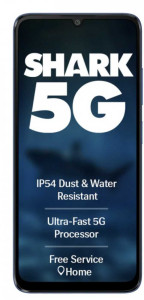
Lava Shark 5G
Xiaomi Redmi A5 4G

Lava Shark 5G Xiaomi Redmi A5 4G

Overview

Welcome to this in-depth spec comparison between the Lava Shark 5G and the Xiaomi Redmi A5 4G — two budget-friendly Android smartphones that share a surprising amount of common ground yet diverge in some meaningful ways. From performance and camera resolution to connectivity and display refresh rate, this side-by-side breakdown will help you determine which device better suits your everyday needs.

Common Features

  • Both phones are water resistant.
  • Neither phone has a rugged build.
  • Neither phone can be folded.
  • Both phones feature an LCD IPS display type.
  • Neither phone has branded damage-resistant glass.
  • Neither phone supports HDR10.
  • Neither phone supports HDR10+.
  • Neither phone has an Always-On Display.
  • Neither phone supports Dolby Vision.
  • Neither phone has a secondary screen.
  • Both phones have a touch screen.
  • The GPU clock speed is 850 MHz on both phones.
  • Both phones have integrated LTE.
  • Both phones support 64-bit processing.
  • Both phones have integrated graphics.
  • Both phones use big.LITTLE technology.
  • Both phones use DDR4 memory.
  • Neither phone has a dual-lens or multi-lens main camera.
  • Neither phone has built-in optical image stabilization.
  • Both phones record video at 1080p 30 fps on the main camera.
  • Neither phone has a dual-tone LED flash.
  • Both phones have a single LED flash.
  • Neither phone has a BSI sensor.
  • Both phones have a CMOS sensor.
  • Both phones support continuous autofocus when recording movies.
  • Both phones run Android 15.
  • Neither phone receives direct OS updates.
  • Neither phone can be used as a PC.
  • Both phones support voice commands.
  • Neither phone supports wireless charging.
  • Both phones support fast charging.
  • Both phones come with a charger.
  • Neither phone has a removable battery.
  • Both phones have a battery level indicator.
  • Both phones have a rechargeable battery.
  • Both phones have a 3.5 mm audio jack.
  • Neither phone has stereo speakers.
  • Neither phone supports LDAC.
  • Neither phone supports aptX Lossless.
  • Both phones support Wi-Fi 4 (802.11n) and Wi-Fi 5 (802.11ac).
  • Both phones have dual SIM support.
  • Both phones have an external memory slot.
  • Both phones have USB Type-C.
  • Neither phone has NFC.
  • Both phones have a fingerprint scanner.
  • Neither phone has emergency SOS via satellite.
  • Neither phone has crash detection.
  • Both phones have a video light.
  • Neither phone has a sapphire glass display.
  • Neither phone has a curved display.
  • Neither phone has an e-paper display.

Main Differences

  • Weight is 200 g on Lava Shark 5G and 193 g on Xiaomi Redmi A5 4G.
  • Thickness is 8.5 mm on Lava Shark 5G and 8.3 mm on Xiaomi Redmi A5 4G.
  • Width is 77.2 mm on Lava Shark 5G and 77.8 mm on Xiaomi Redmi A5 4G.
  • Height is 165.8 mm on Lava Shark 5G and 171.7 mm on Xiaomi Redmi A5 4G.
  • Volume is 108.8 cm³ on Lava Shark 5G and 110.9 cm³ on Xiaomi Redmi A5 4G.
  • Ingress Protection rating is IP54 on Lava Shark 5G and IP52 on Xiaomi Redmi A5 4G.
  • Screen size is 6.75″ on Lava Shark 5G and 6.88″ on Xiaomi Redmi A5 4G.
  • Pixel density is 269 ppi on Lava Shark 5G and 260 ppi on Xiaomi Redmi A5 4G.
  • Resolution is 720 x 1612 px on Lava Shark 5G and 720 x 1640 px on Xiaomi Redmi A5 4G.
  • Refresh rate is 90Hz on Lava Shark 5G and 120Hz on Xiaomi Redmi A5 4G.
  • Internal storage is 64GB on Lava Shark 5G and 128GB on Xiaomi Redmi A5 4G.
  • RAM is 4GB on Lava Shark 5G and 6GB on Xiaomi Redmi A5 4G.
  • The chipset is Unisoc T765 on Lava Shark 5G and Unisoc T7250 on Xiaomi Redmi A5 4G.
  • The GPU is Mali G57 MC2 on Lava Shark 5G and Mali G57 on Xiaomi Redmi A5 4G.
  • CPU speed is 2 x 2.3 & 6 x 2.1 GHz on Lava Shark 5G and 2 x 1.8 & 6 x 1.6 GHz on Xiaomi Redmi A5 4G.
  • RAM speed is 2133 MHz on Lava Shark 5G and 1866 MHz on Xiaomi Redmi A5 4G.
  • Semiconductor size is 6 nm on Lava Shark 5G and 12 nm on Xiaomi Redmi A5 4G.
  • Maximum memory amount is 10GB on Lava Shark 5G and 12GB on Xiaomi Redmi A5 4G.
  • Main camera resolution is 13 MP on Lava Shark 5G and 32 MP on Xiaomi Redmi A5 4G.
  • Front camera resolution is 5 MP on Lava Shark 5G and 8 MP on Xiaomi Redmi A5 4G.
  • Battery capacity is 5000 mAh on Lava Shark 5G and 5200 mAh on Xiaomi Redmi A5 4G.
  • Charging speed is 18W on Lava Shark 5G and 15W on Xiaomi Redmi A5 4G.
  • FM radio is available on Lava Shark 5G but not available on Xiaomi Redmi A5 4G.
  • 5G support is present on Lava Shark 5G but not available on Xiaomi Redmi A5 4G.
  • Bluetooth version is 5.0 on Lava Shark 5G and 5.2 on Xiaomi Redmi A5 4G.
Specs Comparison
Lava Shark 5G

Lava Shark 5G

Xiaomi Redmi A5 4G

Xiaomi Redmi A5 4G

Design:
water resistance Water resistant Water resistant
weight 200 g 193 g
thickness 8.5 mm 8.3 mm
width 77.2 mm 77.8 mm
height 165.8 mm 171.7 mm
volume 108.79796 cm³ 110.873558 cm³
Ingress Protection (IP) rating IP54 IP52
has a rugged build
can be folded

Both the Lava Shark 5G and the Xiaomi Redmi A5 4G share a broadly similar physical profile — neither is foldable, neither carries a rugged certification, and both offer basic water resistance. The most meaningful distinction in their protection ratings is that the Lava carries an IP54 rating versus the Redmi's IP52. In practice, the fourth digit is the water-resistance indicator and both score the same there (protected against splashes from any direction), but the first digit — dust resistance — gives the Lava a slight edge: a ″5″ means dust is largely kept out, whereas a ″2″ only guards against solid objects larger than 12.5 mm. For everyday use this difference is minor, but it matters in dustier environments.

On physical form, the two phones diverge in an interesting way. The Redmi A5 is noticeably taller at 171.7 mm versus the Lava's 165.8 mm, making it harder to reach across one-handed. The Lava is marginally thicker (8.5 mm vs 8.3 mm) and slightly heavier (200 g vs 193 g), but the 7 g weight difference is barely perceptible in daily handling. The Redmi's greater height also results in a slightly larger overall volume, so despite the two phones being nearly the same width, the Lava will feel more compact in a pocket or small hand.

Overall, the Lava Shark 5G holds a modest but real advantage in this category. Its better dust-resistance rating and more pocketable height make it the slightly more practical choice from a design standpoint, while the Redmi's marginal weight and thickness savings are unlikely to sway most users.

Display:
Display type LCD, IPS LCD, IPS
screen size 6.75" 6.88"
pixel density 269 ppi 260 ppi
resolution 720 x 1612 px 720 x 1640 px
refresh rate 90Hz 120Hz
has branded damage-resistant glass
supports HDR10
supports HDR10+
Always-On Display
supports Dolby Vision
Has a secondary screen
has a touch screen

At their core, these two displays are built on the same foundation — both use an LCD IPS panel, share a 720p-class resolution, and lack any HDR support or damage-resistant glass. For buyers hoping for AMOLED-quality contrast or premium screen protection, neither phone delivers. What separates them comes down to two key numbers: refresh rate and pixel density.

The Redmi A5's 120Hz refresh rate is the standout advantage here. Compared to the Lava's 90Hz, the higher refresh rate translates directly into noticeably smoother scrolling, more fluid animations, and a more responsive feel during everyday use — an upgrade that is immediately perceptible even to non-technical users. The Lava partially compensates with a sharper image: its 269 ppi pixel density edges out the Redmi's 260 ppi, a consequence of fitting a similar resolution into a smaller 6.75-inch screen versus the Redmi's larger 6.88-inch panel. In practice, this 9 ppi gap is at the threshold of human perception and is unlikely to be noticeable in normal use.

The Xiaomi Redmi A5 takes the clear edge in this category. The jump from 90Hz to 120Hz is a tangible, day-to-day improvement that most users will notice and appreciate, while the minor pixel density advantage of the Lava Shark 5G is too small to meaningfully offset it.

Performance:
internal storage 64GB 128GB
RAM 4GB 6GB
Chipset (SoC) name Unisoc T765 Unisoc T7250
GPU name Mali G57 MC2 Mali G57
CPU speed 2 x 2.3 & 6 x 2.1 GHz 2 x 1.8 & 6 x 1.6 GHz
GPU clock speed 850 MHz 850 MHz
Has integrated LTE
RAM speed 2133 MHz 1866 MHz
semiconductor size 6 nm 12 nm
Supports 64-bit
Has integrated graphics
Uses big.LITTLE technology
maximum memory amount 10GB 12GB
DDR memory version 4 4

The chipset contrast here is genuinely interesting. The Lava Shark 5G runs on the Unisoc T765 built on a 6nm process, while the Redmi A5 uses the Unisoc T7250 on a larger 12nm node. The smaller fabrication process on the Lava is a meaningful advantage — it enables greater power efficiency and less heat generation under load, which matters for sustained performance and battery longevity. The CPU clock speeds reinforce this: the Lava's cores run at up to 2.3 GHz compared to the Redmi's peak of 1.8 GHz, a gap large enough to produce noticeably snappier app launches and faster processing of demanding tasks.

Where the Redmi A5 fights back is in memory and storage. It ships with 6 GB of RAM versus the Lava's 4 GB, which translates directly into more apps kept active in the background and fewer reloads when multitasking. Its 128 GB of internal storage is also double the Lava's 64 GB — a practical advantage for users who store photos, videos, or offline content without relying on a microSD card. The Lava does edge ahead in RAM speed (2133 MHz vs 1866 MHz), meaning faster data throughput between memory and processor, though this advantage is partially diluted by the Redmi's larger RAM pool.

This category is a genuine trade-off rather than a clean sweep. The Lava Shark 5G holds the edge in raw CPU horsepower and chip efficiency, making it the stronger performer for processor-intensive tasks. However, users who prioritize multitasking headroom and generous onboard storage will find the Redmi A5's memory and storage configuration more practical for daily use.

Cameras:
megapixels (main camera) 13 MP 32 MP
Has a dual-lens (or multi-lens) main camera
megapixels (front camera) 5MP 8MP
has built-in optical image stabilization
video recording (main camera) 1080 x 30 fps 1080 x 30 fps
Has a dual-tone LED flash
number of flash LEDs 1 1
has a BSI sensor
has a CMOS sensor
has continuous autofocus when recording movies
Has phase-detection autofocus for photos
supports slow-motion video recording
has a built-in HDR mode
has manual exposure
has a flash
optical zoom 0x 0x
has manual ISO
has a serial shot mode
has manual focus
has a front camera
Has laser autofocus
Shoots 360° panorama
has manual white balance
shoots raw
has touch autofocus
has manual shutter speed
can create panoramas in-camera
Has a front-facing LED flash
has a dual-lens (or multi-lens) front camera
supports HDR10 recording
supports Dolby Vision recording
has a front-facing camera under the display
Has a RGB LED flash
has 3D photo/video recording capabilities

Strip away everything that matches — and a lot does — and the camera comparison between these two phones narrows down to a single, decisive factor: megapixel count. The Xiaomi Redmi A5 sports a 32 MP main sensor against the Lava Shark 5G's 13 MP, and pairs it with an 8 MP front camera versus the Lava's 5 MP. Higher megapixels allow for more detail in well-lit shots and give users meaningful room to crop into an image without losing clarity — an advantage that is particularly noticeable when printing photos or viewing them on larger screens.

Beyond resolution, the two cameras are functionally identical on paper. Both shoot 1080p at 30fps, both support phase-detection autofocus, HDR mode, slow-motion, and the same set of manual controls. Neither offers optical image stabilization or optical zoom, so low-light and long-distance photography will be similarly limited on both devices. The feature parity is extensive enough that for most shooting scenarios, the experience will feel comparable — the Redmi's edge lies specifically in the resolution ceiling it offers, not in versatility or video capability.

The Xiaomi Redmi A5 holds a clear advantage in this category. The substantial gap in sensor resolution on both the main and front cameras makes it the stronger choice for users who prioritize photo quality, while those who shoot primarily video or rely heavily on manual controls will find both phones on equal footing.

Operating system:
Android version Android 15 Android 15
gets direct OS updates
Can be used as a PC
has voice commands

When two phones share every data point in a spec group, the honest conclusion is a dead heat — and that is exactly the case here. Both the Lava Shark 5G and the Xiaomi Redmi A5 4G launch with Android 15, meaning users get the same baseline feature set, security posture, and app compatibility on either device from day one.

The absence of direct OS updates on both phones is worth flagging. Without a guaranteed update pipeline, future Android versions will depend entirely on the manufacturer's discretion — a common limitation at this price tier, but one that affects long-term software security and feature access equally for both devices. Neither phone offers a PC desktop mode either, so users looking for desktop-like productivity from a single device will need to look elsewhere regardless of which they choose.

This category is a complete tie. Every provided spec is identical, and there is no data here to differentiate one device from the other. The operating system will not be a deciding factor in this comparison.

Battery:
battery power 5000 mAh 5200 mAh
has wireless charging
Supports fast charging
charging speed 18W 15W
comes with a charger
has a removable battery
has a battery level indicator
has a rechargeable battery

Battery capacity and charging speed pull in opposite directions here, creating a genuine trade-off. The Xiaomi Redmi A5 edges ahead on raw capacity with 5200 mAh versus the Lava Shark 5G's 5000 mAh — a 200 mAh difference that is marginal in absolute terms, likely translating to only a small additional buffer of screen-on time under typical usage conditions. Neither phone will struggle with day-long endurance given their large cells, but the Redmi's slight surplus is a technical advantage nonetheless.

Flip the lens to charging, however, and the Lava takes the lead. Its 18W fast charging outpaces the Redmi's 15W, meaning a meaningfully shorter time plugged in when topping up from low. For users who charge during short breaks rather than overnight, that 3W gap can translate into a noticeable real-world difference in how quickly the phone is ready to go again. Both phones include a charger in the box and lack wireless charging, so the wired speed is the only differentiator in how the battery is replenished.

This category is too close to call decisively — it hinges on user priorities. Those who rarely charge mid-day will prefer the Redmi A5's larger capacity, while users who rely on quick top-ups will get more value from the Lava Shark 5G's faster charging. On balance, the two phones are evenly matched in battery.

Audio:
has a socket for a 3.5 mm audio jack
has stereo speakers
has LDAC
has aptX Lossless
Has a radio

Audio hardware is lean on both devices — no stereo speakers, no high-fidelity Bluetooth codecs like LDAC or aptX Lossless, and a shared reliance on a single-channel output. What both phones do offer is a 3.5mm headphone jack, a feature increasingly rare in the broader smartphone market and a genuine practical win for users who prefer wired headphones without the need for an adapter.

The one point of differentiation is the built-in FM radio on the Lava Shark 5G, which the Redmi A5 lacks entirely. For users in areas with strong local broadcast coverage, or those who want a connectivity-free audio source that works without mobile data, this is a meaningful bonus. It also functions as a useful fallback in emergency situations where data networks may be congested or unavailable.

The Lava Shark 5G takes a narrow but clear edge in this category purely on the strength of its FM radio inclusion. Both phones are otherwise equal, and neither will impress audiophiles — but the Lava offers a practical audio feature that the Redmi simply does not.

Connectivity & Features:
release date May 2025 March 2025
has 5G support
Wi-Fi version Wi-Fi 4 (802.11n), Wi-Fi 5 (802.11ac) Wi-Fi 4 (802.11n), Wi-Fi 5 (802.11ac)
SIM cards 2 SIM 2 SIM
Bluetooth version 5 5.2
has an external memory slot
Has USB Type-C
has NFC
Has a fingerprint scanner
has emergency SOS via satellite
has crash detection
is DLNA-certified
has a gyroscope
supports ANT+
Has a heart rate monitor
has GPS
has a compass
supports Wi-Fi
Has an infrared sensor
has an accelerometer
has a cellular module
Has a barometer
has an HDMI output
Uses 3D facial recognition
Has an iris scanner
Stylus included
supports Galileo
Has motion tracking
Has optical tracking
Has a built-in projector

The single most consequential difference in this category is cellular generation. The Lava Shark 5G supports 5G, while the Xiaomi Redmi A5 is limited to 4G LTE. In markets where 5G infrastructure is available or rapidly expanding, this translates to dramatically faster mobile data speeds, lower latency, and a degree of future-proofing that the Redmi simply cannot match. For users who consume a lot of data on the go or plan to keep their phone for several years, this gap is significant.

The Redmi A5 counters with a marginally newer Bluetooth 5.2 versus the Lava's Bluetooth 5.0. The 5.2 specification brings improvements to connection stability and audio synchronization — particularly relevant for true wireless earbuds — though the practical difference over 5.0 in everyday use is subtle rather than transformative. Everything else in this group is evenly matched: both phones carry dual SIM slots, USB Type-C, expandable storage, a fingerprint scanner, GPS with Galileo support, Wi-Fi 5, and an accelerometer.

The Lava Shark 5G holds a clear and decisive advantage here. The step up to 5G connectivity is a fundamental network capability that the Redmi cannot replicate, and it outweighs the Redmi's incremental Bluetooth version improvement by a wide margin. For any buyer prioritizing connectivity longevity, the Lava is the stronger choice.

Miscellaneous:
has a video light
Has sapphire glass display
Has a curved display
Has an e-paper display

The miscellaneous specs for these two phones are identical across every data point provided. Both include a video light — useful for filming in low-light conditions — and neither features a sapphire glass display, curved screen, or e-paper panel. There is simply nothing here to separate one device from the other.

This category is a complete tie. With no differentiating features present in the provided data, miscellaneous specs will play no role in deciding between the Lava Shark 5G and the Xiaomi Redmi A5 4G.

Comparison Summary & Verdict

After examining every specification, both phones emerge as solid entry-level options running Android 15, but they cater to different priorities. The Lava Shark 5G stands out with its more advanced 6 nm Unisoc T765 chipset, faster CPU and RAM speeds, 18W fast charging, built-in FM radio, and crucially, 5G connectivity — making it the forward-looking pick for users who want network readiness and snappier internals. The Xiaomi Redmi A5 4G, on the other hand, wins on camera quality with its 32 MP main and 8 MP front shooters, a smoother 120Hz display, more base storage (128GB), 6GB of RAM, and a slightly larger battery. If photography and a fluid screen experience matter most, Redmi is the stronger choice. If future-proof connectivity and processing efficiency are your priority, the Lava Shark 5G is the one to pick.

Lava Shark 5G
Buy Lava Shark 5G if...

Buy the Lava Shark 5G if you want 5G connectivity, a more efficient processor built on a 6 nm chip, and faster 18W charging. It also includes FM radio, which the Redmi A5 4G lacks.

Xiaomi Redmi A5 4G
Buy Xiaomi Redmi A5 4G if...

Buy the Xiaomi Redmi A5 4G if you prioritize a higher-resolution 32 MP camera, a smoother 120Hz display, and more out-of-the-box storage and RAM for everyday multitasking.