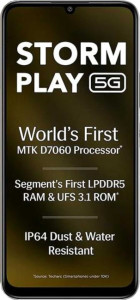
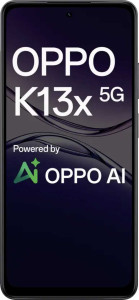
Across the bulk of this category, the two phones are evenly matched — both support 5G, dual SIM, Wi-Fi 5, USB Type-C, GPS with Galileo support, and a fingerprint scanner, with neither offering NFC, an infrared sensor, or a gyroscope. The meaningful divergences, however, are worth examining carefully. The Oppo K13x 5G carries a newer Bluetooth 5.4 versus the Lava's Bluetooth 5.2, which brings incremental improvements in connection stability and energy efficiency — a modest but real advantage for users with multiple paired devices or wireless peripherals.
On cellular throughput, the Oppo also leads with a maximum download speed of 3300 Mbits/s compared to the Lava's 2770 Mbits/s. In practice, real-world speeds are constrained by network conditions far below either ceiling, so this gap will rarely be perceptible in daily use. The storage expansion picture, however, tells a more consequential story in the other direction: the Lava Storm Play 5G includes a microSD card slot, while the Oppo does not. Given that the Oppo also ships with only 128 GB of internal storage — half the Lava's 256 GB — the absence of expandable storage on the Oppo is a genuine long-term limitation for users who accumulate large media libraries.
This category ends in a nuanced split. The Oppo holds a slight edge in Bluetooth version and peak download speed, but the Lava's external memory slot is a more impactful everyday advantage, especially in the context of the Oppo's more limited base storage. For users who value connectivity headroom, the Oppo has a marginal lead; for those who prioritize storage flexibility, the Lava is the stronger choice.