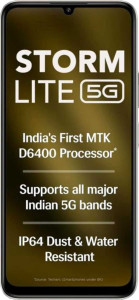
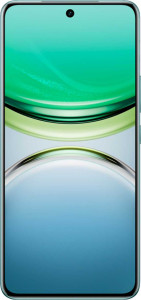
Connectivity is a split decision, with each phone holding distinct advantages. The Vivo T4 5G supports Wi-Fi 6 (802.11ax) in addition to Wi-Fi 4 and 5, while the Storm Play Lite tops out at Wi-Fi 5. Wi-Fi 6 delivers better throughput, lower latency, and more efficient performance in congested environments — a meaningful upgrade for users on modern routers or in busy households. Interestingly, the Storm Play Lite posts a slightly higher peak download speed of 3300 Mbps versus the T4's 2900 Mbps on cellular, though both figures are well beyond what current real-world 5G networks typically deliver, making this difference largely theoretical in practice.
For storage flexibility, the Storm Play Lite has a clear edge with its external memory card slot — a feature the T4 drops entirely. Given that the T4 already ships with 256 GB of internal storage, this omission is less critical than it might otherwise be, but users who want to expand storage affordably or swap cards will find only the Storm Play Lite accommodates that. On the sensor front, the T4 adds a gyroscope and an infrared sensor that the Storm Play Lite lacks. The gyroscope enables more accurate motion-based gaming and augmented reality apps, while the infrared sensor lets the T4 function as a universal remote control for TVs and appliances — a handy convenience feature.
Both phones share the same Bluetooth 5.2, USB-C 2.0, dual-SIM support, fingerprint scanner, GPS, and compass, leaving no daylight between them on those fronts. Neither includes NFC, which rules out contactless payments on both devices. On balance, this category is closely contested — the Storm Play Lite wins on expandable storage, while the Vivo T4 5G edges ahead overall thanks to Wi-Fi 6 and its additional sensors.