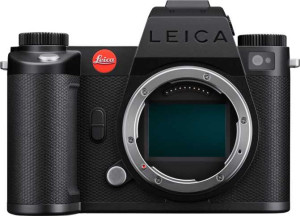
Both cameras share the same full-frame sensor format and Leica L mount, meaning they draw from an identical lens ecosystem — a meaningful point of parity. Beyond that common ground, however, their sensor philosophies diverge sharply. The Panasonic S1R II packs a formidable 44.3 MP resolution, nearly double the SL3-S's 25.3 MP, making it the clear choice for large-format printing, heavy cropping, and fine-detail studio or landscape work. The Leica SL3-S, in turn, leans into speed and sensitivity: its stacked CMOS architecture — absent on the S1R II — enables a maximum ISO of 200,000 versus the S1R II's 51,200, a nearly two-stop advantage in light-gathering ceiling that translates directly into usable handheld shots in near-darkness.
The stacked sensor also pays dividends in burst shooting, where the SL3-S reaches 7 fps mechanically — respectable, though the S1R II edges ahead at 10 fps, a somewhat surprising result given the SL3-S's faster sensor architecture; the S1R II's higher frame rate here likely reflects broader system optimizations. On stabilization, the S1R II holds a decisive advantage: its 8-stop CIPA-rated IBIS (combinable with lens IS) versus the SL3-S's 5 stops is a substantial real-world gap, particularly for telephoto handheld work or slow-shutter creative shots. The S1R II also supports a longer maximum exposure time of 60 s versus 30 s natively, useful for astrophotography without an external trigger.
Choosing between them is really a question of photographic intent. The SL3-S wins decisively on high-ISO performance and low-light versatility, benefiting from its stacked CMOS design. The S1R II counters with a commanding resolution lead, superior image stabilization, and a faster burst rate — making it the stronger all-rounder for resolution-critical and handheld slow-shutter applications. Shooters who prioritize low-light and action should lean toward the SL3-S; those who need maximum detail and subject-matter flexibility will find the S1R II more compelling.