Lenovo Idea Tab Pro
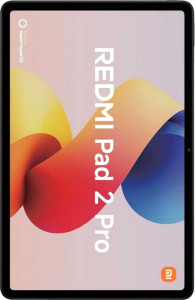
Xiaomi Redmi Pad 2 Pro

Lenovo Idea Tab Pro Xiaomi Redmi Pad 2 Pro

Overview

When choosing between the Lenovo Idea Tab Pro and the Xiaomi Redmi Pad 2 Pro, buyers face a genuinely close contest across display quality, raw performance, battery endurance, and audio versatility. Both 12-inch-class tablets share a solid foundation of 256GB storage, 8GB RAM, and fast charging, yet they diverge sharply in areas like chipset architecture, screen brightness, and connectivity extras. Read on to see how every key specification stacks up between these two capable Android slates.

Common Features

  • Neither product has a detachable keyboard.
  • Neither product has a backlit keyboard.
  • Neither product has water resistance.
  • Neither product has tilt sensitivity.
  • Both products feature an LCD IPS display type.
  • Both products have a touchscreen.
  • Neither product has a sapphire glass display.
  • Neither product supports HDR10+.
  • Neither product has an e-paper display.
  • Both products come with 256GB of internal storage.
  • Both products include 8GB of RAM.
  • Both products have an external memory slot.
  • Both products use a 4 nm semiconductor size.
  • Both products support 64-bit processing.
  • Both products use big.LITTLE technology.
  • Both products support DirectX 12.
  • Both products have integrated graphics.
  • Both products have an 8MP front camera.
  • Both products have a flash.
  • Both products have a front camera.
  • Both products have a built-in HDR mode.
  • Neither product can create panoramas in-camera.
  • Both products support slow-motion video recording.
  • Both products have touch autofocus.
  • Neither product offers optical zoom.
  • Neither product has aptX Low Latency.
  • Neither product has aptX Adaptive.
  • Neither product has aptX Lossless.
  • Both products have stereo speakers.
  • Neither product has a radio.
  • Both products support fast charging.
  • Neither product has wireless charging.
  • Both products have a battery level indicator.
  • Both products have a rechargeable battery.
  • Neither product has a removable battery.
  • Neither product has Mail Privacy Protection.
  • Both products have on-device machine learning.
  • Both products have clipboard warnings.
  • Both products have location privacy options.
  • Both products have camera and microphone privacy options.
  • Both products can block app tracking.
  • Neither product blocks cross-site tracking.
  • Both products support split screen.
  • Both products use DDR5 memory.

Main Differences

  • Weight is 620 g on Lenovo Idea Tab Pro and 610 g on Xiaomi Redmi Pad 2 Pro.
  • Thickness is 6.9 mm on Lenovo Idea Tab Pro and 7.5 mm on Xiaomi Redmi Pad 2 Pro.
  • Width is 291.18 mm on Lenovo Idea Tab Pro and 279.8 mm on Xiaomi Redmi Pad 2 Pro.
  • Height is 189.1 mm on Lenovo Idea Tab Pro and 181.7 mm on Xiaomi Redmi Pad 2 Pro.
  • Volume is 379.93 cm³ on Lenovo Idea Tab Pro and 381.30 cm³ on Xiaomi Redmi Pad 2 Pro.
  • A stylus is included with Lenovo Idea Tab Pro but not with Xiaomi Redmi Pad 2 Pro.
  • Screen size is 12.7″ on Lenovo Idea Tab Pro and 12.1″ on Xiaomi Redmi Pad 2 Pro.
  • Resolution is 2944 x 1840 px on Lenovo Idea Tab Pro and 2560 x 1600 px on Xiaomi Redmi Pad 2 Pro.
  • Pixel density is 273 ppi on Lenovo Idea Tab Pro and 249 ppi on Xiaomi Redmi Pad 2 Pro.
  • Refresh rate is 144Hz on Lenovo Idea Tab Pro and 120Hz on Xiaomi Redmi Pad 2 Pro.
  • Branded damage-resistant glass is present on Xiaomi Redmi Pad 2 Pro but not on Lenovo Idea Tab Pro.
  • HDR10 support is available on Lenovo Idea Tab Pro but not on Xiaomi Redmi Pad 2 Pro.
  • Typical brightness is 400 nits on Lenovo Idea Tab Pro and 600 nits on Xiaomi Redmi Pad 2 Pro.
  • Dolby Vision support is present on Xiaomi Redmi Pad 2 Pro but not on Lenovo Idea Tab Pro.
  • The chipset is MediaTek Dimensity 8300 on Lenovo Idea Tab Pro and Qualcomm Snapdragon 7s Gen 4 on Xiaomi Redmi Pad 2 Pro.
  • The GPU is Mali G615 MP6 on Lenovo Idea Tab Pro and Adreno 710 on Xiaomi Redmi Pad 2 Pro.
  • CPU speed is 1 x 3.35 & 3 x 3 & 4 x 2.2 GHz on Lenovo Idea Tab Pro and 1 x 2.7 & 3 x 2.4 & 4 x 1.8 GHz on Xiaomi Redmi Pad 2 Pro.
  • Maximum external memory supported is 1000GB on Lenovo Idea Tab Pro and 1500GB on Xiaomi Redmi Pad 2 Pro.
  • GPU clock speed is 1400 MHz on Lenovo Idea Tab Pro and 1050 MHz on Xiaomi Redmi Pad 2 Pro.
  • RAM speed is 8533 MHz on Lenovo Idea Tab Pro and 3200 MHz on Xiaomi Redmi Pad 2 Pro.
  • Maximum memory amount is 24GB on Lenovo Idea Tab Pro and 16GB on Xiaomi Redmi Pad 2 Pro.
  • Android version is Android 14 on Lenovo Idea Tab Pro and Android 15 on Xiaomi Redmi Pad 2 Pro.
  • Thermal Design Power is 6W on Lenovo Idea Tab Pro and 5W on Xiaomi Redmi Pad 2 Pro.
  • Maximum memory bandwidth is 68.2 GB/s on Lenovo Idea Tab Pro and 25.6 GB/s on Xiaomi Redmi Pad 2 Pro.
  • Main camera resolution is 13 MP on Lenovo Idea Tab Pro and 8 MP on Xiaomi Redmi Pad 2 Pro.
  • aptX support is present on Xiaomi Redmi Pad 2 Pro but not on Lenovo Idea Tab Pro.
  • aptX HD support is present on Xiaomi Redmi Pad 2 Pro but not on Lenovo Idea Tab Pro.
  • LDAC support is present on Xiaomi Redmi Pad 2 Pro but not on Lenovo Idea Tab Pro.
  • A 3.5 mm audio jack is available on Xiaomi Redmi Pad 2 Pro but not on Lenovo Idea Tab Pro.
  • Battery capacity is 10200 mAh on Lenovo Idea Tab Pro and 12000 mAh on Xiaomi Redmi Pad 2 Pro.
  • Wi-Fi version includes Wi-Fi 6E support on Lenovo Idea Tab Pro but Xiaomi Redmi Pad 2 Pro tops out at Wi-Fi 6.
  • App offloading is supported on Xiaomi Redmi Pad 2 Pro but not on Lenovo Idea Tab Pro.
  • GPS is available on Lenovo Idea Tab Pro but not on Xiaomi Redmi Pad 2 Pro.
  • Bluetooth version is 5.3 on Lenovo Idea Tab Pro and 5.4 on Xiaomi Redmi Pad 2 Pro.
  • Download speed is 7900 MBits/s on Lenovo Idea Tab Pro and 2900 MBits/s on Xiaomi Redmi Pad 2 Pro.
  • A compass is present on Lenovo Idea Tab Pro but not on Xiaomi Redmi Pad 2 Pro.
Specs Comparison
Lenovo Idea Tab Pro

Lenovo Idea Tab Pro

Xiaomi Redmi Pad 2 Pro

Xiaomi Redmi Pad 2 Pro

Design:
weight 620 g 610 g
thickness 6.9 mm 7.5 mm
width 291.18 mm 279.8 mm
height 189.1 mm 181.7 mm
volume 379.9287522 cm³ 381.29745 cm³
Stylus included
Has a detachable keyboard
Has a backlit keyboard
water resistance None None
Has tilt sensitivity

In terms of overall footprint, the Lenovo IdeaTab Pro is the larger of the two, measuring 291.18 × 189.1 mm compared to the Redmi Pad 2 Pro's 279.8 × 181.7 mm. That translates to a noticeably bigger screen area in real-world use, which can be an advantage for productivity, media consumption, or split-screen multitasking. The Redmi Pad 2 Pro is more compact and may feel easier to handle one-handed or fit more comfortably in a bag.

Where the two diverge more meaningfully is thickness and weight. The Lenovo is slightly heavier at 620 g vs. 610 g, a difference small enough to be negligible in practice. However, the Redmi Pad 2 Pro is noticeably thicker at 7.5 mm versus the Lenovo's slimmer 6.9 mm profile. That 0.6 mm gap is perceptible when holding the device flat or sliding it into a sleeve, giving the Lenovo a slightly more premium, sleek feel in hand. Neither device offers water resistance, and both lack tilt sensitivity, a detachable keyboard, and a backlit keyboard.

The most significant design differentiator is that the Lenovo IdeaTab Pro includes a stylus, while the Xiaomi Redmi Pad 2 Pro does not. For users interested in note-taking, sketching, or precise annotation, this gives the Lenovo a clear and practical edge out of the box without any additional purchase. Overall, the Lenovo holds the design advantage for creative and power users, while the Redmi Pad 2 Pro appeals to those who prioritize a more compact and slightly thinner form factor.

Display:
screen size 12.7" 12.1"
resolution 2944 x 1840 px 2560 x 1600 px
pixel density 273 ppi 249 ppi
Display type LCD, IPS LCD, IPS
refresh rate 144Hz 120Hz
has branded damage-resistant glass
supports HDR10
brightness (typical) 400 nits 600 nits
has a touch screen
Has sapphire glass display
supports HDR10+
supports Dolby Vision
Has an e-paper display

Both tablets share the same LCD IPS panel technology, but their displays diverge in ways that matter depending on how you use the device. The Lenovo IdeaTab Pro edges ahead on screen real estate at 12.7″ versus 12.1″, and its higher resolution of 2944 × 1840 px yields a sharper 273 ppi pixel density compared to the Redmi Pad 2 Pro's 249 ppi. That sharpness gap is meaningful for reading fine text, detailed graphics, or close-up work with a stylus. The Lenovo also pulls ahead on refresh rate — 144Hz vs. 120Hz — which produces smoother scrolling and more fluid animations, a perk especially appreciated in gaming or fast-paced UI navigation.

The Redmi Pad 2 Pro strikes back decisively on brightness, rated at 600 nits typical versus the Lenovo's 400 nits. That 50% brightness advantage is substantial in practical terms: the Redmi will remain comfortably legible in bright indoor environments and holds up far better under direct sunlight. The Redmi also supports Dolby Vision and ships with branded damage-resistant glass, adding both premium HDR content compatibility and meaningful drop/scratch protection that the Lenovo lacks. The Lenovo counters with HDR10 support, but without Dolby Vision, its HDR ecosystem coverage is narrower.

This comparison is genuinely split rather than one-sided. The Lenovo IdeaTab Pro wins on resolution, pixel density, and refresh rate — advantages that favor productivity, stylus use, and gaming. The Redmi Pad 2 Pro wins on brightness, Dolby Vision support, and display durability — making it the stronger choice for media consumption and outdoor or bright-room use. The right pick depends on your primary use case.

Performance:
internal storage 256GB 256GB
RAM 8GB 8GB
Chipset (SoC) name MediaTek Dimensity 8300 Qualcomm Snapdragon 7s Gen 4
GPU name Mali G615 MP6 Adreno 710
CPU speed 1 x 3.35 & 3 x 3 & 4 x 2.2 GHz 1 x 2.7 & 3 x 2.4 & 4 x 1.8 GHz
has an external memory slot
semiconductor size 4 nm 4 nm
Supports 64-bit
maximum amount of external memory supported 1000GB 1500GB
Uses big.LITTLE technology
DirectX version DirectX 12 DirectX 12
Has integrated graphics
GPU clock speed 1400 MHz 1050 MHz
CPU threads 8 threads 8 threads
RAM speed 8533 MHz 3200 MHz
Has TrustZone
maximum memory amount 24GB 16GB
Android version Android 14 Android 15
Thermal Design Power (TDP) 6W 5W
Uses HMP
maximum memory bandwidth 68.2 GB/s 25.6 GB/s
OpenCL version 2 2

Under the hood, the Lenovo IdeaTab Pro holds a notable raw performance advantage. Its MediaTek Dimensity 8300 chip posts higher CPU clock speeds across all core clusters compared to the Redmi Pad 2 Pro's Snapdragon 7s Gen 4, meaning the Lenovo is better equipped for sustained, demanding workloads like video editing, large file processing, or heavy multitasking. The GPU gap is equally significant: the Lenovo's Mali G615 MP6 runs at 1400 MHz versus the Redmi's Adreno 710 at 1050 MHz, suggesting a meaningful edge in graphics-intensive tasks and gaming frame rates.

Where the performance difference becomes especially stark is in memory architecture. The Lenovo's RAM operates at 8533 MHz with a memory bandwidth of 68.2 GB/s, compared to the Redmi's 3200 MHz and 25.6 GB/s — a roughly 2.6× bandwidth advantage. In practice, this translates to faster data throughput between the CPU, GPU, and RAM, benefiting tasks like image processing, gaming asset streaming, and snappy app switching. The Lenovo also supports up to 24 GB of maximum RAM versus the Redmi's 16 GB ceiling, giving it more headroom for future higher-RAM configurations.

The Redmi Pad 2 Pro does have two tangible advantages here: it ships with Android 15 out of the box compared to the Lenovo's Android 14, and its slightly lower 5W TDP versus 6W suggests marginally more power-efficient operation under load. It also supports a higher maximum external storage of 1500 GB vs. 1000 GB. These are real but secondary considerations. For overall compute and graphics performance, the Lenovo IdeaTab Pro holds a clear and consistent edge across CPU speed, GPU clock, and memory bandwidth.

Cameras:
megapixels (main camera) 13 MP 8 MP
megapixels (front camera) 8MP 8MP
has a flash
has a front camera
has a built-in HDR mode
can create panoramas in-camera
supports slow-motion video recording
has touch autofocus
optical zoom 0x 0x
has a BSI sensor
has manual white balance
has a CMOS sensor
supports HDR10 recording
has continuous autofocus when recording movies
supports Dolby Vision recording
Has a front-facing LED flash
number of flash LEDs 1 1
has manual ISO
has a video light
Shoots 360° panorama
has a serial shot mode
has built-in optical image stabilization
has 3D photo/video recording capabilities
Has a dual-tone LED flash
has manual focus
Has a RGB LED flash
has manual exposure
has manual shutter speed

Camera systems on tablets are rarely a primary purchase driver, but they do matter for video calls, document scanning, and occasional casual photography. Across the full feature set provided, these two tablets are remarkably similar — both carry an 8 MP front camera, share identical capabilities like touch autofocus, continuous autofocus during video, HDR mode, manual ISO, manual white balance, manual exposure, and a video light. Neither offers optical zoom or optical image stabilization, which is typical for the tablet segment.

The single differentiator between them is the rear camera resolution: the Lenovo IdeaTab Pro packs a 13 MP main sensor versus the Redmi Pad 2 Pro's 8 MP. More megapixels on their own do not guarantee better image quality, but they do provide more detail when cropping shots or scanning documents, and produce larger image files with finer resolution — a practical benefit for use cases like digitizing whiteboards, capturing printed materials, or producing images meant for large-format display.

Given that every other camera feature is identical between the two, the Lenovo IdeaTab Pro holds a narrow but clear edge in this category purely by virtue of its higher-resolution rear sensor. For users who rely on their tablet camera for document capture or need extra detail in photos, that 13 MP advantage is meaningful. For everyone else, the two tablets are effectively tied on camera capability.

Audio:
has aptX
has aptX HD
has LDAC
has aptX Low Latency
has aptX Adaptive
has aptX Lossless
has stereo speakers
has a socket for a 3.5 mm audio jack
Has a radio

Audio is a category where the Xiaomi Redmi Pad 2 Pro pulls ahead decisively. While both tablets feature stereo speakers, the Redmi distinguishes itself with support for aptX, aptX HD, and LDAC Bluetooth audio codecs — none of which are present on the Lenovo IdeaTab Pro. These codecs matter significantly for wireless headphone users: aptX and aptX HD reduce Bluetooth audio compression for noticeably cleaner sound, while LDAC — Sony's high-resolution wireless codec — transmits up to three times more audio data than standard Bluetooth, delivering near-lossless quality to compatible headphones. For anyone using premium wireless headphones, the Redmi's codec support is a tangible, everyday advantage.

The Redmi Pad 2 Pro also retains a 3.5 mm headphone jack, which the Lenovo IdeaTab Pro omits entirely. This is a meaningful practical distinction: wired headphone users, musicians, or anyone connecting to external audio equipment via a standard cable can do so directly on the Redmi without an adapter. The Lenovo's lack of a jack forces reliance on Bluetooth or a dongle, adding friction and potential audio quality trade-offs.

With superior wireless codec support and a wired audio option that the Lenovo simply does not offer, the Redmi Pad 2 Pro wins this category clearly and without caveat. For users who care about audio quality — whether through headphones or wired connections — the Redmi is the more capable and flexible choice.

Battery:
battery power 10200 mAh 12000 mAh
Supports fast charging
has wireless charging
has a battery level indicator
has a rechargeable battery
has a removable battery

Battery capacity is one of the more straightforward metrics to evaluate, and here the Xiaomi Redmi Pad 2 Pro holds a clear numerical advantage with its 12000 mAh cell versus the Lenovo IdeaTab Pro's 10200 mAh. That roughly 18% larger capacity directly translates to more time between charges under equivalent usage conditions — whether that means longer streaming sessions, more hours of productivity work, or extended use away from a power outlet. For a device category where all-day and multi-day battery life is a key selling point, that gap is genuinely meaningful.

Beyond capacity, the two tablets are functionally identical in this category. Both support fast charging, neither offers wireless charging, and both feature non-removable rechargeable batteries with a battery level indicator. The absence of wireless charging on both is worth noting for users who expect that feature at this tier, but it is a shared limitation rather than a differentiator.

The Redmi Pad 2 Pro wins this category on the strength of its larger battery alone. Given that all other battery-related features are evenly matched, the 1800 mAh capacity advantage is the decisive factor — and for users who prioritize longevity between charges, it is a meaningful reason to favor the Redmi.

Connectivity & Features:
release date March 2025 September 2025
Wi-Fi version Wi-Fi 4 (802.11n), Wi-Fi 5 (802.11ac), Wi-Fi 6 (802.11ax), Wi-Fi 6E (802.11ax) Wi-Fi 4 (802.11n), Wi-Fi 5 (802.11ac), Wi-Fi 6 (802.11ax)
has Mail Privacy Protection
has on-device machine learning
has clipboard warnings
has location privacy options
has camera/microphone privacy options
can block app tracking
blocks cross-site tracking
supports split screen
has Live Text
has notification permissions
has full-page screenshots
has Quick Start
has theme customization
has Wi-Fi password sharing
has PiP
Can play games while they download
has an extra dim mode
can offload apps
has focus modes
has media picker
has dynamic theming
has dark mode
has battery health check
Has USB Type-C
has a cellular module
has 5G support
is a multi-user system
gets direct OS updates
has GPS
has a child lock
has an HDMI output
has NFC
Has a fingerprint scanner
Supports widgets
Bluetooth version 5.3 5.4
download speed 7900 MBits/s 2900 MBits/s
has a gyroscope
Is free and open source
Has offline voice recognition
has a compass
supports Wi-Fi
Has sharing intents
Has customizable notifications
Uses 3D facial recognition
supports Galileo
Has a barometer
has an accelerometer
has voice commands
Has an iris scanner
Has a built-in projector
supports Ethernet
Has an infrared sensor
Tracks the current position of a mobile device

Across the broad sweep of connectivity and software features, these two tablets are closely matched — but a few specific gaps are worth unpacking. The most striking difference is theoretical download speed: the Lenovo IdeaTab Pro is rated at 7900 Mbits/s versus the Redmi Pad 2 Pro's 2900 Mbits/s, a gap that is directly tied to the Lenovo's support for Wi-Fi 6E. The Redmi tops out at Wi-Fi 6, which lacks access to the less congested 6 GHz band that Wi-Fi 6E unlocks. In environments with a compatible router, the Lenovo can deliver significantly faster and more stable wireless throughput — a real advantage for large file transfers, 4K streaming, or cloud-based workflows.

The sensor story also favors the Lenovo. It includes both GPS and a compass, which the Redmi Pad 2 Pro lacks entirely. For a Wi-Fi-only tablet, GPS is a meaningful addition — it enables accurate navigation and location-based apps without relying on Wi-Fi positioning estimates, which are far less precise. The Redmi counters with a marginally newer Bluetooth 5.4 versus the Lenovo's 5.3, a minor generational step that offers negligible real-world impact for most users. The Redmi also supports app offloading, a small but useful storage management feature absent on the Lenovo.

Software feature parity between the two is otherwise extensive, with both offering split-screen, PiP, dark mode, dynamic theming, widgets, offline voice recognition, and strong privacy controls. On balance, the Lenovo IdeaTab Pro takes this category thanks to its Wi-Fi 6E support and the inclusion of GPS and a compass — advantages that extend its utility in both high-speed network environments and location-aware use cases.

Miscellaneous:
DDR memory version 5 5

The only data point available in this category is the DDR memory version, and both tablets are identical: each uses DDR5 memory. This is the current mainstream standard for mobile devices at this tier, offering improved power efficiency and higher peak bandwidth compared to DDR4. Neither product holds an advantage here — it is a shared baseline rather than a differentiator.

With just this single shared spec to evaluate, the Miscellaneous category is a straightforward tie. No edge can be declared for either the Lenovo IdeaTab Pro or the Xiaomi Redmi Pad 2 Pro based on the provided data.

Comparison Summary & Verdict

After examining every specification, a clear picture emerges of two tablets built for different priorities. The Lenovo Idea Tab Pro shines for users who demand peak processing throughput, offering a faster CPU, a higher GPU clock speed, a larger 12.7-inch display with 144Hz refresh, Wi-Fi 6E support, GPS, and an included stylus — making it the stronger pick for productivity and creative work. The Xiaomi Redmi Pad 2 Pro, on the other hand, appeals to multimedia and audio enthusiasts, thanks to its brighter 600-nit screen, Dolby Vision, a larger 12000 mAh battery, LDAC and aptX HD Bluetooth audio, a 3.5mm headphone jack, and Android 15 out of the box. Neither tablet is a clear-cut winner for everyone, but your ideal choice depends squarely on whether you value performance and versatility or immersive media consumption and audio quality.

Lenovo Idea Tab Pro
Buy Lenovo Idea Tab Pro if...

Buy the Lenovo Idea Tab Pro if you want a faster processor, a higher-refresh 144Hz display, Wi-Fi 6E connectivity, built-in GPS, and an included stylus for productivity and creative tasks.

Xiaomi Redmi Pad 2 Pro
Buy Xiaomi Redmi Pad 2 Pro if...

Buy the Xiaomi Redmi Pad 2 Pro if you prioritize a brighter screen with Dolby Vision, a larger battery, premium Bluetooth audio with LDAC and aptX HD, and the convenience of a 3.5mm headphone jack.