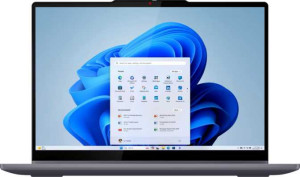
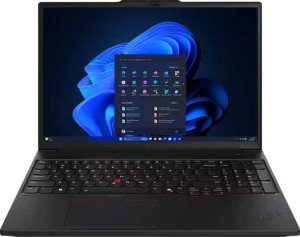
Benchmark results reveal a split verdict that maps neatly onto each machine's intended use case. In Geekbench 6 multi-core — the test most representative of sustained, parallelized workloads like video encoding, compilation, or running multiple demanding applications simultaneously — the ThinkPad P16s pulls ahead decisively with a score of 17,173 versus the IdeaPad's 11,247, a roughly 53% advantage. This aligns with the ThinkPad's higher core count and greater thermal headroom as a larger workstation-class device.
Single-core performance tells a more nuanced story. The ThinkPad scores 2,897 versus the IdeaPad's 2,467 in Geekbench 6 single-core, maintaining a lead, but the gap narrows considerably. PassMark results add an interesting twist: the ThinkPad's single-core PassMark of 4,472 edges above the IdeaPad's 3,878, yet overall PassMark scores are nearly level at 33,969 versus 34,459 — with the IdeaPad marginally ahead. This suggests the IdeaPad's CPU architecture is competitive in certain lightly-threaded scenarios even if it falls back under heavy sustained load.
Taken together, the ThinkPad P16s holds the stronger overall benchmark profile, particularly for multi-threaded workloads where its advantage is substantial. The IdeaPad 5 2-in-1 is no slouch for everyday tasks, and its near-parity in total PassMark score shows it punches above its weight for a 14″ thin-and-light — but users with genuinely demanding workloads will find the ThinkPad's multi-core lead translates into meaningfully faster real-world throughput.