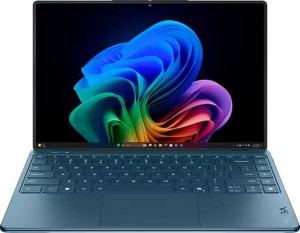
These two laptops take fundamentally different approaches to connectivity, and neither is strictly superior — it depends on what the user needs. The IdeaPad 5 2-in-1 16″ prioritizes versatility with a broader mix of physical ports: two USB-A 3.2 Gen 1 ports, two USB-C 3.2 Gen 2 ports, a dedicated HDMI output, and an external memory card slot. For users who regularly plug in legacy peripherals, connect directly to a monitor, or work with SD cards, this is a plug-and-play friendly setup that requires fewer adapters in daily use.
The Yoga Slim 9i 14″ bets entirely on high-bandwidth modern standards, offering two Thunderbolt 4 ports and two USB 4 40Gbps ports — and nothing else. That 40Gbps ceiling is four times faster than the IdeaPad's USB 3.2 Gen 2 (10Gbps), enabling fast external NVMe drives, high-resolution multi-monitor daisy-chaining, and eGPU connectivity. The trade-off is real, though: without a single USB-A port or HDMI output, the Yoga demands dongles or a hub the moment a standard peripheral enters the picture. Wireless connectivity also tilts toward the Yoga, which supports Wi-Fi 7 and Bluetooth 5.3 versus the IdeaPad's Wi-Fi 6 and Bluetooth 5.2.
Choosing between them is a matter of workflow. The Yoga Slim 9i is built for users invested in a modern, high-throughput ecosystem who are comfortable managing adapters. The IdeaPad offers more out-of-the-box compatibility for a wider range of devices. On wireless and peak wired bandwidth the Yoga leads; on everyday plug-in convenience and port variety, the IdeaPad has a practical edge.