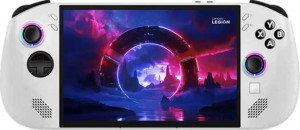
The GPU performance gap between these two devices is striking. The Nintendo Switch 2 delivers 4.27 TFLOPS of floating-point performance versus 2.5 TFLOPS on the Lenovo Legion Go S — a roughly 70% advantage. This is reinforced across every GPU metric: the Switch 2 runs its GPU at 1400 MHz compared to 800 MHz on the Legion Go S, and packs 1536 shading units across 48 compute units, exactly double the Legion Go S's 768 shading units and 12 compute units. In real-world terms, this means the Switch 2's GPU can process significantly more graphical workloads per second, which translates to smoother frame rates and higher visual fidelity in GPU-bound scenarios. Both devices support ray tracing, but the Switch 2 has considerably more raw horsepower to sustain it.
On the CPU side, the picture is more nuanced. The Legion Go S uses 4 cores at 3 GHz, while the Switch 2 fields 8 cores at 1.7 GHz. Neither architecture is outright superior — the Legion Go S has higher per-core clock speed, which benefits single-threaded tasks, while the Switch 2's higher core count can help in multi-threaded workloads. Both devices use multithreading. Where the Legion Go S reclaims significant ground is system memory: its 32GB of DDR5 RAM dwarfs the Switch 2's 12GB, providing far more headroom for memory-intensive applications, background processes, and future-proofing. RAM speed and generation are identical on both at 6400 MHz DDR5.
Overall, the Switch 2 holds a clear GPU performance edge, which is the dominant factor in gaming workloads. However, the Legion Go S's massive RAM advantage and the added flexibility of external drive support make it a more versatile platform for demanding or varied use cases. Users prioritizing raw graphics throughput will favor the Switch 2; those needing memory-heavy workloads or storage expandability will find the Legion Go S more accommodating.