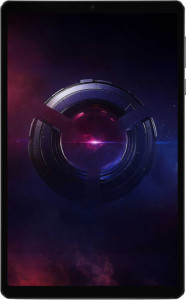
Screen size and sharpness pull in opposite directions here. The Galaxy Tab S10 FE offers a larger 10.9″ panel — better suited for media consumption, split-screen multitasking, and document work — while the Legion Tab Gen 3 works with a more compact 8.8″ screen. However, the Legion Tab wins decisively on pixel density: its 2560 × 1600 resolution crammed into a smaller display yields 343 ppi, versus just 249 ppi on the Galaxy Tab S10 FE. That 94 ppi gap is plainly visible — text and fine details appear noticeably crisper on the Legion Tab, which matters for reading, gaming, and any close-up use.
Refresh rate is another area where the Legion Tab pulls ahead meaningfully. At 165 Hz, it delivers exceptionally fluid motion — animations, fast-paced games, and scrolling all feel smoother compared to the Galaxy Tab S10 FE's 90 Hz panel, which, while decent, is nearly half the refresh rate. For the Legion Tab's gaming-oriented audience, this is a core advantage. On the other hand, the Galaxy Tab S10 FE counters with a slightly higher typical brightness of 600 nits versus 500 nits, giving it a modest edge in well-lit or outdoor environments.
Each tablet also makes a different trade-off in display protection and usability. The Legion Tab includes an anti-reflection coating — a practical feature that reduces glare under artificial lighting — but lacks branded damage-resistant glass. The Galaxy Tab S10 FE flips this, offering damage-resistant glass for better scratch and impact protection, but no anti-reflection treatment. Neither supports HDR10 or HDR10+, so they are evenly matched on that front. Overall, the Legion Tab Gen 3 has a clear display advantage for detail-oriented and gaming use cases thanks to its superior pixel density and refresh rate, while the Galaxy Tab S10 FE is the better fit for users who prioritize screen size and physical durability.