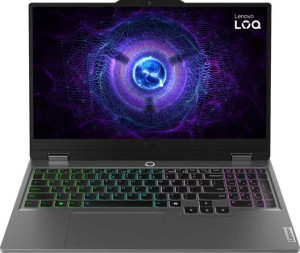
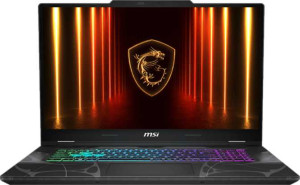
The GPU battle here is nuanced. The Lenovo LOQ 15IRX9 posts stronger raw throughput figures — 14.56 TFLOPS of floating-point performance versus the MSI Cyborg A15's 12.9 TFLOPS — and leads decisively in texture and pixel fill rates (227.52 GTexels/s vs 201.6, and 113.76 GPixel/s vs 80.64). These numbers translate directly to how many geometry and shading operations the GPU can process per second, meaning the Lenovo holds a tangible rasterization advantage in conventional gaming workloads. The MSI counters with a newer GDDR7 memory standard on its GPU versus the Lenovo's GDDR6, and higher peak GPU clock speeds — but those higher clocks are not translating into higher overall compute output based on the provided figures.
On the CPU side, the two machines take different architectural approaches. The Lenovo's processor uses a hybrid design with 20 threads across performance and efficiency cores, while the MSI runs a uniform 8-core, 16-thread configuration at a higher base clock of 3.8 GHz with a 5.1 GHz turbo, edging the Lenovo's 4.9 GHz peak. For single-threaded tasks the MSI's higher clocks are advantageous, but the Lenovo's extra threads give it more headroom in heavily parallelized workloads. System RAM speed also favors the MSI at 5600 MHz versus 4800 MHz, which marginally benefits CPU-bound tasks and memory-intensive applications.
One specification stands out starkly: the MSI supports a maximum of 256GB of RAM compared to the Lenovo's cap of 32GB. For typical gaming this ceiling is irrelevant, but for users who also run virtual machines, large datasets, or professional workloads alongside gaming, the MSI's headroom is in a different league entirely. Weighing everything together, the Lenovo LOQ 15IRX9 holds the clearer edge for pure gaming GPU performance based on the provided throughput metrics, while the MSI Cyborg A15 is the stronger all-rounder for users whose workloads extend beyond gaming.