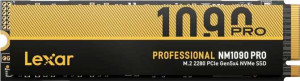
Lexar NM1090 Pro 1TB
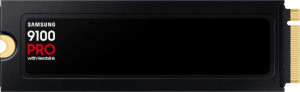
Samsung 9100 Pro 1TB

Lexar NM1090 Pro 1TB Samsung 9100 Pro 1TB

Overview

Welcome to our in-depth specification comparison between the Lexar NM1090 Pro 1TB and the Samsung 9100 Pro 1TB, two high-performance PCIe 5.0 NVMe SSDs competing at the very top of the consumer storage market. Both drives share a strong common foundation, but they diverge in key areas such as sequential and random write speeds, benchmark performance, and endurance ratings. Read on to discover which drive best suits your needs.

Common Features

  • Both drives use the M2 form factor.
  • Both drives feature a DRAM cache.
  • Both drives are NVMe SSDs.
  • Both drives use NVMe version 2.
  • Both drives offer 1000GB of internal storage.
  • Both drives use TLC NAND flash storage.
  • Both drives use PCIe version 5.
  • Both drives have 8 controller channels.

Main Differences

  • Sequential read speed is 14000 MB/s on Lexar NM1090 Pro 1TB and 14700 MB/s on Samsung 9100 Pro 1TB.
  • Random read speed is 1650000 IOPS on Lexar NM1090 Pro 1TB and 1850000 IOPS on Samsung 9100 Pro 1TB.
  • Sequential write speed is 10000 MB/s on Lexar NM1090 Pro 1TB and 13300 MB/s on Samsung 9100 Pro 1TB.
  • Random write speed is 1800000 IOPS on Lexar NM1090 Pro 1TB and 2600000 IOPS on Samsung 9100 Pro 1TB.
  • The PassMark benchmark result is 74037 on Lexar NM1090 Pro 1TB and 81351 on Samsung 9100 Pro 1TB.
  • The controller is the Silicon Motion SM2508 on Lexar NM1090 Pro 1TB and the Samsung Presto (S4LY027) on Samsung 9100 Pro 1TB.
  • Terabytes Written (TBW) endurance rating is 700 TB on Lexar NM1090 Pro 1TB and 600 TB on Samsung 9100 Pro 1TB.
Specs Comparison
Lexar NM1090 Pro 1TB

Lexar NM1090 Pro 1TB

Samsung 9100 Pro 1TB

Samsung 9100 Pro 1TB

Read speed:
sequential read speed 14000 MB/s 14700 MB/s
random read speed 1650000 IOPS 1850000 IOPS

Both drives deliver exceptional sequential read performance, but the Samsung 9100 Pro holds a measurable lead with 14700 MB/s versus 14000 MB/s for the Lexar NM1090 Pro — a roughly 5% gap. In practice, both figures are so far beyond what typical workloads saturate that the difference is largely invisible during everyday tasks like booting, launching applications, or loading game assets.

Where the gap becomes more meaningful is in random read performance: the Samsung reaches 1850000 IOPS compared to the Lexar's 1650000 IOPS, a ~12% advantage. Random IOPS governs responsiveness under real-world mixed workloads — database queries, OS multitasking, and virtualization scenarios where the drive handles thousands of small, scattered read requests simultaneously. Here the Samsung's edge is tangible for demanding professional workloads.

Overall, the Samsung 9100 Pro holds a clear read-speed advantage in this group, particularly in random performance where it matters most. For mainstream users, both drives will feel effectively identical; for power users running I/O-intensive workloads, the Samsung's higher IOPS ceiling gives it a practical edge.

Write speed:
sequential write speed 10000 MB/s 13300 MB/s
random write speed 1800000 IOPS 2600000 IOPS

Write speed is where the gap between these two drives widens considerably. The Samsung 9100 Pro pulls ahead with sequential write speeds of 13300 MB/s against the Lexar NM1090 Pro's 10000 MB/s — a ~33% difference that is large enough to matter in real workflows. Transferring large video files, writing full drive backups, or capturing high-bitrate footage directly to the SSD are all scenarios where this gap translates into noticeably shorter wait times.

The random write disparity is even more striking: the Samsung reaches 2600000 IOPS versus the Lexar's 1800000 IOPS, a ~44% advantage. High random write throughput is critical for write-heavy professional workloads such as compiling large codebases, running transactional databases, or handling intensive virtual machine disk I/O. At this performance tier, the Samsung's lead is substantial and not merely theoretical.

The Samsung 9100 Pro takes a decisive edge in this group across both metrics. The Lexar NM1090 Pro's write performance is still strong in absolute terms and will satisfy most users, but content creators, developers, and data-intensive professionals will find the Samsung's significantly higher write ceiling more aligned with demanding workloads.

Benchmarks:
PassMark result 74037 81351

PassMark scores synthesize a range of real-world storage behaviors — sequential transfers, random access, and mixed workloads — into a single composite figure, making them a useful cross-check against raw spec claims. The Samsung 9100 Pro scores 81351 against the Lexar NM1090 Pro's 74037, a ~10% margin that aligns closely with the performance leads Samsung demonstrated in both read and write specs.

A gap of this size in PassMark is meaningful: it reflects a consistently faster drive across multiple test dimensions, not just a single headline number. For users who rely on benchmarks as a practical proxy for sustained, varied workload performance, the Samsung's score reinforces that its advantages are broad rather than narrow or situational.

The Samsung 9100 Pro holds the clear edge here. The Lexar NM1090 Pro's score of 74037 is still a high-tier result and well ahead of mid-range competition, but the benchmark data confirms the pattern seen throughout this comparison — the Samsung delivers a measurable, consistent performance lead that extends beyond any single spec category.

General info:
type M2 M2
SSD cache DRAM cache DRAM cache
Is an NVMe SSD
NVMe version 2 2
internal storage 1000GB 1000GB
release date April 2025 February 2025
controller Silicon Motion SM2508 Samsung Presto (S4LY027)
SSD storage type TLC TLC
PCI Express (PCIe) version 5 5
Controller channels 8 8
Terabytes Written (TBW) 700 600
MTBF 1.5million hours 1.5million hours
warranty period 5 years 5 years
Has an integrated heatsink
has RGB lighting

At the foundational level, these two drives share an identical architecture: both are M.2 NVMe SSDs running on PCIe 5.0 with NVMe 2.0, DRAM cache, TLC NAND, and an 8-channel controller. This common platform explains why their performance characteristics are in the same tier — the differences seen in speed and benchmark scores come down to controller execution rather than any fundamental design divergence.

The most meaningful differentiator in this group is endurance. The Lexar NM1090 Pro is rated for 700 TBW versus the Samsung's 600 TBW — a 17% advantage that favors write-intensive users such as video editors, data engineers, or anyone running frequent large backups. Both drives share identical 1.5 million hours MTBF and 5-year warranties, so the TBW gap is the sole reliability differentiator here.

On general specifications, the Lexar NM1090 Pro earns a narrow but genuine edge through its higher endurance rating. For most users the difference will never be reached in the drive's practical lifespan, but for those who push write volumes hard, the Lexar's TBW headroom offers a meaningful long-term advantage — making this the one category where it outpoints the Samsung.

Comparison Summary & Verdict

After examining all the evidence, both drives are clearly elite PCIe 5.0 NVMe SSDs that share the same form factor, TLC NAND flash, DRAM cache, and NVMe 2.0 interface. However, the Samsung 9100 Pro 1TB pulls ahead in virtually every speed metric, delivering superior sequential write performance of 13300 MB/s and a commanding random write speed of 2600000 IOPS, making it the stronger choice for demanding workloads like video editing and data-intensive applications. On the other hand, the Lexar NM1090 Pro 1TB counters with a notably higher TBW endurance rating of 700TB versus 600TB, making it the more attractive option for users who prioritize long-term drive longevity and write-heavy reliability over peak throughput.

Lexar NM1090 Pro 1TB
Buy Lexar NM1090 Pro 1TB if...

Buy the Lexar NM1090 Pro 1TB if long-term endurance is your top priority, as its higher TBW rating of 700TB outpaces the Samsung 9100 Pro 1TB for write-heavy workloads over time.

Samsung 9100 Pro 1TB
Buy Samsung 9100 Pro 1TB if...

Buy the Samsung 9100 Pro 1TB if you demand the fastest possible read and write speeds, as it leads across all sequential and random performance metrics including a 13300 MB/s sequential write speed.