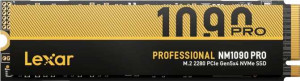
Lexar NM1090 Pro 2TB
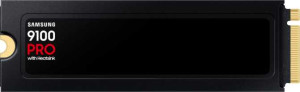
Samsung 9100 Pro 8TB

Lexar NM1090 Pro 2TB Samsung 9100 Pro 8TB

Common Features

  • Both products are M2 type SSDs.
  • Both products have a DRAM cache.
  • Both products are NVMe SSDs.
  • Both products support NVMe version 2.
  • Both products use TLC storage type.
  • Both products support PCI Express version 5.
  • Both products have 8 controller channels.
  • Both products have an MTBF of 1.5 million hours.

Main Differences

  • Sequential read speed is 12000 MB/s on Lexar NM1090 Pro 2TB and 14800 MB/s on Samsung 9100 Pro 8TB.
  • Random read speed is 2100000 IOPS on Lexar NM1090 Pro 2TB and 2200000 IOPS on Samsung 9100 Pro 8TB.
  • Sequential write speed is 11000 MB/s on Lexar NM1090 Pro 2TB and 13400 MB/s on Samsung 9100 Pro 8TB.
  • Random write speed is 1800000 IOPS on Lexar NM1090 Pro 2TB and 2600000 IOPS on Samsung 9100 Pro 8TB.
  • PassMark result is 72554 on Lexar NM1090 Pro 2TB and 82109 on Samsung 9100 Pro 8TB.
  • Internal storage is 2000GB on Lexar NM1090 Pro 2TB and 8000GB on Samsung 9100 Pro 8TB.
  • The controller is Silicon Motion SM2508 on Lexar NM1090 Pro 2TB and Samsung Presto (S4LY027) on Samsung 9100 Pro 8TB.
  • Terabytes Written (TBW) is 1400 on Lexar NM1090 Pro 2TB and 4800 on Samsung 9100 Pro 8TB.
Specs Comparison
Lexar NM1090 Pro 2TB

Lexar NM1090 Pro 2TB

Samsung 9100 Pro 8TB

Samsung 9100 Pro 8TB

Read speed:
sequential read speed 12000 MB/s 14800 MB/s
random read speed 2100000 IOPS 2200000 IOPS

The Lexar NM1090 Pro 2TB and Samsung 9100 Pro 8TB both offer strong read speeds, but there are some differences to note. The Lexar NM1090 Pro delivers a sequential read speed of 12000 MB/s, while the Samsung 9100 Pro outperforms it slightly with a sequential read speed of 14800 MB/s.

For random read speeds, the Lexar NM1090 Pro provides 2,100,000 IOPS, while the Samsung 9100 Pro offers 2,200,000 IOPS. Again, the Samsung model shows a higher figure in this category, though the difference in performance may not be noticeable in many real-world use cases.

In summary, both products offer high read speeds, with the Samsung 9100 Pro slightly ahead in both sequential and random read performance.

Write speed:
sequential write speed 11000 MB/s 13400 MB/s
random write speed 1800000 IOPS 2600000 IOPS

The Lexar NM1090 Pro 2TB and Samsung 9100 Pro 8TB both offer impressive write speeds, though the Samsung model has a clear edge in both sequential and random write performance. The Lexar NM1090 Pro has a sequential write speed of 11000 MB/s, while the Samsung 9100 Pro delivers a faster sequential write speed of 13400 MB/s.

In terms of random write speed, the Lexar NM1090 Pro provides 1,800,000 IOPS, whereas the Samsung 9100 Pro significantly outpaces it with 2,600,000 IOPS. This means the Samsung model has a notable advantage in both sequential and random write speeds.

To summarize, the Samsung 9100 Pro is faster than the Lexar NM1090 Pro in both sequential and random write speeds, with differences in performance that could be important for demanding workloads.

Benchmarks:
PassMark result 72554 82109

In terms of benchmark results, the Lexar NM1090 Pro 2TB has a PassMark score of 72,554, while the Samsung 9100 Pro 8TB outperforms it with a PassMark score of 82,109.

The difference in these scores suggests that the Samsung 9100 Pro is capable of handling more demanding tasks and workloads, as reflected by its higher benchmark result.

In conclusion, the Samsung 9100 Pro has a higher PassMark result than the Lexar NM1090 Pro, indicating stronger overall performance in benchmark tests.

General info:
type M2 M2
SSD cache DRAM cache DRAM cache
Is an NVMe SSD
NVMe version 2 2
internal storage 2000GB 8000GB
release date April 2025 February 2025
controller Silicon Motion SM2508 Samsung Presto (S4LY027)
SSD storage type TLC TLC
PCI Express (PCIe) version 5 5
Controller channels 8 8
Terabytes Written (TBW) 1400 4800
MTBF 1.5million hours 1.5million hours
warranty period 5 years 5 years
Has an integrated heatsink
has RGB lighting

Both the Lexar NM1090 Pro 2TB and Samsung 9100 Pro 8TB are M.2 NVMe SSDs with DRAM caches, offering high-end performance. Both products use the same PCIe version (5) and NVMe version (2), as well as the same controller channel count (8), indicating similar core architecture. The Lexar NM1090 Pro features 2TB of internal storage, while the Samsung 9100 Pro offers a much larger capacity of 8TB.

Regarding endurance, the Samsung 9100 Pro has a significantly higher Terabytes Written (TBW) value of 4800 compared to the Lexar NM1090 Pro's 1400, suggesting that the Samsung model is rated for more data writing over its lifetime. Both drives have an MTBF (Mean Time Between Failures) of 1.5 million hours, and a warranty period of 5 years, offering similar long-term reliability.

Neither product has an integrated heatsink or RGB lighting, ensuring both focus on performance without additional visual or thermal management features.

Comparison Summary

This is a specification comparison between Lexar NM1090 Pro 2TB and Samsung 9100 Pro 8TB. Both products are M2 type SSDs with a DRAM cache and use PCI Express version 5. However, the Samsung 9100 Pro 8TB offers higher sequential read speed (14800 MB/s vs 12000 MB/s) and sequential write speed (13400 MB/s vs 11000 MB/s). It also has a larger internal storage (8000GB vs 2000GB) and a higher Terabytes Written (TBW) rating (4800 vs 1400). Additionally, the Samsung model outperforms the Lexar in PassMark results (82109 vs 72554).